
Cooling makes water. The drain has to carry it away.
For AC drain pan overflow, Coastal Carolina Comfort can help you plan a diagnostic visit. An AC drain pan can overflow when condensate cannot leave through its intended path. A blocked line, damaged pan, installation problem or failed condensate pump may be involved. Ice melting from a coil can add to the water. Stop cooling when safe and arrange an inspection if water is collecting indoors.
Reference: Trane; Little Giant.
First published 2025-07-13 · Content revised September 7, 2026 · About 13 minutes to read
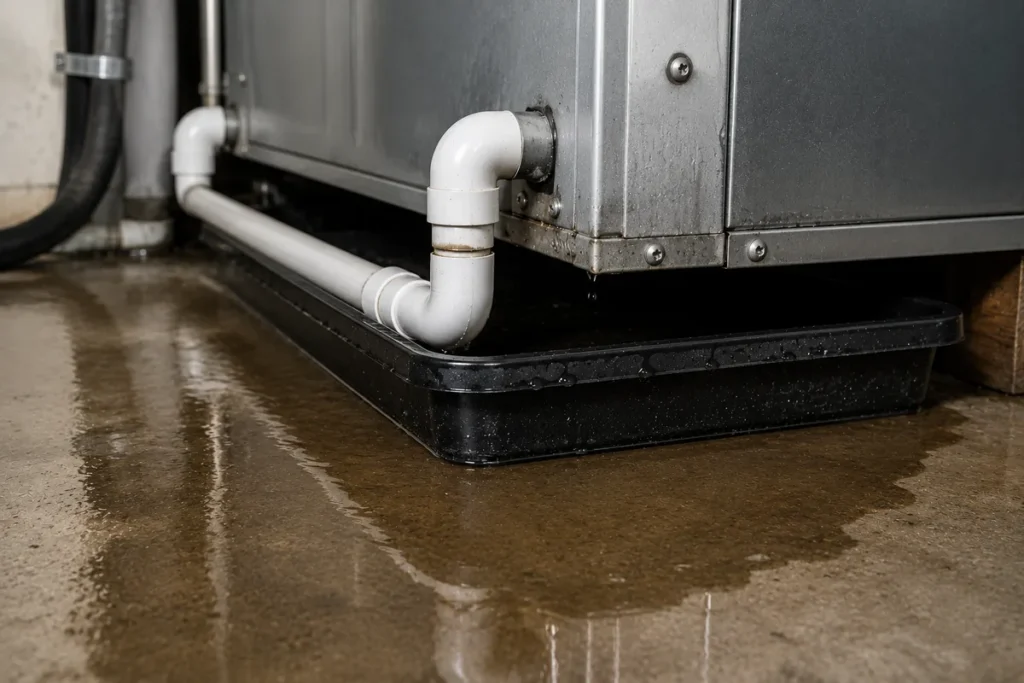
Indoor leakage is a reason to investigate the water path, not empty the pan.
ENERGY STAR’s cited efficiency effect of airflow problems; not your measured loss. ENERGY STAR.
Typical-house duct air loss estimate; not a measurement of your home. ENERGY STAR.
ENERGY STAR recommends preseason professional HVAC checkups. ENERGY STAR.
ENERGY STAR’s filter inspection and care reminder; follow equipment instructions. ENERGY STAR.
The visible symptom depends on where water collects and which overflow controls are installed.
Drainage may be restricted, the pan may be damaged or overflow protection may be absent or ineffective. Protect the area only when you can do so safely.
Reference: Trane; RectorSeal.
An installed float switch may interrupt operation as water rises. That does not prove the thermostat has failed or mean the drainage problem has cleared.
Reference: RectorSeal.
During cooling, moisture condenses on the cold indoor coil. The system must collect and remove that water. Layouts differ; some use a pump.
Reference: U.S. Department of Energy; Little Giant.
Moisture in the passing air condenses on the coil.
Reference: U.S. Department of Energy.
The line carries condensate away by the designed route.
Reference: Trane.
Water reaches its approved outlet, sometimes through a condensate pump.
Reference: Little Giant.
Debris or biological buildup can slow the drain. Cleaning must suit the equipment and drain arrangement; adding chemicals at random can create other problems.
Reference: Trane.
Water can escape through damage or collect when the pan and outlet do not drain properly. Emptying visible water does not repair the cause.
Reference: Trane.
Where a condensate pump is fitted, a pump or discharge fault can stop water removal. Drain slope, connections and traps also need to match the installation.
Reference: Little Giant; Carrier.
A frozen coil can release water as it thaws. Airflow restrictions and other cooling faults require investigation; the drain is not always the only problem.
Reference: Carrier.
A technician should trace the source of the water, inspect the pan and drainage route, check any condensate pump and test installed overflow controls. A secondary pan and a float switch have different jobs; neither removes the need to correct the underlying fault.
Reference: ENERGY STAR; Little Giant; RectorSeal.

ENERGY STAR includes condensate-drain inspection in its HVAC maintenance checklist because a plugged drain can cause water damage. If water is collecting around indoor equipment, describe where you can see it without opening the cabinet. Keep clear of wet electrical components and do not enter an unsafe attic or crawlspace to investigate the source. Source: ENERGY STAR.
Note whether water is near the cabinet, below a ceiling area or around a visible drain outlet. Record when you first noticed it and whether the system was cooling. If a water stain has grown, describe that change. A location and timeline give the service team a starting point without requiring you to decide which pan or pipe has failed.
Take a photo only from a safe, accessible position. Include enough surrounding context to show the location. Do not move a wet electrical component, lift a full pan, open equipment covers or stand beneath a visibly damaged ceiling to improve the picture. Explain any unsafe access when you request service so the visit can be planned around it.
Coastal Carolina Comfort’s diagnostic process includes the drain line, filter, coils and electrical connections. Ask the technician to trace the source of the water and explain which condition caused it to escape. A repair discussion should connect the diagnosis with the actual leak location, rather than treating every indoor water complaint as the same blocked pipe.
The Department of Energy’s cooling guide explains how the indoor evaporator and air-moving components participate in the cooling cycle. Condensate drainage is part of maintaining the indoor equipment. A homeowner’s useful contribution is the visible water pattern and equipment response; the technician can identify the installed pan, drain route and any pump or overflow protection. Source: U.S. Department of Energy.
Avoid guessing whether the pan you can see is the primary pan or an auxiliary pan. Ask the technician to identify it and show how the system is supposed to drain. If a previous visit involved the same area, have that invoice available. A recurring symptom deserves a comparison with the earlier diagnosis and work, not an assumption that nothing else has changed.
RectorSeal’s SS2 product description explains that the switch can stop an AC system when it detects a clogged condensate drain condition. This illustrates why a drainage problem and a shutdown can occur together. It does not prove which switch your system has or why it stopped. Leave identification and testing of that protection to the technician. Source: RectorSeal.
Do not bypass a float switch to restore cooling. Tell Coastal Carolina Comfort about the shutdown and any visible water, even if the amount seems small. If the thermostat also went blank, include that observation. The thermostat troubleshooting guide can help you record the display and equipment response without touching the wiring.
Ask the technician to explain where water forms, which pan collects it, how it leaves the equipment and where it discharges. If the installation uses a pump, include the pump in that explanation. A drawing or a labeled photograph can make the route easier to understand. You do not need to know the plumbing layout before requesting the visit.
ENERGY STAR places drain inspection alongside coil cleaning, blower service and control checks. That wider checklist matters when a water complaint appears with weak airflow, unusual operation or a shutdown. Report each symptom separately. The technician can then decide whether they share a cause or whether the system has more than one issue to address. Source: ENERGY STAR.
If the proposed repair clears an obstruction, ask how the drain path will be checked afterward. If the proposal replaces a pan or pump, ask what evidence identifies that component as the problem. Request an explanation of any additional recommended work and whether it is required to correct the current leak or is an optional improvement.
Keep the service record specific. “Drain problem repaired” is less useful to you later than a description of the location, condition and correction. Ask for language you understand rather than an unexplained part number. Coastal Carolina Comfort’s diagnostic discussion should leave you able to describe what was found and what you authorized.
If water returns after a prior repair, record how long normal operation lasted and whether the new leak appears in the same location. Provide the earlier invoice and any photos. Do not assume that a new stain has the same source. Ask the technician to compare the present findings with the previous work and identify what remains uncertain.
Ask Coastal Carolina Comfort how the installed overflow protection will be checked and what a homeowner should notice if it activates. Follow the instructions for your actual equipment. Avoid adding drain chemicals, compressed air, improvised wiring or a replacement switch based on a general article. The appropriate service procedure depends on the equipment and the route that the technician identifies.
ENERGY STAR’s checklist treats the evaporator coil, blower, drain and controls as parts of the same maintenance visit. For your service request, that means airflow observations belong alongside the water report. Note whether vents became weak before the leak, whether the fan kept operating, and whether the thermostat showed a message. Do not use those clues to select a refrigerant repair yourself. Source: ENERGY STAR.
Read the AC airflow guide if several vents feel weak. Use the air handler guide for cabinet noise or a broader indoor-unit complaint. The AC leaking water inside guide provides another route for organizing a visible leak. Mention all relevant symptoms when booking.
If the problem followed a storm or outage, include that timing and consult the HVAC power-surge guide. Timing is context, not confirmation of damage. Keep the water area and electrical equipment untouched when there is any question about safe access, and ask the service team how to proceed.
Share the symptom and ask about the next available diagnostic visit for your Charleston home.
ENERGY STAR recommends monthly filter inspection and annual preseason professional checkups. The same guidance calls for inspection of the condensate drain. Ask the technician how those general recommendations apply to your installed equipment and what homeowner care the manufacturer allows. A reminder schedule can support routine care, but it does not replace diagnosis of an active leak. Source: ENERGY STAR.
Coastal Carolina Comfort’s service process puts homeowner approval before repair work. Review the proposed correction and ask about any remaining concern before signing off. The process also includes photographs of findings; keep those with the invoice. This creates a record for later questions without turning a general prevention recommendation into a guarantee against every future leak.
Give the team your address, the leak location, when it began, whether the system still runs and any access issue. Mention a ceiling stain or water near electrical equipment at the start of the conversation. Ask Coastal Carolina Comfort about the next available visit and diagnostic charge. Do not continue running tests to gather more details while water is escaping.
For the complete repair process, return to the Charleston HVAC diagnostic guide. To discuss service, use Charleston AC repair. If you use a heat pump, mention that equipment when calling or see heat pump repair. Describe the operating mode and symptoms instead of choosing the failed part.
Keep this note with your equipment information. Record uncertainty rather than guessing at a component or cause.
Billy Webb, owner
Author profile
At Coastal Carolina Comfort, we start with the basic checks before recommending a repair: the filter, coils, drain line and electrical connections. Our service process includes showing you photographs of findings and getting your approval before repair work.
Bring the symptom notes from this guide to the visit. Ask how the findings connect to the problem you reported and what the proposed correction covers.
Review the diagnosis and proposed work before you authorize a repair. Keep the explanation and any photographs supplied with your service records.
For the service conversation, visit Charleston AC repair. Bring your symptom notes so we can discuss the next available diagnostic visit. For heating-mode concerns, see Charleston heating repair.
Condensate passes through the primary pan during cooling, but persistent standing water, overflow or indoor leakage needs investigation. The drain should remove water as the system is designed. Discuss your observations with Coastal Carolina Comfort before authorizing a repair.
Reference: Trane.
No. A float switch senses rising water and may interrupt equipment operation, depending on how it is installed. The blockage or other drainage fault still needs correction. Discuss your observations with Coastal Carolina Comfort before authorizing a repair.
Reference: RectorSeal.
Removing visible water does not establish that the cause is fixed. If leakage or a protective shutdown occurred, have the drainage and equipment checked before returning to normal operation. Discuss your observations with Coastal Carolina Comfort before authorizing a repair.
Reference: Trane.
Tell Coastal Carolina Comfort when the leak returned and whether the location matches the earlier problem. Bring the previous invoice and any safely obtained photos. Ask the technician to compare the present findings with the work already completed.
Ask where the water escaped, what condition caused it and how the proposed work corrects that condition. Coastal Carolina Comfort’s process includes photographs and approval before repair. Ask how the drain and any installed protection will be checked afterward.
By Billy Webb, owner. Coastal Carolina Comfort publishes this guide for homeowners using our Charleston HVAC services. Company-process guidance uses CCC’s documented diagnostic workflow.
This guide explains observable symptoms. It does not replace equipment-specific instructions or an on-site diagnosis.
Read the equipment guidance and source notes below. This article explains observations and service decisions; it does not replace the instructions for your installed equipment.
ENERGY STAR. (n.d.). Maintenance Checklist. Accessed September 7, 2026.
U.S. Department of Energy. (n.d.). Home Cooling 101. Accessed September 7, 2026.
Trane. (n.d.). AC Leaking Water. Accessed September 7, 2026.
Little Giant. (2023, June 6). Resolve Condensate Pump Issues with Confidence. Accessed September 7, 2026.
RectorSeal. (n.d.). Safe-T-Switch SS2 (New). Accessed September 7, 2026.
Carrier. (n.d.). Why Is My AC Leaking Water?. Accessed September 7, 2026.
ENERGY STAR. (n.d.). Duct Sealing. Accessed September 7, 2026.
Company-process statements use Coastal Carolina Comfort’s approved diagnostic guidance. This guide includes original homeowner observation tools; examples do not describe actual customer jobs.
Read the symptom checks and service questions for AC airflow problems.

Read the symptom checks and service questions for AC thermostat troubleshooting.
Read the symptom checks and service questions for Air handler problems.
Call Coastal Carolina Comfort with the location of the leak and whether the system is still running. We can help arrange a Charleston AC inspection.