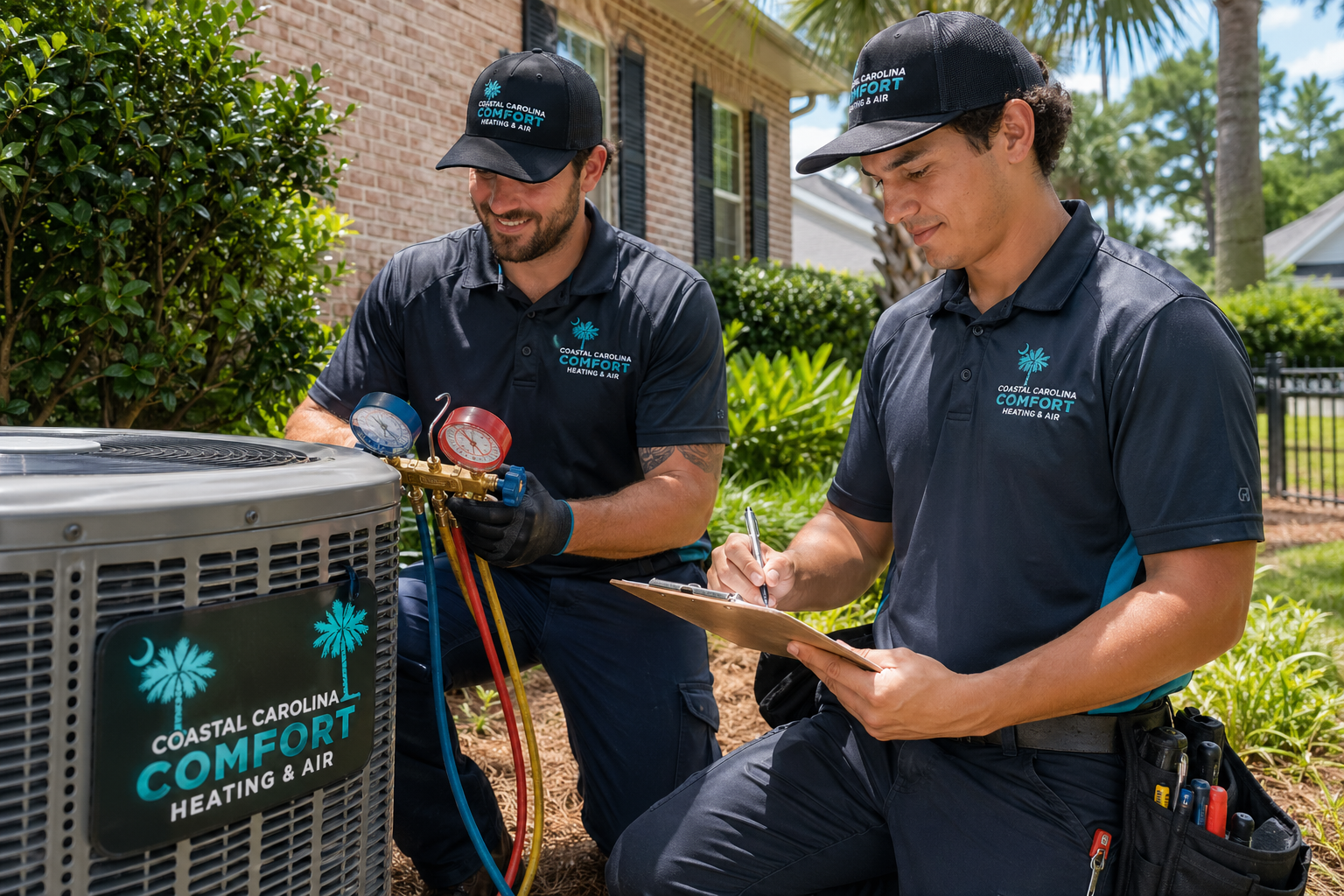
My AC Won't Turn On: Troubleshooting Before You Call a Technician
About 30% of 'AC won't start' calls we respond to across South Carolina are resolved by basic homeowner checks. Here's what to look at before calling a technician.
Read More →Home of the $79 SPRING TUNEUP | 0% Interest for 24 Months
Home of the $79 SPRING TUNEUP | 0% Interest for 24 Months
AC repair in Charleston costs between $150 and $650 for most common failures — capacitor replacement, refrigerant recharge, contactor repair, and thermostat issues fall on the lower end. Major component repairs (compressor, evaporator coil) range $600–$1,500+. Coastal Carolina Comfort provides same-day diagnosis and upfront flat-rate pricing before any work begins. Most Charleston homeowners see a technician within 2 hours of calling.
System running but air is warm? Likely a refrigerant leak, compressor failure, or frozen evaporator coil.
Puddles around your indoor unit? A clogged condensate drain or frozen coil can cause water damage fast.
Grinding, buzzing, or clicking from your AC? We diagnose mechanical failures and electrical issues fast.
AC repair in Charleston, SC addresses cooling system failures ranging from refrigerant leaks and compressor malfunctions to thermostat issues and clogged condensate drains. Charleston's coastal humidity, salt air exposure, and extended cooling season — March through October — put significant stress on residential AC systems, making professional repair essential.
Coastal Carolina Comfort provides same-day AC repair service across Charleston, from the Historic District and West Ashley to Mount Pleasant and James Island, with NATE-certified technicians who diagnose the problem before recommending solutions. Most common AC repairs in the Charleston area cost between $150 and $650, with major component replacements ranging higher.
Our trucks are dispatched from our Summerville headquarters on Lipman St. — not from a call center in another state. We carry the specific parts needed for the major brands found in Charleston County homes, and our technicians have worked in historic Charleston homes long enough to know what to expect before they open a panel.
RESTORE MY COOL AIR NOWCharleston sits in one of the most demanding climates for residential cooling systems in the United States. Average summer temperatures regularly exceed 95°F, and relative humidity holds at 74% or higher from June through September. Salt air infiltration accelerates corrosion on copper refrigerant lines — particularly on properties east of the Ashley River, on James Island, and within two miles of the harbor. Here are the problems we see most often in Charleston County homes.
Lowcountry humidity makes your AC work double duty—cooling and dehumidifying. When the system can't keep up, you get a home that feels clammy even at 72°F. Oversized AC units are a common culprit in newer Charleston subdivisions like West Ashley, where builder-grade systems may short-cycle rather than properly dehumidify.
Low refrigerant levels are the number-one cause of warm air blowing from your vents. In the Lowcountry, salt air and coastal moisture accelerate corrosion on copper refrigerant lines, making leaks more common here than in inland areas. We test and recharge with R-410A or identify if your older system still runs on phased-out R-22 Freon.
The compressor is the heart of your air conditioning system. Extended run times during Charleston's brutal summers put enormous strain on this component. Symptoms include warm air from vents, the outdoor unit humming but not starting, or the system tripping your circuit breaker repeatedly.
High humidity means your AC produces more condensation than systems in drier climates. When the condensate drain line clogs with algae, mold, or debris, water backs up into your home. In Charleston, we see this especially in older homes in the Historic District and Goose Creek where drainage systems may not have been updated.
Homes in West Ashley, James Island, Johns Island, and Daniel Island built between 2015 and 2024 are now hitting their first major repair windows. Capacitors typically fail at the 7–10 year mark. Refrigerant lines in homes approaching a decade old show early corrosion in Lowcountry conditions — accelerated by salt air exposure this close to the harbor and coast. Builder-grade systems in newer Charleston subdivisions were often sized for cost efficiency rather than humidity performance — meaning short-cycling and inadequate dehumidification are the most common complaints we see from these neighborhoods. If your home is in one of these areas and your system is 7 years or older, a preventive diagnostic is worth scheduling before peak summer.
Catching these problems early is the difference between a $200 repair and a $2,000 compressor replacement. Read our complete guide to signs your AC needs professional repair to know exactly when to call.
National Weather Service Charleston historical climate data shows Charleston averages more than 45 days per year with a heat index above 100°F — among the highest of any metro area on the East Coast [STAT NEEDED: NWS Charleston annual heat-index URL + East Coast metro comparison verification]. From June through September, relative humidity holds at 74% or higher. That combination forces residential AC systems to run longer cycles, remove more moisture per hour, and operate under thermal loads that exceed what most systems were sized to handle.
The result is accelerated wear on three components in particular: compressor windings overheat faster under sustained high-load operation, condensate drain lines clog more frequently because the system produces 30–50% more moisture per cycle than systems in drier climates [STAT NEEDED: ACCA Manual J latent load reference or ASHRAE handbook section on humid-climate latent cooling], and copper refrigerant lines corrode faster due to salt air infiltration — particularly on properties east of the Ashley River, on James Island, and in any neighborhood within two miles of the harbor.
These aren't generic HVAC problems. They're Charleston problems. A technician who services systems in Columbia or Greenville doesn't encounter these failure patterns at the same frequency. Our technicians do, because Charleston is the only market we serve.
Homes in the Charleston Historic District, Harleston Village, Wagener Terrace, and Radcliffeborough present cooling challenges that newer construction simply doesn't. Pier-and-beam foundations limit ductwork routing options. Pre-1950s wall cavities weren't designed around HVAC penetrations. Plaster walls make retrofitting returns difficult without significant remediation. Single-zone limitations mean one thermostat has to manage rooms with vastly different heat loads — south-facing rooms with original single-pane windows versus north-facing rooms with 12-foot ceilings.
When an AC system in a historic home fails, the repair often involves working around constraints that don't exist in a 2010 subdivision build. Ductless mini-split systems have become the preferred solution for many historic Charleston homes precisely because they avoid the ductwork problem entirely. For homes that do have existing ductwork, locating and accessing the air handler often requires navigating crawl spaces, partial attics, or original mechanical closets that weren't built to modern service standards.
Our technicians have worked in historic Charleston homes long enough to know what to expect before they open a panel. We don't quote a standard residential repair rate and then discover complications on-site. We ask the right questions upfront.
Every AC repair from Coastal Carolina Comfort starts with a thorough diagnostic evaluation. We never recommend parts or repairs until we understand exactly what's wrong with your cooling system. Our process is designed to get you an honest answer and a lasting fix—not a quick patch that fails in two weeks.
When you call, our team dispatches a technician directly from our headquarters on Lipman St. in Summerville. No waiting for a truck to drive up from another county. Most Charleston homeowners see a technician within 2-4 hours of their call.
Your technician performs a comprehensive diagnostic that includes checking refrigerant levels and pressure, testing electrical connections and capacitors, evaluating airflow through the evaporator and condenser coils, inspecting the thermostat calibration, and checking the condensate drain for blockages.
Before any wrench turns, we explain the problem in plain language and give you a written estimate. If the repair cost approaches the threshold where AC replacement makes more financial sense, we'll tell you that too. We provide upfront flat-rate pricing before we start.
We complete the repair using manufacturer-specified parts, then run a full system verification. We check temperature differential across the evaporator coil, verify refrigerant charge, and confirm the system cycles properly before we leave your home. You get a written summary and a warranty on parts and labor.
For after-hours failures during peak summer heat, we also offer emergency AC repair across the Lowcountry — same diagnostic process, same pricing transparency, available when you need it most.
Charleston homes use a variety of cooling systems depending on the age and style of the home. From builder-grade central air in Mount Pleasant to the heat pump systems common in Johns Island and older window-unit-to-central conversions in the Historic District, our NATE-certified technicians are trained on every system type.
Split-system central air conditioning is the most common setup in Charleston. We repair all major brands including Trane, Carrier, Lennox, Rheem, Goodman, and Daikin. Our technicians carry common replacement parts for these manufacturers on every truck.
Heat pumps provide both heating and cooling and are increasingly popular in Lowcountry homes. Repair considerations differ from standard AC units, especially regarding the reversing valve, defrost cycle, and dual-fuel configurations. We understand the nuances of heat pump repair in a subtropical climate.
Mini-splits are a smart solution for older Charleston homes without existing ductwork, bonus rooms, and garage conversions. We service and repair all major mini-split brands and handle unique issues like condensate pump failures and indoor unit drainage problems.
Some Charleston homes, particularly manufactured and modular homes, use self-contained package units where all components are housed in a single outdoor cabinet. These systems require specific repair expertise because the compressor, evaporator, and air handler are integrated.
Not every AC issue is an emergency, but every symptom is a signal. Catching problems early prevents small repairs from becoming major replacements. Here are the warning signs Charleston homeowners should watch for, especially during our demanding cooling season.
If your system runs but the air coming out isn't cold, you may have a refrigerant leak, a failing compressor, or restricted airflow from a dirty evaporator coil.
Grinding often indicates a failing fan motor bearing. Buzzing can signal electrical issues. Clicking at startup may point to a bad capacitor or contactor. None of these resolve on their own.
A sudden spike in your Dominion Energy bill often means your system is working overtime to compensate for a failing component.
If your AC turns on and off every few minutes rather than running steady cycles, the system may be oversized, low on refrigerant, or have a malfunctioning thermostat.
Ice on your evaporator coil or water pooling around the air handler signals restricted airflow or low refrigerant. In the Lowcountry's humidity, a frozen coil can quickly lead to water damage.
A musty smell from your vents can indicate mold growth inside the ductwork or on the evaporator coil—a real concern in humid Charleston. Burning smells suggest electrical issues that need immediate attention.
For a deeper look at each of these symptoms and when they cross the line from 'keep an eye on it' to 'call a pro now,' read our complete guide to signs your AC needs professional repair.
Charleston has no shortage of HVAC companies advertising on Google. But there's a difference between a company that bids on your zip code and one that actually operates from it. Here's what sets Coastal Carolina Comfort apart.
Historic homes, salt air corrosion, pier-and-beam foundations, pre-1950s ductwork — our technicians encounter these conditions every week. We ask the right questions before arriving so we show up prepared.
NATE (North American Technician Excellence) certification is the HVAC industry's highest standard. Every technician on our team holds current NATE certification, meaning they've passed rigorous testing on installation, service, and repair.
We quote a price before we start. No hourly rates that climb while you wait. No surprise charges when the job takes longer than expected.
We hold a current SC LLR Mechanical Contractor license and carry full liability and workers' compensation insurance. This protects you and your home.
Our reputation is built on every call. Check our Google Business Profile and you'll see why Charleston families call us back year after year.
Choosing the right contractor matters. See our guide on how to choose an AC repair company in the Lowcountry.
Not every AC problem requires a full system replacement. But sometimes repair costs approach or exceed the value of putting money into an aging system. Knowing the difference saves you money and frustration.
Our technicians will always give you an honest assessment. If repair makes sense, we'll fix it. If replacement makes more financial sense, we'll explain why. For a detailed decision framework, read our guide on whether to repair or replace your AC system.
For a full cost breakdown by repair type — including current R-410A recharge pricing — read our guide on how much AC repair costs in South Carolina.
Per the EPA's AIM Act final rule (40 CFR Part 84), the production and import ban on R-410A refrigerant for new equipment took effect January 1, 2025 [STAT NEEDED: EPA AIM Act direct .gov URL for verification]. R-410A was the dominant residential refrigerant for roughly 15 years and is present in the majority of Charleston-area homes with systems installed between 2010 and 2024.
What this means practically: if your R-410A system develops a refrigerant leak, the repair cost is higher than it was two years ago because supply is limited and prices are rising. A leak repair that cost $350 in 2022 may run $500–$700 today depending on the charge required. The economics of repairing a refrigerant leak on an older R-410A system now need to be weighed against replacement with a newer R-454B or R-32 system.
We'll tell you which refrigerant your system uses during the diagnostic, give you the current recharge cost, and walk you through whether repair or replacement makes more sense given your system's age and condition. No pressure — just the math.
Call (843) 708-8735 or fill out the form below. Most calls answered within 2-4 hours.
📞 (843) 708-8735Reviews from recent Charleston service calls. Pulled from our Google Business Profile — names, dates, and quotes exactly as the customers wrote them.
On time, professional, courteous, and respectful! And got the unit operating as it should. Thank you!Jeffrey McWhorter — January 2026
Wonderful service from Coastal Carolina Comfort for the Comfort Club maintenance plan. Mike was Very thorough and highly attentive to the system as a whole. Was informed that the system installed on a year old home is undersized which creates various issues that we'll have to address sooner than later.Mark Rainwater — January 2026
Best experience ever! Called for an appointment and they came the same day. Will be using this company for all hvac needs! The service was even better Mike B did a amazing job and very knowledgeable.landon wong — January 2026
Most AC repairs in Charleston cost between $150 and $650. Capacitor replacement runs $150–$300. Refrigerant recharge (including leak detection) runs $250–$600 depending on the refrigerant type and charge required — R-410A costs have risen significantly since the January 2025 production ban. Compressor repair or replacement can reach $1,200–$2,500. We provide upfront flat-rate pricing after diagnosis, before any work begins.
The most common causes are low refrigerant from a leak, a dirty evaporator or condenser coil, a failing compressor, or ductwork leaks dumping cooled air into your attic. In Charleston's humidity, a clogged air filter alone can freeze the evaporator coil and shut down cooling within hours. Check your filter first. If it's clean and the system still isn't cooling, call for a diagnostic.
Yes. We regularly service homes in the Historic District, Harleston Village, Wagener Terrace, and other pre-1950s neighborhoods where ductwork access, pier-and-beam foundations, and original construction create repair challenges that standard residential HVAC companies aren't prepared for. We ask the right questions before arriving so we come equipped.
It depends on the repair and the system's age. Minor fixes — capacitor, contactor, thermostat — are still cost-effective on R-410A systems regardless of age. Refrigerant leak repairs are more expensive now due to the 2025 production ban, so the math changes on older systems. Compressor replacement on an R-410A system over 12 years old rarely makes financial sense. We'll give you the specific numbers during the diagnostic.
Most Charleston-area service calls are answered within 2–4 hours. We dispatch from Summerville and have technicians covering West Ashley, James Island, Mount Pleasant, Daniel Island, North Charleston, and the peninsula. Same-day service is available for calls placed before 2 PM.
We service all major residential brands including Trane, Carrier, Lennox, Rheem, Goodman, Daikin, York, and Amana. As a Daikin partner, we stock Daikin parts on every truck. We also repair ductless mini-split systems from Mitsubishi, Fujitsu, and LG — which are common in Charleston's older homes that lack existing ductwork.
Twice per year — once in early spring before the cooling season starts and once in fall. Charleston's cooling season runs March through October, which is longer than most of the country. High humidity accelerates coil fouling, condensate drain clogging, and capacitor wear faster than in drier climates. Regular maintenance catches these before they become emergency calls during peak summer heat.
Yes — significantly. Properties east of the Ashley River, on James Island, and within two miles of the harbor experience accelerated corrosion on copper refrigerant lines from salt air infiltration. This makes refrigerant leaks more common in coastal Charleston than in inland markets like Columbia or Greenville. Outdoor condenser coils also accumulate salt deposits that reduce heat transfer efficiency over time. Systems in these zones benefit from annual coil cleaning and more frequent refrigerant pressure checks than the manufacturer's standard maintenance schedule recommends.
Short cycling is usually caused by an oversized system, a failing capacitor, low refrigerant triggering safety shutoffs, or a thermostat malfunction. In newer Charleston developments, builder-grade systems are often oversized for the actual cooling load, which causes short cycles and inadequate dehumidification — the home reaches the set temperature but still feels clammy because the system never runs long enough to properly remove moisture. Read our full guide on AC short cycling causes and fixes.
For minor repairs — capacitor, contactor, thermostat — yes, even on a 15-year-old system. For major component failures like compressor replacement or evaporator coil leaks, replacement usually makes more financial sense, especially given Charleston's 8-month cooling season that puts significantly more annual hours on equipment than the national average. If the system also uses phased-out R-22 Freon, replacement is almost always the right call. We will give you the honest comparison during the diagnostic. See our guide on whether to repair or replace your AC.
From our headquarters in Summerville, SC, Coastal Carolina Comfort covers all of greater Charleston. Whether you're dealing with a refrigerant leak in West Ashley or a compressor failure on Daniel Island, our team is on the way.
These guides cover everything Charleston homeowners need to know about AC repair, maintenance, and making smart decisions about your cooling system.
About 30% of 'AC won't start' calls we respond to across South Carolina are resolved by basic homeowner checks. Here's what to look at before calling a technician.
Read More →
In South Carolina's high-humidity environment, frozen coils are both more common and more damaging than in drier climates. Here's what causes them and what to do.
Read More →
Your AC can produce 5–20 gallons of water per day in South Carolina's summer humidity. When the drainage system fails, that water ends up inside your home.
Read More →
Short cycling damages your compressor, spikes energy bills, and fails to properly dehumidify your home. Here are the 7 most common causes and how we fix them.
Read More →
Grinding, buzzing, clicking, banging, hissing—each AC noise points to a specific problem. This sound-by-sound diagnostic guide tells you exactly what you're dealing with.
Read More →
When your AC runs all day but your home never reaches the set temperature, the system is failing to produce or deliver adequate cooling. Here are the 7 most common reasons.
Read More →Serving West Ashley, Mount Pleasant, James Island, Historic District, and all of Charleston County.
📞 (843) 708-8735110 Lipman St, Summerville, SC 29483 · Licensed & Insured · NATE-Certified · Daikin Partner