AC Frozen Evaporator Coil: Why It Happens in Lowcountry Humidity and How to Thaw It Safely
[AUTHOR — Coastal Carolina Comfort technician, credentials TBD] · Updated for the 2026 cooling season · ~8 minute read
A frozen AC evaporator coil is almost always caused by restricted airflow (clogged filter, closed registers, dirty coil, failed blower motor) or low refrigerant pressure. Both drop coil temperature below freezing; condensate water freezes onto the coil instead of draining. The fast move: shut the AC off at the thermostat and switch the fan to ON. Running a frozen system damages the compressor. Coastal Carolina Comfort sees this failure pattern across Summerville and Charleston every summer — Lowcountry humidity gives less margin for airflow restriction than inland systems get.
If there's visible ice on the copper line going into the outdoor unit, on the indoor coil, or water pooling around the air handler, the system has frozen. The diagnostic below is the seven-step walk-through a Coastal Carolina Comfort tech runs, in the order they run it, after shutting the system down and letting it thaw.
Don't chip the ice. Don't run a hair dryer on the coil. Don't restart the AC just to "see if it works now." Each of those damages refrigerant lines, electrical components, or the compressor itself — the three most expensive parts in the system.
Why an AC evaporator coil freezes
The evaporator coil is the indoor coil — the one inside the air handler, usually upstream of the blower. Refrigerant inside the coil absorbs heat from return air; the coil surface runs cool, condensate forms on it, and that water drains away through the condensate line.
Two things can drop the coil below freezing:
- Restricted airflow. Return air carries heat to the coil. Less air across the coil means less heat reaching the refrigerant, which means the coil keeps getting colder until condensate freezes instead of draining. A clogged filter is the most common cause. Closed registers, blocked supply vents, a dirty coil, or a failed blower motor cause the same effect.
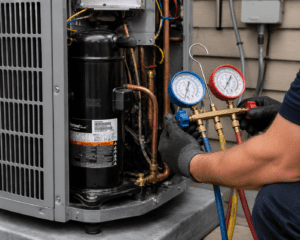
- Low refrigerant pressure. When refrigerant charge drops below spec (usually a leak), the pressure inside the coil drops, and the boiling point of the refrigerant drops with it. The coil runs cold enough to freeze condensate. Low refrigerant freezes are less common than airflow freezes, and they recur quickly after thaw because the underlying leak hasn't been fixed.
Coastal Carolina Comfort works through the airflow causes first because they're cheaper to fix, faster to diagnose, and account for the majority of freeze calls Coastal techs run on. If airflow is fine and the coil refreezes after thaw, the next conversation is refrigerant leak detection.
The seven-step diagnostic walk-through
Step 1 — Shut the AC off, set the fan to ON
The most important step, and the one homeowners most often skip. At the thermostat:
- Switch System from Cool to Off.
- Switch Fan from Auto to On.
That keeps the indoor blower running while the compressor stops. Room-temperature air moving across the frozen coil accelerates the thaw. Without the fan, thaw time stretches longer and the meltwater has more time to find its way past the drain pan onto the floor.
Expect a meaningful volume of water as the coil thaws. Place towels around the air handler — especially in attic installations where leaks find their way through ceilings. Coastal Carolina Comfort runs into "frozen coil that melted into the drywall" calls more than once a season; it's avoidable with five minutes of towel placement.
Step 2 — Replace the air filter
This is the single most common cause of a frozen coil. If the filter looks gray, matted, or you can't remember when it was last changed, replace it. Match the size printed on the filter frame — wrong-size filters leave gaps that bypass filtration and pull in unfiltered air that fouls the coil.
In coastal SC, the timing matters more than the calendar says. Pollen seasons coat filters faster than rated. Coastal Carolina Comfort recommends every 60 days during cooling season for most Lowcountry homes, more often during peak pollen weeks.
Step 3 — Open every register and supply vent
Counterintuitive but correct. Some homeowners close registers in rooms they don't use to "save energy." That restricts airflow across the coil — the same effect as a clogged filter. Walk the house and open every supply register and every return grille. Check that furniture, rugs, or curtains aren't blocking airflow.
Coastal Carolina Comfort techs find this pattern most often in two-story homes where the upstairs registers got closed during winter and never reopened.
Step 4 — Inspect the evaporator coil for visible dirt
If the air handler has an accessible coil access panel, open it (with the system off, per the safety note below). A clean coil looks like polished aluminum fins. A dirty coil looks matted with gray-brown dust or, in homes with pets, gray fuzz.
Cleaning a dirty coil isn't a DIY job — chemical coil cleaner is corrosive, the fins bend under hand pressure, and getting cleaner past the fins without damaging the refrigerant lines requires the right tools. Confirming the coil is dirty is useful for the service call; the cleaning itself is a tech job.
Step 5 — Listen for the blower motor
While the system is off but the fan is set to On, walk to the air handler and listen. The blower motor should be audible — a steady hum or whoosh. If you hear nothing, or the motor cycles on briefly and stops, the blower is the cause of the freeze.
Blower motor failures in coastal SC tend to start with bearing noise (grinding, squealing) months before total failure. If the system was noisy before the freeze, the motor was probably the warning that got missed.
Step 6 — Check the thermostat configuration
Running an AC when outdoor temperature is below 60°F can freeze the coil. Refrigerant pressure depends on outdoor temperature; below a manufacturer-specified threshold, the indoor coil runs colder than design and freezes.
Modern thermostats lock out AC operation below an outdoor temperature setpoint. Older mechanical thermostats don't. If the freeze happened during a cool-but-humid Lowcountry spring evening — common in March and April — the thermostat is the likely cause.
Step 7 — After thaw, restart and watch
Once the coil is fully thawed (allow a few hours, longer if the freeze was severe), reset the thermostat to Cool and watch the system for the first four to six hours of operation.
If it runs without re-freezing, the cause was one of the airflow steps above and the system is back in operation. Schedule a maintenance visit to confirm the coil and refrigerant charge are clean.
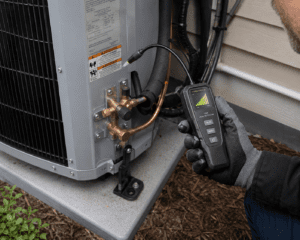
If it re-freezes within those four to six hours, the cause is refrigerant pressure — almost always a leak somewhere in the system. Refrigerant leak detection is a tech job with electronic leak detectors, ultraviolet dye, or pressure decay testing. Stop and call.
Should you keep going, or stop and call?
The split, same as on every Coastal Carolina Comfort diagnostic:
- Keep going: filter replacement, register opening, blocked vent clearing, thermostat configuration check. All four are homeowner-safe and resolve the majority of freeze calls.
- Stop and call: dirty coil confirmed but not yet cleaned, blower motor not spinning, system re-freezes within six hours of thaw, visible refrigerant oil staining on the copper lines or at line-set joints.
A safety note
Refrigerant lines and coil fins are thin copper and aluminum. A screwdriver, putty knife, or even a credit card can puncture a line during chipping. A punctured refrigerant line converts a $0 thaw into a refrigerant leak repair plus a recharge — and refrigerant recovery is EPA-regulated under Section 608.
Do not use a heat gun or hair dryer either. Uneven heating warps fins and stresses the copper bends on the line set.
The fan-only thaw is slow because slow is safe. The coil will thaw on its own.
Past Step 6? Tell us what's happening.
Same-day Lowcountry routing when an AC freezes mid-summer.
Call (843) 708-8735 and tell the dispatcher: how long the system was running before the freeze, what the air filter looked like when you pulled it, and whether the blower motor was audible. The tech arrives with the parts that match what you've described — filter, blower capacitor, blower motor, or refrigerant tools — so most frozen-coil repairs finish in one visit after thaw.
What a frozen-coil repair involves
The repair scope follows the cause. Coastal Carolina Comfort doesn't publish flat-rate pricing because the actual scope depends on the diagnosis, the brand, and the access conditions of the air handler. The general scope:
Airflow fix (filter, registers, thermostat config)
The lightest-scope set of fixes. Filter replacement and register opening are homeowner-resolvable and free. A thermostat configuration adjustment by a tech is usually a single-visit job rolled into a maintenance call.
Evaporator coil cleaning
A standalone service or part of a deeper-clean tune-up. The coil access panel comes off, the coil is sprayed with manufacturer-approved cleaner (the rinse drains through the existing condensate line), and the panel goes back on. In older systems with no accessible coil panel, scope expands.
Blower motor replacement
A larger repair. Blower motors are brand-matched by horsepower, voltage, rotation direction, and frame size. Some are ECM (electronically commutated) variable-speed motors that cost meaningfully more than PSC (permanent split capacitor) motors. The motor itself is the labor anchor.
Refrigerant leak repair plus recharge
The largest-scope freeze repair. The technician finds the leak (often at a joint, sometimes at the coil itself, occasionally at the line set), seals or replaces the leaking component, evacuates the system, and recharges to the manufacturer-specified amount. Refrigerant is EPA-regulated; only EPA Section 608 certified technicians can purchase or handle it. If the system uses R-22 (phased out for new equipment), recharge cost is meaningfully higher than for R-410A or R-454B systems and may make repair-versus-replace the next conversation.
Why Lowcountry coils freeze more often than inland systems
Three reasons coastal SC AC systems run a thinner margin against freezing than inland or drier-climate systems:
- Humidity drives condensate volume. A Lowcountry AC pulls a meaningfully larger volume of water out of the air than a system in a dry climate. The coil already runs near the freezing threshold of the condensate it's producing. Any airflow restriction pushes it over.
- Pollen seasons clog filters faster. The Summerville and Charleston pollen calendar runs heavy from late February through May, with a secondary peak in fall. Filters rated for 60-day intervals in dry climates may need replacement at 30-45 days during peak pollen weeks.
- Older ductwork has airflow imbalances. Many homes in Summerville's historic district, James Island, and West Ashley have ductwork that pre-dates modern static-pressure design. The system pulls less return air than the coil is sized for, which puts it in chronic freeze risk during humid conditions.
None of those make a Lowcountry AC inherently unreliable. They mean the maintenance interval needs to match the environment. Coastal Carolina Comfort sets maintenance plans for Lowcountry homes that account for pollen timing and humidity load rather than copying generic national service intervals.
Get this fixed in your area
Coastal Carolina Comfort runs same-day frozen-coil response across both the Summerville and Charleston markets. Most freeze calls finish in a single visit once thaw is complete. Pick the hub closest to you.
Summerville and Berkeley County
Frozen-coil repair across Nexton, Cane Bay, Carnes Crossroads, Knightsville, Wescott Plantation, Historic Downtown, and Summers Corner.
Summerville AC repair →Charleston and the Lowcountry
Mount Pleasant, Daniel Island, James Island, West Ashley, Johns Island, North Charleston, and the surrounding Lowcountry communities.
Charleston AC repair →Related diagnostic guides
-
AC not cooling
The walk-through when the system runs but the house won't drop temperature — often the first symptom of an imminent freeze.
-
AC leaking water inside
What a thawing frozen coil looks like in the laundry room, attic, or hallway — and when leaking water signals something else.
-
AC won't turn on
The diagnostic flowchart when the freeze has triggered a safety lockout and the system refuses to restart.
Frequently asked questions
How long does it take a frozen AC coil to thaw?
With the system off and the fan set to On, most coils thaw within one to three hours. Severe freezes — where the ice extends down the copper line set to the outdoor unit — can take longer, occasionally overnight. Coastal Carolina Comfort recommends waiting until there is no visible ice on the coil or the line set before restarting, then watching the first four to six hours of operation for a refreeze.
Will a frozen AC unit fix itself?
The ice will melt if you shut the system off, but the underlying cause won't fix itself. Restarting without addressing the cause — usually a clogged filter, closed registers, or low refrigerant — guarantees the system refreezes. Coastal Carolina Comfort's tech follow-up after a freeze is to identify which of the seven diagnostic steps explains the cause, fix that, and confirm the system runs through six hours without refreezing.
Can I keep using my AC if it has ice on the lines outside?
No. Running an AC with a frozen coil draws liquid refrigerant back to the compressor instead of vapor — the condition technicians call slugging. Slugging damages the compressor, which is one of the most expensive components in the system. Shut it off at the thermostat the moment you see ice and let it thaw with the fan on. Compressor replacement is a far bigger repair than whatever caused the freeze.
How do I know if my coil is dirty without opening the air handler?
Indirect signs of a dirty coil: rising electric bills with no change in usage, longer cooling cycles to reach setpoint, a musty smell from the supply vents, and gradual reduction in cold air output over weeks. The direct check requires removing the coil access panel, which Coastal Carolina Comfort techs handle as part of any tune-up or freeze diagnostic.
Why does my AC keep freezing even after I changed the filter?
If a fresh filter doesn't stop the refreezing, the next likely cause is a dirty evaporator coil, closed registers somewhere in the house, a failing blower motor running at reduced speed, or a refrigerant pressure problem. Refrigerant pressure issues usually mean a leak somewhere in the system and require an EPA Section 608 certified technician to diagnose and repair.
Is a frozen AC coil an emergency?
If you can shut the system off and tolerate the temperature in the house for a few hours, it's not a same-night emergency — the safe move is to shut it off, thaw, and call Coastal Carolina Comfort during regular hours. Where it becomes urgent: someone in the home has a medical reason to need cooling, the indoor temperature is climbing into a range that risks heat illness, or the meltwater is coming through a ceiling. Same-day routing covers all three.
Coil thawed but the system keeps freezing back up?
Call (843) 708-8735 for same-day Summerville and Charleston service.
If the coil keeps freezing, Coastal Carolina Comfort provides same-day air conditioning repair in Summerville and AC repair in Charleston. Call (843) 708-8735 for a real person and a stocked truck.