AC Compressor Failure: How to Tell, and Why the Math Usually Points to Replacement
By the Coastal Carolina Comfort team · Last updated 2026-05-20
The compressor is the heart of an AC system. When it fails, the question is rarely "how do we fix it." The question is whether repair makes financial sense at all. Here is the diagnostic framework.
Quick Answer: What AC Compressor Failure Looks Like
Compressor failure shows up as warm air despite the system running, loud or unusual noises from the outdoor unit, hard starting, frequent breaker trips, or visible oil around the outdoor cabinet. Unlike a capacitor swap or a small refrigerant repair, compressor failure on a system that is more than ten years old usually triggers a replacement conversation rather than a repair. Coastal Carolina Comfort diagnoses compressor problems on the same visit for the standard $110 diagnostic fee, and walks through the repair-versus-replace math in writing before any work begins.
What the AC Compressor Actually Does
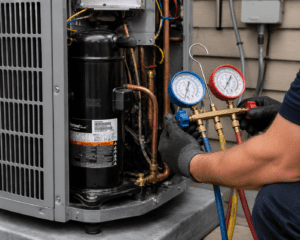
The compressor is the pump that moves refrigerant through your AC system. It pressurizes refrigerant gas, raising its temperature, and pushes it to the outdoor coil where the heat is released to the air. The refrigerant then expands, cools, and returns to the indoor coil to absorb heat from your home. Without the compressor, no heat moves. Nothing else in the system can do this job.
The compressor sits inside the outdoor unit (the box on your concrete pad). It is the most expensive single component in a residential AC system. Replacing one is closer to half the cost of replacing the entire outdoor unit, depending on the model. That is why a confirmed compressor failure changes the conversation from "what does the repair cost" to "what does this system look like for the next five years."
Signs Your AC Compressor Is Failing
Compressor failure is rarely subtle. There is usually a window of weeks or months where the symptoms are obvious but not catastrophic. Catching the diagnosis early gives you time to make the repair-versus-replace decision without the pressure of a dead system in July.
Warm air at the vents while the system runs
The fan blows, the thermostat reads correctly, the outdoor unit appears to be running, but the air at the vents is warm. The compressor is either not pumping refrigerant or pumping it ineffectively. This is the headline signal. If a quick check rules out a tripped breaker and a clogged filter, the differential goes to compressor or a major refrigerant leak.
Loud or unusual noises from the outdoor unit
Compressors fail in characteristic noise patterns. Loud knocking, grinding, or a continuous rattling that was not there before all suggest mechanical wear inside the compressor. A high-pitched squeal can indicate a refrigerant pressure problem the compressor is straining against. None of these resolve on their own.
Hard starting, the unit struggles to come on
You hear the contactor click and the unit hums for several seconds before actually starting up. Sometimes it never starts at all. This is the compressor working against more load than it can handle, often because of refrigerant issues, capacitor degradation, or compressor windings beginning to fail.
Frequent breaker trips on the AC circuit
A failing compressor draws elevated current at startup. Repeated breaker trips on the same circuit are the breaker doing its job, protecting the wiring and the equipment from the elevated draw. Resetting the breaker repeatedly compounds the damage. Call before the third reset.
Visible oil around the outdoor unit
Compressor failure sometimes shows up as oil leaking from the housing or from refrigerant line connections. The oil that lubricates the compressor's internal bearings can escape when seals fail. A puddle of oil on the concrete pad under the outdoor unit is a strong sign of a serious problem.
System short cycling on the worst days
A compressor approaching failure may overheat and shut down on safety thresholds during peak demand. The system runs for ten minutes, dies, comes back on after a cool-down, and repeats. Short cycling can have other causes, but on an older system in mid-summer it is a leading compressor-failure indicator.
Why AC Compressors Fail
Compressor failure rarely happens out of nowhere. It is usually the end of a chain of issues that started earlier and were not addressed. Understanding the chain helps explain why some failures are "the system did its time" and others are "we could have caught this last summer."
Overheating from sustained high duty cycle
Lowcountry cooling seasons run from March deep into fall. The compressor in a Summerville or Charleston home runs more hours per year than the same unit installed in cooler regions. Heat is the long-term enemy of compressor windings. Even properly maintained equipment shows wear earlier here than in drier or cooler markets.
Refrigerant issues that were never resolved
Both undercharge (from leaks) and overcharge stress the compressor. A refrigerant leak that runs for a season has the compressor working against an undercharged loop the whole time. That extra heat and current degrades the windings. By the time the refrigerant issue gets diagnosed, the compressor is already on a shorter lifespan than it would have been.
Electrical failures upstream
A failing capacitor forces the compressor to draw elevated current at every startup. Over hundreds of cycles, that current spike breaks down winding insulation. A bad contactor produces voltage chatter that also stresses the windings. Both of these are cheaper repairs than a compressor, and both, ignored, eventually become a compressor failure.
Simple age
A residential AC compressor that has been maintained well in a non-coastal market often runs 15 to 20 years. The same compressor in the Lowcountry, with longer cycles and harder duty, more often runs 10 to 15. Past year 12, every additional season is a season on borrowed time.
Repair the Compressor, or Replace the System?
This is the most important section of this page. A compressor diagnosis is not a yes/no on repair. It is a math problem with four inputs: the age of the system, the repair cost as a fraction of replacement cost, the refrigerant type, and the warranty status.
Repair Makes Sense When
- System is under 10 years old
- Repair cost is below half of new-system cost
- Compressor is still under manufacturer warranty
- System uses current R-454B or R-32 refrigerant
- The rest of the system (coils, lines, air handler) is in good shape
Replacement Usually Wins When
- System is 12+ years old
- Repair cost approaches half of new-system cost or more
- System uses R-22 (phased out, very expensive)
- System uses R-410A AND has multiple aging components
- You have had multiple major repairs in the past two years
How we walk through the math during the diagnostic
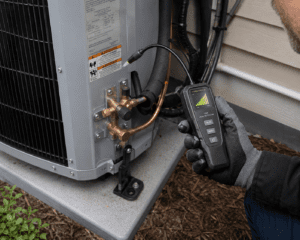
The Coastal technician confirms the compressor failure with electrical testing. From there, the conversation moves to the four inputs above. We quote both paths in writing: what the compressor replacement costs (parts plus refrigerant recovery and recharge plus labor), and what a system replacement costs (new condenser unit or new full split system, depending on age and condition of the indoor coil and air handler).
The 50% rule is the most common simple heuristic, if the repair quote is more than half the cost of a replacement, replacement usually wins. But the rule has exceptions. A newer system with a covered warranty on the compressor itself is often a clear repair even if labor pushes the cost up. An older system on R-22 with corroded outdoor coils is often a clear replacement even if the compressor itself is cheap to swap.
The repair-versus-replace conversation does not feel like a sales pitch when it is grounded in actual numbers and your specific system. Either path is fine with us. The goal is the right answer for the next 5 to 10 years of your home, not the most expensive job on the work order.
Why Compressor Work Is Not a DIY Job
Compressor repair or replacement requires recovering refrigerant from the system before any disassembly, brazing high-pressure refrigerant lines, evacuating the system to remove moisture, and recharging with the correct amount of refrigerant by weight. Every one of those steps requires EPA Section 608 certification by federal law. Homeowners legally cannot purchase or handle refrigerant. Beyond the regulatory frame, the physical work involves high-pressure systems and equipment that hold dangerous voltage. This is a pro-only repair without exception.
Coastal technicians hold current EPA 608 and NATE certifications. The compressor diagnosis happens during the standard $110 service visit. Whether the recommendation is repair or replacement, the work is done in-house, we are not handing you off to a different installer for the replacement path.
What an AC Compressor Repair or Replacement Costs
Compressor work is the most variable cost in residential HVAC. The compressor part itself is expensive. Refrigerant recovery, evacuation, and recharge add labor and material cost. The actual replacement labor depends on the system layout and how accessible the outdoor unit is.
The $110 diagnostic fee covers the diagnostic visit and is applied toward the repair when you authorize the work. After the diagnostic, you get a written quote for the repair path and a written quote for the system replacement path. From there, you decide. We do not require commitment during the diagnostic visit.
On systems where the compressor is still under manufacturer warranty, the part itself may be covered. Labor to install the warranty part is your cost. The Coastal technician identifies any warranty coverage during the diagnostic and walks through what that means for your specific quote.
Same-Day Service
Most Charleston and Summerville service calls are answered the same day from our Lipman St. dispatch in Summerville.
NATE + EPA 608 Certified
Every Coastal technician holds current NATE and EPA Section 608 certifications, the federal requirement for refrigerant handling.
Honest Repair-vs-Replace Math
Both quotes in writing during the diagnostic. No pressure either direction. The right answer for your home.
Get a Compressor Diagnosis in Your Area
Coastal Carolina Comfort serves both metros from a single Summerville location. Pick the page for your area for service-area details, neighborhood coverage, and the local contact form.
If Your AC Has These Symptoms, A Failing Compressor Could Be the Underlying Cause
AC Not Cooling
The system runs but the house never reaches setpoint. A compressor that has lost pumping efficiency produces exactly this pattern.
AC Blowing Warm Air
The fan runs but the air at the vents is warm. A compressor not pressurizing the refrigerant correctly produces warm-air delivery.
AC Short Cycling
System runs briefly, shuts off, restarts. A compressor overheating and tripping safety limits is one of the diagnostic possibilities.
AC Compressor Failure: Frequently Asked Questions
The strongest signals are warm air at the vents while the system is running, loud or unusual noises from the outdoor unit, hard starting where the unit hums but does not come on, repeated breaker trips on the AC circuit, and visible oil around the outdoor cabinet. A technician confirms the diagnosis with electrical testing, measuring compressor windings resistance, startup current, and refrigerant pressures.
No. Compressor work requires recovering refrigerant before disassembly, brazing high-pressure refrigerant lines, evacuating the system, and recharging with the correct amount of refrigerant. Every one of those steps requires EPA Section 608 certification by federal law. Homeowners legally cannot purchase or handle refrigerant. This is a pro-only repair without exception.
The four-input framework: system age, repair cost as a fraction of replacement cost, refrigerant type, and warranty status. Under 10 years and under 50% of replacement cost usually points to repair. Over 12 years, R-22 refrigerant, or repair cost approaching half of replacement usually points to replacement. The Coastal technician walks through both quotes in writing during the diagnostic. See our AC repair pillar in Charleston for the broader repair-vs-replace framework.
Most major HVAC manufacturers (Trane, Carrier, Lennox, Rheem, Goodman, Daikin) offer compressor warranties of 10 years on systems where the homeowner registered the unit at install. Warranty terms vary by brand, install year, and registration status. The Coastal technician identifies your manufacturer and serial number during the diagnostic and checks warranty status directly with the manufacturer. If the compressor part is covered, your cost drops to the labor and refrigerant material side only.
Compressor replacement is the most variable cost in residential HVAC. The part itself is the most expensive single component in the system. Refrigerant recovery, evacuation, and recharge add labor and material. Total cost depends on system tonnage, refrigerant type, accessibility of the outdoor unit, and warranty status of the part. The $110 diagnostic fee covers the diagnostic visit and is applied toward the repair. After the diagnostic, you get the exact number in writing for both repair and replacement paths.
A residential AC compressor that has been maintained well in a non-coastal market often runs 15 to 20 years. The same compressor in the Lowcountry, with longer summer duty cycles, more often runs 10 to 15. Past year 12, every additional season is a season on borrowed time. Salt-air corrosion does not directly attack the compressor (which is sealed), but the corrosion on the outdoor unit's coils and refrigerant lines often shortens the life of the system as a whole.
Sometimes yes, sometimes no. Compressor failures from age are not preventable beyond running the system reasonably and not pushing it past its expected service life. Compressor failures driven by other causes, a failing capacitor that was not replaced, a refrigerant leak that ran for a season, a contactor that was chattering for months, were often preventable with earlier diagnosis. Twice-yearly maintenance catches most of the upstream causes before they cascade.
AC Compressor Acting Up? Get the Repair-vs-Replace Math.
$110 diagnostic, applied toward the repair. Both quotes in writing during the same visit. Same-day service from Lipman St.
📞 (843) 708-8735Coastal Carolina Comfort · 110 Lipman St, Summerville, SC 29483 · Licensed & Insured · NATE-Certified · EPA 608