AC Capacitor Failure: Why It Happens and How to Recognize It
By the Coastal Carolina Comfort team · Last updated 2026-05-20
Capacitors are the small components that start your compressor and fan motor. When one fails, the whole system stops cooling. Here is what is happening, how to spot it, and why this specific repair belongs to a technician.
Quick Answer: What a Failed AC Capacitor Looks Like
A failed AC capacitor usually shows up as a humming outdoor unit that will not start, a system that trips the breaker, intermittent cooling that comes and goes, or a swollen or leaking can on top of the capacitor itself. Capacitor failure is the most common cause of "AC won't turn on" calls. Coastal Carolina Comfort diagnoses capacitor problems on the same visit for the standard $110 diagnostic fee and replaces the capacitor on the spot when the part is in stock on the truck.
What an AC Capacitor Actually Does
A capacitor is a small cylindrical electrical component that stores a charge and releases it when called on. Your outdoor AC unit has at least one capacitor. Larger systems have two. The capacitor's job is to give the compressor and the condenser fan motor the kick of voltage they need to start turning. Without that kick, neither motor can spin up against the load that is sitting on it.
You can think of the capacitor as the match that lights the burner. The burner runs on a different fuel source (your home's electrical service), but it cannot light itself. The capacitor provides the spark. Once the motors are running, they need much less voltage to keep going. The capacitor's work is done in fractions of a second every time the system kicks on.
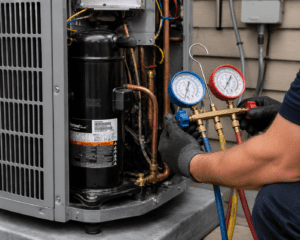
Capacitors are rated by their storage capacity (microfarads) and voltage. A capacitor in a residential AC system is typically the size of a soda can or smaller. It is mounted inside the electrical panel on the outdoor unit, usually behind a sheet-metal cover that requires a screwdriver to open.
Signs Your AC Capacitor Is Failing
Capacitor failure rarely happens cleanly. There is usually a window of weeks or months where the symptoms are intermittent before the part fails completely. Catching it during that window saves you from a no-cool call during peak heat.
The outdoor unit hums but does not start
The compressor or fan motor is trying to start but does not have the voltage push it needs. You hear a low hum from the unit. The fan blades do not turn, or they turn and then stop. This is the classic capacitor-failure signature. If you spin the fan blade gently with a stick and it then keeps running, you have effectively confirmed the diagnosis (but the system is still unsafe to operate that way — call for service).
The system trips the breaker
A weak capacitor forces the motors to draw more current than they should during startup. That elevated draw can trip the breaker. If your AC tripped the breaker once and you reset it and it tripped again, stop resetting it and call for a diagnostic. Repeated breaker trips on the same circuit can damage the breaker, the wiring, and the motor itself.
Intermittent cooling — sometimes works, sometimes does not
A capacitor that is partway degraded fires correctly some of the time. On hot afternoons when the system has the most work to do, it fails. On cooler mornings, it works. If your AC is fine in the morning and dead at 3 PM, intermittent capacitor failure is high on the differential.
The capacitor is visibly swollen or leaking
The capacitor housing is normally a smooth cylinder. A failing capacitor often shows a swollen or domed top, sometimes with oily residue around it. If you can see the capacitor and it looks misshapen, the diagnosis is essentially confirmed. Do not touch it.
Hot-start failures during peak heat
Long Lowcountry afternoons that drive the system continuously are the conditions under which a weak capacitor finally fails. Charleston and Summerville homeowners commonly notice this in July and August when the system is at its highest duty cycle. The capacitor that limped through May breaks down on a 95-degree afternoon. Lowcountry humidity compounds the stress because the system runs longer cycles to remove moisture in addition to cooling air.
Why Capacitors Fail
Most residential AC capacitors fail between year 7 and year 10 of equipment life. Lowcountry conditions tend to push that window earlier rather than later. The reasons fall into three categories.
Heat exposure
The capacitor sits inside the electrical compartment of the outdoor unit, which sits in full sun on a concrete pad. Internal temperatures inside that compartment on a Charleston summer afternoon are well above ambient air temperature. Capacitor dielectric material breaks down faster the hotter it runs. A capacitor rated for years of inland service can show degradation in much less time when it is processing Lowcountry summer load every day.
Voltage fluctuations and brownouts
Capacitors are also damaged by voltage events on your electrical service — brownouts, surges from afternoon thunderstorms, utility-side switching. The Lowcountry has more lightning days per year than most of the country, and storm-driven power events take a toll on capacitors over time.
Simple age
Even without heat or voltage stressors, capacitors have a finite service life. The dielectric oil inside slowly degrades. Service technicians treat any capacitor over 8 years old as a candidate for proactive replacement during a maintenance visit, even when the part still tests within tolerance.
This Is a Call-a-Pro Repair. Here Is Why.
AC capacitor replacement looks deceptively simple online. The part costs little, and the physical swap takes a technician maybe ten minutes once the panel is open. None of that means it is a safe DIY job.
⚠️ Capacitors hold lethal voltage even with the power off
A capacitor is, by definition, an electrical storage device. Even after you shut off the disconnect at the unit and the breaker at the panel, the capacitor inside the system continues to hold a charge — often several hundred volts. Touching the terminals before the capacitor is properly discharged is a real electrocution risk that has killed people who thought they had killed the power.
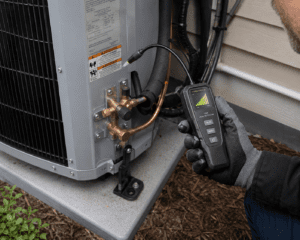
Professional technicians carry an insulated discharge tool and use it on every capacitor before they touch the terminals, every time, with no exceptions. This is not the place to learn the discipline on a YouTube video.
Beyond the discharge step, a capacitor replacement done correctly involves confirming the correct microfarad and voltage rating for the system, testing the new capacitor on installation, and verifying the motors draw the right current at startup. A wrong-rated capacitor will burn itself out in days and damage the compressor while it is doing it.
If your AC is showing capacitor symptoms, the answer is to call. Same-day diagnosis at the standard $110 diagnostic fee. Coastal technicians carry the most common capacitor sizes on every truck, so the repair usually happens during the same visit.
What AC Capacitor Repair Costs in Charleston and Summerville
Capacitor replacement is one of the more affordable AC repairs. The $110 diagnostic fee covers the technician's drive, electrical testing, and a written diagnosis. If the diagnosis is a failed capacitor, the diagnostic fee is applied toward the repair cost.
The total cost depends on the capacitor size, whether one or two capacitors need replacement, and whether the failure damaged any other components. A single dual-run capacitor swap is on the lower end of AC repair pricing. A capacitor that has been failing long enough to damage the compressor motor is a more expensive job. Coastal Carolina Comfort quotes the full repair cost in writing before any work begins.
Same-Day Service
Most Charleston and Summerville service calls are answered the same day. We dispatch from our Lipman St. headquarters in Summerville.
NATE-Certified Technicians
Every Coastal technician holds current NATE certification — the HVAC industry's highest standard for service and repair.
Licensed and Insured
We hold a current SC LLR Mechanical Contractor license and carry full liability and workers' compensation insurance.
Get Your Capacitor Fixed in Your Area
Coastal Carolina Comfort serves both metros from a single Summerville location. Pick the page for your area for service-area details, neighborhood coverage, and the local contact form.
If Your AC Has These Symptoms, A Capacitor Could Be Behind Them
AC Not Cooling
The system runs but the house never reaches the set temperature. A weak capacitor that lets the compressor start but underperform is one of the common causes.
AC Won't Turn On
The thermostat calls for cooling but nothing happens at the outdoor unit. Capacitor failure is the number-one suspect for this symptom.
AC Blowing Warm Air
The fan runs but the air coming out is warm. A capacitor that fires the fan but not the compressor produces exactly this pattern.
AC Capacitor Failure: Frequently Asked Questions
The strongest signal is a humming outdoor unit where the fan is not turning. Other signals are a system that trips the breaker, intermittent cooling that comes and goes with the heat of the day, and a visibly swollen or leaking capacitor housing inside the electrical panel. A technician with a multimeter can confirm in a couple of minutes whether the capacitor still tests within its microfarad tolerance.
We strongly recommend against it. Capacitors store electrical charge even with the power off, often at several hundred volts. Touching the terminals before the capacitor is properly discharged with an insulated tool is an electrocution risk that has killed people. Beyond the discharge step, a wrong-rated replacement capacitor will burn out fast and can damage the compressor. The repair is genuinely fast in a technician's hands and inexpensive enough that the risk math does not favor DIY.
The capacitor swap itself is fast once the diagnostic is complete and the correct replacement part is on the truck. The full visit — drive, diagnostic, part verification, replacement, startup testing, and written summary — is usually under an hour. Coastal technicians stock the most common capacitor sizes on every truck, so most jobs finish on the same visit.
Capacitor replacement is on the lower end of AC repair pricing. The $110 diagnostic fee covers the technician's drive, electrical testing, and written diagnosis, and is applied toward the repair cost. The full repair price depends on capacitor size, whether one or two need replacement, and whether the failure damaged any other components. You get the exact number in writing before any work starts.
It can if the capacitor is failing for long enough. A weak capacitor forces the compressor motor to draw elevated current at startup, which generates heat inside the motor windings. Over time that overheating breaks down the winding insulation. By the time the compressor itself fails, you are looking at a much larger repair. This is why we recommend addressing a known-bad capacitor as soon as you have the diagnosis — even if the system is still cooling intermittently. See our guide on AC compressor failure for the cascade.
Most residential AC capacitors fail between year 7 and year 10 of equipment life. Lowcountry conditions — heat soak on the outdoor cabinet, lightning-driven voltage events, long summer duty cycles — push that toward the earlier end. If your AC is 8 years or older and you have not had the capacitor tested during maintenance, asking for a capacitor check is reasonable preventive thinking.
If the capacitor was the only problem, yes. The technician confirms this by testing the motor current draw at startup after the new capacitor goes in. If the motor still pulls high current after the swap, the underlying problem is the motor itself rather than the capacitor — and the diagnostic continues from there. The standard visit includes the verification step, so you do not leave with an unresolved issue.
Think Your AC Capacitor Is Failing? Call Now.
Same-day diagnosis. $110 diagnostic fee applied toward the repair. Capacitor parts stocked on every truck.
📞 (843) 708-8735Coastal Carolina Comfort · 110 Lipman St, Summerville, SC 29483 · Licensed & Insured · NATE-Certified