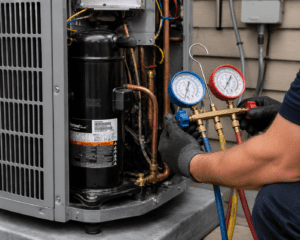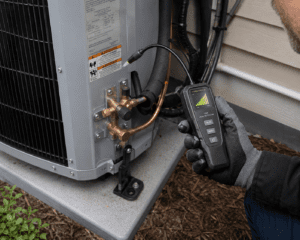
AC Not Blowing Air? A Lowcountry Diagnostic When the System Runs but the Vents Are Quiet
[AUTHOR — Coastal Carolina Comfort technician] · Updated for the 2026 cooling season · ~7 minute read
When an AC runs but no air comes from the vents, the airflow chain has broken somewhere between the return air and the supply registers. The seven most common causes: a thermostat fan set to Auto when the compressor is off, a clogged air filter blocking return flow, a frozen evaporator coil blocking the coil face, a failed blower motor, a failed blower capacitor, closed or blocked supply registers, and a disconnected or major duct leak in the supply trunk. Coastal Carolina Comfort diagnoses these in order from cheapest-to-fix to most expensive on every service call. The first three are homeowner-checkable in ten minutes.
This spoke is distinct from "AC running but not cooling." If air is moving from the vents but it's warm, that's the warm-air diagnostic. If the system runs (you hear the compressor or air handler) but nothing — or barely anything — comes out of the supply registers, you're in the right walk-through.
The diagnostic below is the order a Coastal Carolina Comfort tech runs on a no-airflow service call. Work the steps in order. If a step finds the problem and the fix is in the homeowner range, fix it. If a step reveals the problem but the fix needs a tech (blower motor replacement, capacitor diagnosis, duct repair), stop and call.
Why no air is coming from the vents
An AC moves air in a continuous loop. Return air enters through the return grille, passes through the air filter, crosses the evaporator coil (which removes heat and moisture), gets pushed by the blower motor through the supply ductwork, and exits through the supply registers in each room. If any link in that chain breaks, airflow at the supply registers stops or drops dramatically.
Two underlying conditions cause the no-airflow symptom:
- The blower motor isn't moving air. A failed motor, a dead blower capacitor, a thermostat fan setting that turned the blower off, or a control board fault all produce the same downstream symptom: no air at the supply registers because no air is moving through the system.
- The blower is moving air but the air can't get to the registers. A clogged filter, a frozen coil blocking the coil face, closed supply registers throughout the house, or a disconnected duct in the attic or crawlspace all interrupt the airflow path between the blower and the room.
The diagnostic splits these two paths quickly: stand at the air handler with the system running. If you can hear the blower motor moving air inside the cabinet, the problem is downstream (filter, coil, ducts, registers). If you can't hear the blower at all, the problem is the blower itself (motor, capacitor, thermostat setting, control board).
The seven-step diagnostic walk-through
Step 1 — Thermostat fan setting
At the thermostat, find the Fan setting. If it's set to Auto, the blower only runs when the compressor is calling for cool. If the compressor isn't running (system has hit setpoint, or system has shut down for any other reason), the blower won't run either — and no air comes out of the vents.
Switch the fan to On. The blower should kick on within a few seconds regardless of whether the compressor is running. If air now comes out of the vents (even if it's not cold), the thermostat setting was the issue.
Step 2 — Air filter
Pull the filter. A clogged filter restricts return airflow so severely that the blower has nothing to move forward to the supply ducts. Symptom presentation: blower runs, but airflow at registers is meaningfully reduced or near-silent.
Replace if matted, gray, or older than 60 days. In Lowcountry pollen seasons (late February through May, secondary peak in fall), the interval shortens. Some systems also have a return grille filter and a separate filter at the air handler — check both locations.
Step 3 — Frozen evaporator coil
If the filter looks fine but airflow is still weak or absent, check for ice on the indoor coil or the copper line set. A frozen coil blocks airflow across the coil face — the blower runs, the system tries to cool, but air can't pass the ice barrier.
If ice is visible, shut the AC off at the thermostat and switch the fan to On. Let the coil thaw fully (usually one to three hours; longer for severe freezes). Don't restart cooling until the underlying cause is diagnosed. See the related guide on frozen evaporator coils.
Step 4 — Supply registers and return grilles
Walk the house. Check that every supply register is fully open. Check that no furniture, rug, or curtain is blocking a register. Check that the return grille (usually one large vent per zone, often in a hallway or central wall) is unobstructed.
Counterintuitive note: closing supply registers in unused rooms doesn't save energy — it reduces airflow across the coil and can cause the same freeze-up symptom as a clogged filter. Open every register in the house.
Step 5 — Listen for the blower motor
Stand near the air handler with the fan set to On. The blower motor should produce a steady audible hum or whoosh. If you hear nothing, or the motor clicks briefly and stops, the blower is the failure.
Two failure modes are common: a worn-out direct-drive blower motor (the motor itself has failed) or a failed blower capacitor (the motor energizes but can't start because the capacitor isn't delivering its charge). Both are tech-diagnosed with a multimeter and clamp meter. A failed blower motor or capacitor is a single-visit repair with stocked parts on Coastal Carolina Comfort trucks for the most common air handler platforms.
Step 6 — Inspect accessible ductwork
If the blower is running and air is moving in the air handler cabinet but not reaching the registers, the air is escaping into the attic, crawlspace, or wall cavity before it gets to the rooms. The most common scenarios:
- A flex duct has come disconnected from the supply trunk or from a register boot. Listen at the supply trunk in the attic or crawlspace — disconnected ducts usually announce themselves with audible airflow into the space.
- A major duct seam has separated. Less audible, but you'll see hot or cold spots in the attic / crawlspace that correspond to the leak location.
- The blower fan is operating but the squirrel cage has slipped on the shaft, so the fan spins without moving air. This one's a tech-diagnosable failure.
Accessible duct repair is straightforward — a Coastal Carolina Comfort tech reconnects flex duct or seals the seam with mastic during a service call. Inside-wall duct damage expands the scope.
Step 7 — Stop and call
Past these six checks, the diagnostic moves into the blower control board, the ECM motor controller (on variable-speed systems), or the static-pressure analysis. None of those are homeowner-serviceable. A Coastal Carolina Comfort tech with the right meter and parts inventory resolves them in a single visit.
Should you try to fix it yourself, or call?
The decision rule:
- Keep going: thermostat fan-setting check, filter replacement, frozen-coil shutdown and thaw, opening closed registers, clearing register obstructions, visual duct-disconnection check.
- Stop and call: blower motor silent or short-cycling, audible buzz from the blower without movement, ductwork damage inside a wall, frozen coil that re-freezes after thaw, any duct or motor diagnosis past the visual.
A safety note
Air handler blower motors run on 120V or 240V depending on the system. The control board and blower wiring are inside the same compartment. Kill power at the breaker for the air handler before any inspection past the filter and the access panel screws. A tech with the right meter can verify power is fully off in seconds; without that meter, the safe default is to keep the breaker off and let the tech open the cabinet.
Past Step 6? Tell us what's happening.
Same-day Lowcountry routing when the AC runs but no air reaches the vents.
Call (843) 708-8735 and tell the dispatcher: whether the blower is audible at the air handler, what the filter looked like when you pulled it, whether the coil has visible ice, and whether you've checked for duct disconnections in the attic. The tech arrives with the parts most likely to match — capacitor, blower motor, control board, or duct repair materials — so most no-airflow repairs finish in one visit.
What a no-airflow repair involves
Coastal Carolina Comfort scopes the repair after diagnosis. The general scope by cause:
Thermostat reconfiguration or replacement
The lightest-scope fix when the thermostat is the cause. Often resolved during a maintenance visit. If the thermostat itself has failed (relay stuck, control board fault), a smart thermostat replacement with the correct C-wire setup is a single-visit job.
Filter replacement and register/grille check
Homeowner-resolvable. Coastal Carolina Comfort can roll filter replacement and a duct inspection into any service call. For households that want it managed, a Comfort Club maintenance plan handles filter timing on the Lowcountry pollen schedule.
Frozen-coil thaw and underlying cause
Variable scope. The thaw is incidental; the underlying cause needs separate diagnosis (clogged filter, dirty coil, refrigerant pressure problem, blower motor failure). See the frozen evaporator coil walk-through.
Blower capacitor replacement
Single-visit repair. Capacitor part is inexpensive; labor is the bulk of the cost. Brand-matched capacitors are stocked on the truck for the most common air handler platforms.
Blower motor replacement
A larger repair. Motors are brand-matched by horsepower, voltage, frame size, and rotation direction. ECM (variable-speed) motors cost meaningfully more than PSC (single-speed) motors. The labor of pulling the old motor, transferring the squirrel cage, and reinstalling is the anchor cost.
Duct repair
Scope depends on accessibility. A reconnected flex duct at an accessible joint is fast. A separated trunk seam in an attic is a moderate repair. Damage inside a wall cavity expands scope to include drywall work.
Control board or ECM controller diagnosis
The largest-scope diagnostic-only path. Brand-matched parts; some platforms have a lead time of a day or two for special-order boards. If the board is the failure, repair-versus-replace becomes the next conversation on older systems.
Why Lowcountry systems hit no-airflow failures more often
Three reasons coastal SC homes see this symptom on a tighter timeline than inland systems:
- Pollen seasons clog filters faster. The Summerville and Charleston pollen calendar runs heavy from late February through May, with a secondary peak in fall. National 60-day filter intervals are too long during peak pollen weeks; a Lowcountry filter at 45 days under pollen load can be the same as a national filter at 90 days.
- Humidity drives blower bearing wear. Sealed motor bearings work harder when the system has to run longer cycles to meet the latent (dehumidification) load. Lowcountry blowers run more total hours per cooling season than inland-climate blowers do.
- Attic ductwork takes a beating. Charleston and Summerville attic temperatures climb high in summer, and flex duct connections at register boots come loose from thermal cycling more often than they do in milder climates. Annual duct inspection catches this before it becomes a no-airflow call.
None of those make a Lowcountry AC inherently unreliable. They calibrate the maintenance interval to the environment. Coastal Carolina Comfort tune-ups for Lowcountry homes include a duct inspection and a static pressure check specifically because the no-airflow failure modes track to operating conditions, not random component failure.
Get this fixed in your area
Coastal Carolina Comfort runs same-day routing for no-airflow calls across both the Summerville and Charleston markets. Most blower-related repairs finish in a single visit once the cause is identified. Pick the hub closest to you.
Summerville and Berkeley County
Same-day blower and duct repair across Nexton, Cane Bay, Carnes Crossroads, Knightsville, Wescott Plantation, Historic Downtown, and Summers Corner.
Summerville AC repair →Charleston and the Lowcountry
Mount Pleasant, Daniel Island, James Island, West Ashley, Johns Island, North Charleston, and the surrounding Lowcountry communities.
Charleston AC repair →Related diagnostic guides
-
AC frozen evaporator coil
The diagnostic for when ice on the coil is the cause of the no-airflow symptom — clogged filter, dirty coil, or refrigerant pressure problem.
-
AC making strange noises
When the blower is producing buzzing, grinding, or screeching sounds in addition to the no-airflow symptom — the noise narrows the diagnosis.
-
AC won't turn on
When the no-airflow symptom is paired with the system not starting at all — the diagnostic moves upstream of the blower.
Frequently asked questions
Why is my AC running but no air is coming out of the vents?
The airflow chain between the blower and the supply registers has broken somewhere. Seven causes are common: thermostat fan set to Auto when the compressor is off, clogged filter, frozen evaporator coil, failed blower motor, failed blower capacitor, closed or blocked supply registers, or a disconnected duct. The diagnostic walk-through above identifies which one in order from cheapest-to-fix to most expensive. Most cases resolve at the filter or thermostat step.
Why is the AC compressor running but the indoor fan isn't?
The blower is the indoor fan. If the compressor runs but the blower doesn't, the cause is upstream of the blower itself: a failed blower capacitor (most common), a failed blower motor, a control board fault that's calling for cool without calling for fan, or a thermostat with a wiring issue between the cool and fan terminals. Coastal Carolina Comfort techs verify with a clamp meter at the blower in seconds; most repairs are single-visit.
Can a clogged air filter really stop all airflow?
Yes, and Lowcountry pollen seasons make it more likely than national 60-day filter guidance suggests. A severely clogged filter can restrict airflow enough that the blower has nothing to push forward to the supply ducts. The symptom looks identical to a failed blower motor from the room: vents are silent, air doesn't move. Pulling the filter and trying again is the fastest diagnostic — if airflow returns immediately, the filter was the cause.
What's a blower capacitor and why does it fail?
The blower capacitor stores the electrical charge that starts the blower motor and (on some motor types) sustains the run charge during operation. Capacitors degrade over time from heat exposure, salt-air corrosion on outdoor units, and electrical stress. When a blower capacitor fails, the motor either won't start at all or starts briefly then shuts off. Replacement is one of the faster repairs in the no-airflow cluster — Coastal Carolina Comfort stocks brand-matched capacitors on the truck for the most common air handler platforms.
How do I check for a disconnected duct in the attic?
With the system running and the fan set to On, listen at the supply trunk in the attic or crawlspace. A disconnected flex duct usually produces audible airflow into the space rather than into the rooms. Visually trace each flex duct from the trunk to its register boot — disconnections often happen at the boot end where the duct attaches to the ceiling or wall opening. Re-seating a slip-fit connection is possible if you're comfortable working in an attic; otherwise, schedule a Coastal Carolina Comfort visit.
Is no airflow an emergency or can it wait?
It's not a same-night emergency unless someone in the home has a medical reason to need cooling or indoor temperatures are climbing into heat-illness range. The repair scope is usually small (filter, thermostat setting, capacitor) — schedule a same-day call rather than waiting a week. If the underlying cause is a frozen coil, continuing to run the system damages the compressor; in that case, shut the AC off and the call becomes more urgent.
System runs but vents are quiet? Don't keep cycling it.
Call (843) 708-8735 for same-day Summerville and Charleston service.