AC Blowing Warm Air: A Lowcountry Diagnostic and Repair Guide
Warm air out of the vents is one of four real failure modes. The longer the system runs in that state, the more the repair tends to cost. This guide identifies the cause from the homeowner’s side, names the safety call on whether to keep the system running, and lays out the typical repair-cost range for each cause in coastal South Carolina.
By Billy Webb, Owner of Coastal Carolina Comfort Updated April 30, 2026
The five real causes of warm-air output
Most warm-air diagnostic calls in Charleston and Summerville resolve to one of these five causes. They are listed in rough order of how often Coastal Carolina Comfort technicians find them in coastal South Carolina homes, refrigerant issues lead in this region because of salt-air corrosion on outdoor coil tubing east of I-26 (EPA Section 608 covers refrigerant handling for any leak repair). Each cause has a clear tell from the homeowner side. Match the symptoms below to narrow it down before the visit.
01
Refrigerant loss (low charge or leak)
Most common in coastal SC
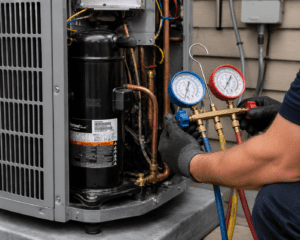
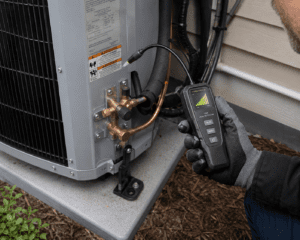
An AC system does not consume refrigerant the way an engine consumes oil. If the charge is low, refrigerant has escaped through a leak, most often a pinhole in the outdoor condenser coil tubing or at a service connection. In the Lowcountry the failure curve runs faster than national averages because salt-laden coastal air corrodes copper coil tubing on a shorter cycle. Standard coils last 12 to 15 years inland; coastal-exposed coils without protective coatings can fail in 5 to 8 years (Carrier’s Environmental Corrosion Protection selection guide covers the failure mechanisms and the coatings that extend coil life).
Tell: System runs without cycling off, vents put out air that feels close to room temperature, outdoor unit may show ice on the smaller copper line near the wall. Repair requires EPA-certified handling per Section 608.
02
Frozen evaporator coil
Common
The evaporator coil sits inside the air handler. When refrigerant flow drops or airflow across the coil falls below design (low refrigerant and a clogged filter are the two most common drivers), coil temperature falls below freezing and condensation locks up as ice. Once the coil ices over, the unit blows whatever ambient air is in the duct: warm, then warmer, until you switch the system off. See the full diagnostic guide on frozen evaporator coils in humid South Carolina weather for the deeper read on how the freeze develops.
Tell: Reduced airflow at the vents, water pooling near the indoor air handler as ice melts, frost on the larger copper line near the outdoor unit. Switch the system to off and let the coil thaw before any further diagnosis.
03
Thermostat misconfiguration
Quickest fix
The simplest cause and the one worth ruling out first. A thermostat set to fan on instead of auto circulates room-temperature air through the vents whenever the AC compressor is between cycles. A thermostat set to heat by accident does the obvious. A failing thermostat that has lost calibration calls for cooling at the wrong setpoint, and the compressor never engages.
Tell: Outdoor unit silent or cycling on and off, vent air matches indoor temperature rather than ducts feeling cool. Walk to the thermostat first.
04
Dirty condenser (outdoor coil)
Often paired with #1
The outdoor condenser unit sheds heat from the refrigerant. When the coil fins pack with pollen, lawn debris, dryer lint, or coastal grime, heat transfer drops and the system cannot move enough heat outside to cool the indoor air. Lowcountry homeowners hit this hardest in pollen season and after lawn equipment runs near the unit. Severe blockage looks like a refrigerant problem from inside the house: warm air, system running without cycling off.
Tell: Visible debris or pollen mat on the outdoor unit’s side panels, fan running but the unit’s metal cabinet feels hotter than usual, vents put out air that is cool early in a cycle and warms as the run continues.
05
Blower motor or capacitor problem
Mechanical / electrical
The indoor blower motor moves air across the cooled evaporator coil and out through the ducts. A blower motor running below speed, from a failing capacitor, worn bearings, or an aged motor, does not pull enough air across the coil to carry the cool away. The result reads as warm-air output even when the AC itself is making cold air at the coil. A failed run capacitor on the outdoor unit produces the same symptom on the condenser side.
Tell: Reduced air volume at the vents (a sheet of paper held to a vent does not move the way it used to), a humming sound from the air handler or the outdoor unit at startup, occasional warm gusts followed by cool ones.
Can the system keep running until a technician gets here?
The honest answer depends on which cause is in play. Two of the five carry a real damage risk if the system runs through the failure. The other three are inefficient but not destructive in the short term. Warm air is one symptom, the other warning signs an AC system gives before it fails follow similar damage-risk logic.
Stop running
Frozen evaporator coil. Continued runtime keeps the coil frozen, drives liquid refrigerant back to the compressor (slugging), and risks compressor damage that turns a $400 service into a $2,000 replacement. Switch to off, leave the fan running on auto if airflow is acceptable, and let the coil thaw before the visit.
Stop running
Capacitor or compressor failure. A burned capacitor that keeps cycling the compressor on and off, or a compressor that is stalling and overheating, gets worse the longer it runs. Power the system off at the thermostat and at the disconnect outside if the outdoor unit is making mechanical sounds, then call.
Run with caution
Refrigerant loss. A low-charge system freezes the indoor coil over time and pulls the failure into the stop-running category above. Short-term running for an hour or two while a Coastal Carolina Comfort technician is en route is acceptable. Past that, switch off.
Safe to keep running
Thermostat misconfiguration. Once the setting is corrected, the system is fine. There is no underlying mechanical fault.
Safe to keep running
Dirty condenser. Inefficient but not damaging in the short term. A homeowner with a garden hose can rinse the coil from the inside out at low pressure (system off at the disconnect first) to buy efficiency until the visit. Avoid pressure washers, coil fins bend.
When in doubt, switch the thermostat to off and call. A diagnostic visit costs less than a compressor replacement, and the right call early is what keeps a $400 fix from becoming a $2,000 one., Coastal Carolina Comfort, on every service-call dispatch
What does the repair cost in coastal South Carolina?
Repair cost moves with the cause, the part, the model, and the access. The ranges below reflect typical 2026 residential AC service pricing across the southeastern U.S., sourced from Angi’s HVAC repair cost guide and HomeGuide’s AC repair cost data. For the deeper Coastal-specific breakdown, see the complete AC repair cost guide for South Carolina. The technician confirms the cause and sets specific job pricing on-site.
| Cause | Typical Lowcountry range | What moves the number |
|---|---|---|
| Thermostat replacement or reconfigure | $150 to $400 | Smart-thermostat models cost more; reconfigure-only visits sit at the low end. |
| Capacitor replacement | $150 to $400 | Run-capacitor parts are inexpensive; most of the cost is diagnostic time. |
| Frozen-coil thaw + airflow correction | $150 to $600 | If the freeze is downstream of low refrigerant, cost shifts to row 4. |
| Refrigerant leak diagnosis and repair | $250 to $1,500 | Refrigerant type (R-410A vs R-454B), leak location, and recharge volume. |
| Condenser-coil cleaning | $100 to $300 | Severity of debris; combined with maintenance visit reduces cost. |
| Blower-motor replacement | $300 to $700 | ECM motors cost more than PSC; access in older Lowcountry homes adds time. |
| Compressor replacement | $1,500 to $3,500 | Often the repair-vs-replace decision point on systems past year 12. |
Ranges sourced from Angi’s 2026 HVAC repair cost guide and HomeGuide; they serve as the buyer’s-guide range for residential AC service pricing across the southeastern U.S. Refrigerant pricing has shifted since the 2025 R-454B transition. Industry surveys including the Air Conditioning Contractors of America (ACCA) annual member benchmark track national HVAC repair pricing.
Why Lowcountry homeowners call Coastal Carolina Comfort
Warm-air diagnostic calls are bread-and-butter Lowcountry HVAC work, and the right repair starts with a technician who has seen the salt-air corrosion patterns, the Cane Bay builder-grade systems hitting year ten, and the older Mount Pleasant homes whose ductwork was sized before high-humidity loads were the design constraint. Coastal Carolina Comfort dispatches techs from a local team, same trucks, same names, same phone, backed by the inventory and warranty depth of a long-tenured regional operation.
1947
Coastal Carolina Comfort heritage backing every service call
NATE
Industry-standard HVAC technician certification
M111694
SC mechanical contractor license
Happy clients across the Lowcountry
Reviews from recent service calls in Summerville and Charleston. Names, dates, and quotes pulled verbatim from our Google Business Profile.
Colby Tindall · April 2026 · Google
Matthew Dennis · February 2026 · Google
Robert McMillan · February 2026 · Google
Get this fixed in your area today
Dispatch is fastest when the request comes from inside the service area. Pick the city closest to home to start a diagnostic visit, or call the Coastal Carolina Comfort dispatch line direct.
Summerville & Dorchester County
AC Repair in Summerville
Cane Bay, Nexton, Knightsville, Carnes Crossroads, Historic Summerville, and the rest of the metro.
Start a Summerville visit →
Charleston Metro & Berkeley County
AC Repair in Charleston
Mount Pleasant, Daniel Island, James Island, West Ashley, North Charleston, and the rest of the metro.
Start a Charleston visit →
Or call dispatch direct: (843) 708-8735, emergency calls handled with priority routing.
Related diagnostic guides
Warm-air output sits in a cluster of related symptoms that share root causes. The guides below cover the rest of the cluster Coastal Carolina Comfort diagnoses across the Lowcountry.
Common questions about warm-air output
How do I fix my AC blowing warm air?
Walk the five-cause diagnostic above: check the thermostat first, look at the indoor coil for ice and the outdoor coil for debris, listen for the outdoor unit running, and watch the airflow at the vents. The fix depends on which cause matches. Thermostat misconfiguration and dirty condenser are homeowner-resolvable. Refrigerant loss, frozen coil, and capacitor or compressor failure require an EPA-certified technician. Coastal Carolina Comfort dispatches across Summerville and Charleston for diagnostic visits.
Should I turn off the AC if it is blowing warm air?
In two of the five cases, yes. Keep running the system and the repair gets bigger. A frozen evaporator coil and a failing capacitor or compressor both worsen with continued runtime. If the cause is thermostat misconfiguration or a dirty outdoor coil, the system is safe to keep running. When the cause is unclear, switch the thermostat to off, leave the fan on auto, and call.
Why is my AC suddenly giving hot air?
A sudden change points to one of three causes: a thermostat setting that flipped from cool to fan-on or to heat, a tripped breaker on the outdoor unit’s circuit (the indoor blower keeps running while the compressor is off), or a refrigerant leak that has reached the threshold where the coil ices. A thirty-second walk to the thermostat and the breaker panel rules out the first two.
How do I reset an AC that is not blowing cold air?
Switch the thermostat to off and wait five minutes. Locate the outdoor disconnect (a small box near the outdoor unit), pull the disconnect, wait one minute, and re-seat it. Switch the thermostat back to cool and set it five degrees below room temperature. If the system still produces warm air, the reset has confirmed the issue is mechanical rather than a controller fault. That is the point to call Coastal Carolina Comfort.
How much does it cost to repair an AC blowing warm air in the Lowcountry?
Repair cost ranges from about $150 for a thermostat reconfigure or capacitor replacement to $1,500 for a refrigerant-leak repair, and up to $3,500 if the compressor is involved (Angi 2026 cost guide). The diagnostic visit confirms the cause; the technician sets final pricing on-site.
How fast can a Coastal Carolina Comfort technician get to my home?
Coastal Carolina Comfort dispatches priority routing for emergency service calls. Systems switched off because of the safety call above route to the top of the queue. Summerville-metro and Charleston-metro homes route through the same dispatch line at (843) 708-8735.
Does Coastal Carolina Comfort offer emergency AC repair?
Coastal Carolina Comfort treats emergency service calls as top priority across the Summerville and Charleston service areas. Heat-stress situations involving infants, elderly residents, or medical equipment receive priority dispatch.
Diagnose at home. Repair with the local team.
Use the form above to start a diagnostic visit, or pick the closest city hub for service-area details and the local dispatch number.