
AC Won't Turn On? A Lowcountry Diagnostic Flowchart Before You Call
[AUTHOR — Coastal Carolina Comfort technician, credentials TBD] · Updated for the 2026 cooling season · ~7 minute read
When an AC won't turn on, the cause is almost always upstream of the compressor: a thermostat set wrong, a tripped breaker, a clogged condensate drain that activated the float switch, or a failed capacitor. The seven-step diagnostic below is the order a Coastal Carolina Comfort tech checks on a service call. Most "won't turn on" failures resolve at step 1, 2, or 4.
Coastal Carolina Comfort gets the "AC won't turn on" call most often during the first 90-degree week of the season — after the system sat idle through spring. The same components that worked fine in October don't always wake up in May. Salt air, humidity, and a long off-season are the three reasons coastal SC systems fail at start-up more often than inland systems.
The good news: most of the diagnostic is non-electrical, doesn't require tools, and takes under 15 minutes. Work the steps in order. If a step finds the problem and it's safe to fix yourself, fix it. If a step reveals a problem that's electrical, refrigerant-related, or inside the outdoor unit's access panel, stop and call.
Why a residential AC won't start
An air conditioner is a chain of safety interlocks. Any one of them shutting down stops the whole system, even when every other component is fine. The chain runs roughly in this order:
- Thermostat signal — if the thermostat doesn't call for cooling, nothing downstream runs.
- Power path — indoor breaker, outdoor breaker, outdoor disconnect, control transformer.
- Safety switches — the condensate float switch (a Lowcountry-specific failure pattern), the high-pressure switch on the outdoor unit, the limit switch on the air handler.
- Start components — capacitor, contactor, motor windings.
- Control board — the printed circuit board that orchestrates the sequence.
Coastal Carolina Comfort runs through the chain from cheapest-to-fix to most expensive-to-fix. That's why the diagnostic below starts at the thermostat, not the compressor.
The seven-step diagnostic walk-through
Step 1 — Thermostat: mode, set point, batteries
Open the thermostat. Confirm three things:
- Mode is set to Cool, not Off, Heat, or Fan.
- Set point is at least 4°F below current room temperature. The system won't run if the set point is at or above what the room already reads.
- Batteries are fresh. Battery-powered thermostats die silently — the screen looks normal until you push a button.
If the thermostat is hard-wired and the screen is blank, the issue is upstream — the air handler isn't supplying 24V control voltage. Skip to Step 2.
Step 2 — Both breakers, in the right order
Residential central air uses two breakers: one for the indoor air handler, one for the outdoor condenser. Find them in the electrical panel — they're usually labeled, often paired as a double-pole 30-amp for the condenser and a single-pole for the air handler.
If a breaker is tripped, it sits between fully-on and fully-off. To reset it: push it firmly to the OFF position first, then back to ON. Halfway doesn't work.
Stop if the breaker trips again within 30 seconds of reset. That's a dead short somewhere downstream — usually a failed compressor, a damaged contactor, or rodent damage to outdoor wiring. Calling a tech at this point is the correct move; resetting a tripping breaker repeatedly can cause electrical damage.
Step 3 — The outdoor disconnect
Next to the outdoor unit there's a metal box with a pull-out switch — the disconnect. It cuts power to the condenser independently of the breaker. Open the box and confirm the disconnect is fully seated.
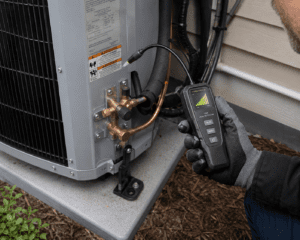
On coastal SC homes, salt-air corrosion on the disconnect terminals can cause a loose connection that reads as "off" to the unit even when the switch looks engaged. If the disconnect looks corroded, pitted, or green-tinged, note it for the tech — it's a known coastal failure mode and easy to replace during a service call.
Step 4 — The condensate float switch (the Lowcountry-specific failure)
This is the single most common "AC won't turn on" cause Coastal Carolina Comfort sees in Summerville, Charleston, and the surrounding Lowcountry. It's also the one homeowners almost never know about until a tech explains it.
The condensate drain line carries water away from the air handler's drain pan. In humid coastal air, an AC pulls a high volume of moisture out of the home. When the drain line clogs — usually with algae growth — the pan fills, and a small float switch trips to shut the system down before water spills into the house.
To check:
- Find the air handler. In Summerville and Charleston homes it's usually in the attic, garage, or a utility closet.
- Locate the white PVC drain line exiting the drain pan. The float switch is a small plastic device clipped to the line, with two thin wires running to it.
- If the float is lifted, the drain is backed up. Pour a cup of distilled white vinegar (not bleach if the line is PVC and the home has a septic system) down the drain access. Wait 15 minutes, then flush with warm water.
- Once water flows freely, the float drops, the safety switch closes, and the system can call for cool again.
A clogged drain line is a maintenance issue, not a failure. If it has happened once, it will happen again within 12 months. Coastal Carolina Comfort flushes the drain line as part of every spring tune-up for exactly this reason.
Step 5 — The air filter
A clogged air filter restricts return airflow. With reduced airflow, the evaporator coil temperature drops below freezing, ice builds up, and the system trips a safety to prevent compressor damage. The symptom looks identical to "won't turn on" — except the unit will run for a few minutes, then shut off and refuse to restart.
Pull the filter. If it looks gray or matted, replace it. If the indoor coil has visible ice, set the thermostat to Off, turn the fan to On, and wait six to twenty-four hours for the ice to thaw before retrying.
Step 6 — The capacitor (listen, don't open)
The dual run capacitor stores the electrical charge that starts the compressor and the outdoor fan motor. When a capacitor fails, two patterns are typical:
- You hear a low hum from the outdoor unit but the fan blade doesn't spin.
- The unit clicks (the contactor closing) but nothing follows — no hum, no fan, no compressor.
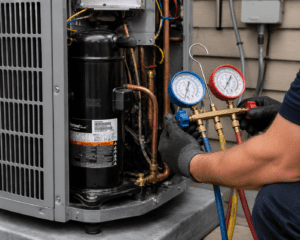
Coastal Carolina Comfort doesn't recommend a DIY capacitor replacement unless the homeowner has worked with capacitors before. They store charge after power is removed; the discharge procedure has to be done correctly or the capacitor will deliver that charge through whatever conductor closes the circuit — usually a screwdriver, sometimes a hand. The part itself is inexpensive. The labor is short. It's a fast service-call repair.
Step 7 — Stop here
Past Step 6, the diagnostic moves into the control board, the contactor coil, the compressor windings, or the refrigerant-side high-pressure switch. None of those are homeowner-serviceable. A tech with the right meter and a brand-matched parts inventory resolves them in a single visit. Without those tools, more diagnostic time at this point doesn't add information — it just delays the fix.
Should you keep going, or stop and call?
The rule is simple: if the problem is mechanical or accessible, finish the fix. If the problem is electrical or behind an access panel, stop.
- Keep going: thermostat batteries, set point, mode, breaker reset, filter replacement, float switch reset, drain line flush.
- Stop and call: breaker trips on reset, capacitor diagnosis, fan motor not spinning, hum without start, contactor not pulling in, control board fault codes, refrigerant pressure readings.
A safety note
The outdoor condenser runs on 240V power. The capacitor inside it holds an electrical charge for minutes after the breaker is off. Never open the outdoor unit's electrical access panel unless the breaker AND the disconnect are both pulled, and the capacitor has been discharged with the correct tool. Coastal Carolina Comfort gets one or two "I tried to fix it myself" calls per season that involve a shock or a small fire. The cost of a service call is lower than a hospital visit.
Past Step 6? Tell us what's happening.
Same-day routing in Summerville and Charleston when an AC won't fully start.
Call (843) 708-8735 and tell the dispatcher which steps you tested. The tech will arrive with the parts that match what you've described — usually a capacitor, a contactor, a thermostat, or a float switch — so most "won't turn on" repairs finish in one visit.
What an AC won't-start repair involves
Coastal Carolina Comfort doesn't publish flat-rate pricing because the actual repair scope depends on which component failed, which brand, and how accessible the unit is. The general scope:
Thermostat replacement or rewire
The smallest-scope fix. A smart thermostat installation may require running a C-wire if the existing wiring is 4-conductor, which adds a small amount of labor.
Float switch reset and drain line clearing
Usually a single visit. If the drain pan or pan-tablet system needs replacement, scope expands modestly. This is the repair that converts cleanly into a recurring maintenance plan, since the underlying cause — algae growth in the drain line — recurs annually.
Capacitor or contactor replacement
The part itself is one of the cheaper components in the system. Labor is the bulk of the visit cost. Brand-matched capacitors (microfarad rating and voltage) are stocked on the truck for the most common AC platforms.
Condenser fan motor
A larger repair. The motor has to match the original spec exactly — same horsepower, same rotation direction, same shaft diameter. For some brands the motor is generic; for others it's a brand-specific part with a lead time.
Control board
Brand-specific. A failed control board is most common after a lightning event or a long brownout. The board itself is the largest single-part cost in the "won't turn on" cluster.
Compressor
Rare as a "won't turn on" cause — compressor failures usually present as the system running but not cooling, not as a no-start. If the diagnosis lands on the compressor, the next conversation is repair-versus-replace based on the system's age and remaining warranty.
Why Lowcountry start-up failures happen more often
Coastal SC homes ask more of an AC than the textbook installation specs assume. Three reasons systems in Summerville, Charleston, Mount Pleasant, and the surrounding Lowcountry fail at start-up more often than inland systems:
- Salt air corrodes electrical contacts. Contactor terminals, capacitor terminals, and disconnect blades all show pitting earlier than they do inland. The mechanism is straightforward chemistry — chloride ions accelerate oxidation on copper and aluminum. East of I-26 is where Coastal Carolina Comfort sees the steepest difference.
- Humidity drives condensate volume. An AC in a humid Lowcountry summer pulls a meaningful volume of water out of the home each day. That water has to go somewhere. When the drain line clogs, the float switch trips. Coastal techs see this failure pattern across every neighborhood from Cane Bay to Daniel Island.
- Long off-seasons let components settle. A capacitor that limped through October will sometimes refuse to start in May. Off-season storage isn't a stress test, so latent failures don't surface until the system is asked to run hard again.
None of those are unique to a single home or a single brand. They're conditions of operating an AC in coastal South Carolina. Maintenance — drain line flush, contact cleaning, capacitor microfarad test, refrigerant pressure check — addresses each one before it becomes a no-start call.
Get this fixed in your area
Coastal Carolina Comfort runs same-day AC repair routes from a single Summerville dispatch across both the Summerville and Charleston markets. Pick the hub closest to you — the city pages cover service area, response-time expectations, and what to have ready when you call.
Summerville and Berkeley County
Same-day repair across Nexton, Cane Bay, Carnes Crossroads, Knightsville, Wescott Plantation, Historic Downtown, and Summers Corner.
Summerville AC repair →Charleston and the Lowcountry
Mount Pleasant, Daniel Island, James Island, West Ashley, Johns Island, North Charleston, and the surrounding Lowcountry communities.
Charleston AC repair →Related diagnostic guides
-
AC not cooling
The diagnostic walk-through when the system runs but the house won't drop temperature.
-
AC blowing warm air
What's happening when the air handler runs but the air from the vents isn't cold.
-
AC frozen evaporator coil
Why coils ice up in Lowcountry humidity and the safe order to thaw and diagnose.
Frequently asked questions
How do I know if it's the thermostat or the AC itself?
Pull the thermostat off the wall and check the screen. If it's blank with batteries installed, the thermostat is the failure. If the screen is live and the system still won't run, the thermostat is sending the call-for-cool but something downstream is not responding. Coastal Carolina Comfort techs verify this with a meter at the air handler in under a minute on a service call.
Will the AC turn on if the breaker just keeps tripping?
No. A breaker that trips immediately after reset is doing its job — it's detecting a fault downstream. Resetting it repeatedly can damage the breaker, the wiring, or the component that's faulting. Pull the breaker to off and call. Most breaker-trip causes are a failed contactor, a shorted compressor, or rodent damage to the outdoor wiring — all single-visit repairs with the right parts.
What's a condensate float switch and why does it shut my AC off?
The condensate float switch is a small safety device on the AC's drain line that detects when the drain pan is overflowing and shuts the system down before water damages the home. In humid coastal SC, the drain line clogs with algae growth more often than it does inland. Clearing the line drops the float and the AC starts again. It's a Lowcountry-specific failure mode and the most common "won't turn on" cause Coastal Carolina Comfort sees.
Can I replace a capacitor myself?
The part is inexpensive and the swap is mechanically simple — but the capacitor holds an electrical charge after power is removed, and that charge has to be discharged correctly. Coastal Carolina Comfort doesn't recommend a DIY replacement unless you've worked with capacitors before. A service-call capacitor replacement is one of the faster repairs in the won't-turn-on cluster.
Why does my AC turn on at the breaker but the outdoor fan doesn't spin?
Usually a failed capacitor or a seized fan motor. The contactor closes (you may hear a click or a low hum), but the motor doesn't get the start charge it needs from the capacitor. A tech with a multimeter and a clamp meter can isolate which one in under five minutes. Both are stocked parts on a Coastal Carolina Comfort truck.
How long does an AC won't-turn-on repair take?
Most "won't turn on" repairs finish in a single visit. Thermostat, breaker, drain-line, filter, capacitor, and contactor jobs typically wrap in under an hour on-site once the diagnosis is set. Control board, condenser fan motor, and compressor repairs depend on parts availability — brand-matched components for some platforms ship in 24 to 48 hours.
Still won't turn on after the walk-through?
Call (843) 708-8735 for same-day Summerville and Charleston service.
When the system still will not start, Coastal Carolina Comfort handles Summerville air conditioner repair and Charleston AC repair. Call (843) 708-8735 for a real person and a stocked truck.