AC Not Cooling? A Lowcountry HVAC Owner’s Diagnostic Walk-Through
If your central air is running but the house isn’t getting any cooler, the cause is almost always one of seven things. Most of them you can check in ten minutes before you call anyone. The rest tell you it’s time to stop and bring in a tech.
By Billy Webb, Owner of Coastal Carolina Comfort Updated May 2026
Need it fixed today? Call (843) 708-8735
Why a residential AC stops cooling
A central AC has one job: pull heat out of the house and dump it outside. The system depends on three pieces working together — airflow through the equipment, electrical components turning the compressor on, and refrigerant circulating in a sealed loop. If any one breaks, the unit keeps running while the house keeps warming. According to Carrier’s residential troubleshooting guide, the most common causes — in the order a homeowner should check — are thermostat settings, a clogged air filter, a tripped breaker, a blocked outdoor condenser, ice on the indoor coils, a failed capacitor, and a refrigerant leak. The first four are homeowner-fixable. The last three need a tech.
In the Lowcountry, the order shifts. Coastal humidity and salt air compress equipment service life, which moves “ice on the coils” and “outdoor unit corrosion” higher up the priority list than they would be inland.
The diagnostic walk-through
Start with the cheap checks. Each step takes a few minutes. If the system starts cooling at any point, you’re done. If you reach Step 6 and the house is still warm, stop and call a tech. Past that point, continuing to run the system can do real damage.
Check the thermostat
Confirm the system is set to COOL, not FAN or HEAT. Set the target 3 to 5 degrees below current room temperature. AUTO runs the blower only while the system is cooling; ON runs it at all times, which can make the air feel warmer because it keeps moving regardless of whether refrigerant is doing its job.
Watch for: a thermostat that’s blank, dim, or shows a low-battery icon. Replace the batteries before assuming a system problem.
Replace or clean the air filter
A clogged filter is the single most common cause of an AC that runs without cooling. Industry guidance is to replace every 1 to 3 months during heavy-use seasons. In Lowcountry homes with pollen season and pet hair, lean toward the shorter end. A blocked filter chokes return airflow, the indoor coil can’t release heat into circulating air, and within a few hours that coil starts to ice up.
Watch for: a filter that’s gray rather than white, or fuzzy with debris. If you can’t see light through it, it’s done.
Check the breaker on the outdoor unit
Most homes have a dedicated double-pole breaker for the outdoor condenser. After a thunderstorm — which the Lowcountry gets every week through summer — that breaker can trip. Open the main panel and look for an AC breaker centered between ON and OFF. Push it all the way to OFF, then back to ON. Wait five minutes for the system to cycle.
Watch for: a breaker that trips again within minutes of resetting. That’s an electrical fault. Stop, call a tech, and don’t keep cycling it.
Clear the outdoor condenser
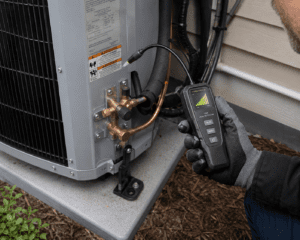
Walk to the outdoor unit. The condenser fan should be turning and the air off the top should feel hot — that’s heat being pulled from inside the house. Clear leaves, pollen mats, and grass clippings from the fins. Trim back any vegetation within two feet of the unit. If the fins look matted with debris, a gentle rinse from the outside-in with a garden hose helps; high-pressure water bends the fins and makes the problem worse.
Watch for (Lowcountry-specific): heavy white corrosion on the coil fins, especially on systems east of I-26. Carrier’s Environmental Corrosion Protection guide documents 5 to 8 year coastal coil service life versus 12 to 15 year inland. Coil corrosion isn’t something you clean off; it’s a sign the coil is on borrowed time.
Check the indoor coil for ice
If steps 1–4 didn’t restore cooling, look at the indoor air handler — in a closet, attic, or garage on most homes. Open the access panel and inspect the evaporator coil. If you see ice or frost, the system needs to thaw before it can do anything else. Switch the system OFF at the thermostat. Set the fan to ON to circulate room-temperature air across the coil and speed the thaw. A full thaw can take 1 to 4 hours.
Watch for: ice that returns within a day of thawing. That points to a refrigerant problem or a persistent airflow restriction. At that point the diagnosis crosses into pro territory.
Listen to what the outdoor unit is doing
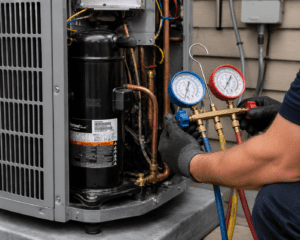
With the system calling for cooling, stand near the outdoor unit. The fan should turn and the compressor should hum at a steady pitch. If the fan turns but the compressor is silent — or you hear a buzz or hum without the fan moving — the most common culprit is a failed start or run capacitor. Capacitors fail at high rates in coastal climates because heat and humidity stress the dielectric. They cost a fraction of a compressor to replace, but the work involves stored electrical energy and refrigerant-system access. Homeowner work stops here.
Watch for: a clicking sound from the disconnect, a unit that hums but doesn’t turn, or an outdoor fan that lags or stalls. All point to capacitor or contactor failure.
If none of the above worked: refrigerant or compressor
If the thermostat is set right, the filter is clean, the breaker holds, the outdoor unit is clear and turning, the indoor coil isn’t iced, and the compressor sounds normal — but the air from the supply vents still isn’t cold — the most common causes are low refrigerant or a compressor problem. Both are sealed-system work. Per EPA Section 608, only certified technicians may handle refrigerant. This is the stop point. Past Step 6, the next move is a phone call to (843) 708-8735.
Should you keep going, or stop and call?
The line between homeowner-fixable and pro-only sits in two places: federal rules govern refrigerant handling, and several components in an AC system store enough electrical energy to be dangerous. Capacitors hold a charge after power is cut. Compressors cost more than the rest of the system combined.
Keep going if
- You’ve completed Steps 1–4 only and haven’t reached the indoor air handler yet
- The thermostat shows a low battery (a five-dollar fix on most models)
- The filter is gray with debris and you have a replacement on hand
- The outdoor unit is choked with leaves or pollen you can clear from the outside
- The breaker tripped once and stayed reset for 24 hours
Stop and call when
- The breaker trips again within minutes of resetting (electrical fault)
- The indoor coil keeps icing back over within a day of thawing
- The outdoor unit hums but doesn’t turn (capacitor or contactor failure)
- You see refrigerant oil staining around the outdoor unit (a leak indicator)
- The system has been running but not cooling for 24+ hours; continuing to run a struggling system can damage the compressor
- Anyone in the home is elderly, pregnant, or has a respiratory condition and the indoor temperature has climbed above 80°F
A safety note
If you’re not sure what’s wrong and the system has been running for hours without cooling, switch it OFF at the thermostat. Industry guidance is to leave a non-cooling system off until the cause is diagnosed. A system that’s off costs nothing to leave off. A compressor that fails because it ran for 18 hours under stress is a much larger repair than the original problem.
Past Step 6? Tell us what’s happening.
A Coastal Carolina Comfort tech will read the symptoms, tell you what they point to, and confirm how soon a technician can be on site. Or call (843) 708-8735 for priority routing on emergency service calls.
What an AC repair costs
Cost depends on what failed, how old the system is, and whether the parts are still in production. Coastal Carolina Comfort gives you a written estimate before any repair work starts. The 2026 industry ranges below come from Angi’s HVAC repair cost guide and HomeGuide’s AC repair cost data; final pricing on your invoice depends on your specific system and current parts pricing.
Thermostat replacement or reconfigure
$150–$400
The cheapest fix on the diagnostic ladder. Often a battery swap or a configuration error caught during the visit.
Capacitor replacement
$150–$400
The most common single repair on residential AC. The part is inexpensive; most of the cost is labor on the disconnect.
Frozen-coil thaw + airflow correction
$150–$600
Diagnostic plus addressing the underlying restriction. Often a filter, return-duct, or blower issue.
Condenser-coil cleaning
$100–$300
Routine maintenance pricing. More involved if salt corrosion has set in on a coastal system.
Refrigerant leak repair
$250–$1,500
Cost varies by leak location. A loose schrader valve is cheap; a coil leak is the high end of the range.
Compressor replacement
$1,500–$3,500
The largest single component cost. On systems past 10–12 years, replacing the full outdoor unit often makes more sense.
There’s a common rule of thumb in the HVAC industry — sometimes called the $5,000 rule — that helps frame the repair-vs-replace decision: multiply the age of the system by the estimated repair cost. If the result is more than $5,000, replacement tends to make more long-term sense. According to Trane’s residential blog, the rule is most useful for systems between 8 and 12 years old. A full repair-vs-replace decision framework and South Carolina-specific cost ranges dig deeper.
Why Lowcountry HVAC failures don’t follow the textbook
Most national HVAC content addresses inland climates. The Lowcountry isn’t an inland climate. Three factors change the diagnostic order on coastal systems.
Salt air east of I-26. Aluminum condenser coils corrode faster within a few miles of the marsh than they do further inland. Carrier’s Environmental Corrosion Protection literature documents 5 to 8 year coastal coil service life versus 12 to 15 year inland service life on equivalent equipment.
Humidity that runs 90%+ from June through September. The evaporator coil works harder removing moisture from the air than it does in drier climates. That extra load means restricted airflow ices the indoor coil faster. Step 5 in the flowchart above moves up the priority list during peak summer.
Older Charleston-area housing stock. Pre-2000 homes in Historic Summerville, Hanahan, and the peninsula often had central air retrofitted in rather than designed from scratch. Undersized return ducts and long line sets show up as low cooling capacity even when the system itself is working as designed. Other early-warning signs are worth catching before they tip into a no-cool call.
Coastal Carolina Comfort is a licensed South Carolina mechanical contractor based in Summerville, serving the Charleston, Summerville, Columbia, and Lowcountry coastal market.
1947
Coastal Carolina Comfort heritage backing every service call
NATE
Industry-standard HVAC technician certification
M111694
SC mechanical contractor license
Happy clients across the Lowcountry
Reviews from recent service calls. Names, dates, and quotes pulled verbatim from our Google Business Profile.
marshall was a great ac repairman, he came out, diagnosed the problem, and fixed it. tony was also a awesome sales rep for the company
Colby Tindall · April 2026 · Google review
Derrick and team were fantastic. Replaced a 4 ton unit with Daikin inverter. Very professional
Matthew Dennis · February 2026 · Google review
This was my third time using CCC, and they continue to impress. Derrick handled a follow-up issue after our initial service and identified a hidden programming flaw in our Ecobee thermostat that was causing the system to shut down during the January 2026 freeze. I’m incredibly grateful for their expertise and highly recommend this team.
Robert McMillan · February 2026 · Google review
Get this fixed in your area
Priority service across the Lowcountry
Coastal Carolina Comfort serves the Charleston, Summerville, and Columbia metros with priority routing on emergency service calls. Call (843) 708-8735 or pick the hub closest to you.
Summerville & surrounding
AC Repair in Summerville, SC →
Cane Bay · Nexton · Carnes Crossroads · Knightsville
Charleston metro
AC Repair in Charleston, SC →
Mount Pleasant · Daniel Island · West Ashley · James Island
Columbia metro
AC Repair in Columbia, SC →
Forest Acres · Irmo · Lexington · Northeast Columbia
Related diagnostic guides
If this article doesn’t match what you’re seeing, one of the related diagnostic walk-throughs may be a closer fit.
Symptom guide
AC blowing warm air: a diagnosis guide
Symptom guide
AC frozen or iced over: causes and fixes
Symptom guide
AC won’t turn on: diagnostic flowchart
Frequently asked questions
Why is my AC running but not cooling enough?
A unit that runs without cooling is almost always one of seven things: thermostat misconfiguration, a clogged air filter, a tripped breaker, a blocked outdoor condenser, ice on the indoor coil, a failed capacitor, or a refrigerant leak. The first four are homeowner-fixable. The other three need a technician. Walk the diagnostic flowchart on the page before calling. Most homeowners find the cause within Step 4.
Should I turn the AC off if it’s not cooling?
Yes. A system that runs for hours without cooling can ice the indoor coil, overheat the compressor, or burn out a struggling motor. Industry guidance is to switch the system off at the thermostat once you’ve identified that it’s running but not cooling, and leave it off until the cause is diagnosed. Continuing to run a failing system can turn a small capacitor repair into a much larger compressor replacement.
Why does AC equipment fail faster in coastal South Carolina?
Two reasons. First, salt air carries chloride ions that corrode aluminum condenser coil fins. Carrier’s corrosion-protection literature documents 5 to 8 year coastal coil service life versus 12 to 15 year inland on equivalent equipment. Second, summer humidity at 90%+ runs the evaporator coil under heavier dehumidification load than systems in drier markets. Both compress the realistic service life of HVAC equipment.
What is the $5,000 rule for AC repair?
The $5,000 rule is an industry rule of thumb. Multiply the age of the AC system by the estimated repair cost. If the product is more than $5,000, replacement tends to make more long-term sense than the repair. According to Trane’s residential blog, the rule is most useful for systems between 8 and 12 years old where the repair cost approaches a meaningful fraction of replacement.
How fast can Coastal Carolina Comfort get to a no-cool call?
Coastal Carolina Comfort prioritizes emergency service calls in the Charleston, Summerville, and Columbia metros during peak season. Specific response times depend on call volume and your location. Households with elderly residents, infants, or someone with a respiratory condition get priority routing. The dispatch line at (843) 708-8735 is answered by Coastal Carolina Comfort staff in Summerville, not a national call center.
Is my AC repair covered under warranty?
It depends on the system age, the original installer, and what failed. Most residential AC systems carry a 10-year parts warranty if the homeowner registered the unit with the manufacturer at install. Compressor warranties vary by brand. Labor warranties depend on whether the original installer offered one. Bring the system model number and install paperwork to the diagnostic visit; Coastal Carolina Comfort checks warranty status before quoting the repair.