 How Long Do Heating Systems Last? A Lifespan Guide for Summerville Homeowners
Gas furnaces typically last 15–20 years, heat pumps last 10–15 years, and electric furnaces can last 20–30 years with proper maintenance. However, Lowcountry conditions—salt air, high humidity, and long cooling seasons—can shorten these lifespans by several years if equipment isn’t properly maintained. The key factors affecting longevity include installation quality, maintenance frequency, system sizing, and environmental exposure. Knowing your system’s age and condition helps you plan for replacement before emergency failure, budget appropriately, and make informed decisions about whether to repair or replace when problems arise. For heating repair decisions, understanding expected lifespan is essential context.
Why Lifespan Matters for Homeowners
Your heating system won’t last forever. Understanding its expected lifespan helps you:
- Plan financially: Replacement costs $5,000–$15,000. Knowing when to expect this expense prevents budget surprises.
- Make repair decisions: A $500 repair makes sense on a 10-year-old system. On a 20-year-old system? Maybe not.
- Avoid emergency replacement: Systems that fail in January leave you scrambling. Planning ahead means choosing equipment on your timeline, not under pressure.
- Maximize efficiency: Older systems cost more to operate. Knowing when efficiency losses justify replacement saves money long-term.
The question isn’t just “how long will my system last?” but “how long should I keep it?”
Average Lifespan by System Type
Different heating systems have different life expectancies:
Gas Furnaces: 15–20 Years
Gas furnaces are workhorses. With proper maintenance, many exceed 20 years of service. The limiting factors are usually:
- Heat exchanger: This critical component can crack with age, creating carbon monoxide risks. Replacement often costs more than a new furnace.
- Electronic controls: Circuit boards and ignition systems fail over time.
- Efficiency degradation: Older furnaces lose efficiency as components wear.
What determines where in the range your furnace falls:
| Factor | Shorter Lifespan (15 years) | Longer Lifespan (20+ years) |
|---|---|---|
| Maintenance | Irregular or skipped | Annual professional service |
| Filter changes | Infrequent | Monthly checks, regular replacement |
| Sizing | Oversized (short cycling) | Properly sized for home |
| Installation | Budget installation | Quality installation with proper airflow |
| Usage | Heavy use, extreme temperatures | Moderate use, mild climate |
Heat Pumps: 10–15 Years
Heat pumps have shorter lifespans than furnaces because they work year-round—heating in winter and cooling in summer. That’s twice the operational hours of a furnace.
Components that typically limit heat pump life:
- Compressor: The heart of the system. Compressor failure often means replacement time.
- Outdoor coil: Exposed to weather, debris, and in coastal areas, salt air.
- Reversing valve: Switches between heating and cooling modes. Failure affects system function.
- Refrigerant system: Leaks develop over time, and older refrigerants become unavailable.
Lowcountry-specific factors affecting heat pump lifespan:
Our climate is simultaneously ideal for heat pump operation and hard on heat pump equipment:
- Long cooling seasons: Heat pumps run 6–7 months for cooling alone, accumulating wear.
- High humidity: Moisture accelerates electrical component degradation.
- Salt air: Coastal and near-coastal areas experience accelerated corrosion.
- Mild winters: Less heating stress, but year-round operation means no “off season” for recovery.
Electric Furnaces: 20–30 Years
Electric furnaces have the longest potential lifespan because they’re mechanically simple:
- No combustion (no heat exchanger to crack)
- No gas valves or ignition systems
- Fewer moving parts than heat pumps
- Heating elements are relatively inexpensive to replace
The catch: Electric furnaces are expensive to operate. Many homeowners replace them with heat pumps before they fail, simply to reduce energy costs.
Dual Fuel Systems: Mixed Lifespan
Dual fuel systems combine a heat pump with a gas furnace. Each component ages according to its type:
- Heat pump portion: 10–15 years
- Furnace portion: 15–20 years
When the heat pump fails, you can often replace just that component while keeping the furnace. This extends the overall system investment.
How Lowcountry Conditions Affect Equipment Longevity
Summerville’s climate creates specific challenges for HVAC equipment:
Salt Air Corrosion
Even 20+ miles from the coast, salt particles in the air accelerate metal corrosion. Effects include:
- Outdoor unit degradation: Coils, fan blades, and cabinet panels corrode faster
- Electrical connection corrosion: Creates resistance, heat, and eventual failure
- Refrigerant line deterioration: Copper lines develop pinhole leaks
Mitigation: Coastal-rated equipment with corrosion-resistant coatings lasts longer. Regular cleaning removes salt deposits before they cause damage.
High Humidity
Our 70–90% average humidity affects equipment in several ways:
- Electrical component stress: Moisture accelerates circuit board and relay degradation
- Condensation issues: Improper drainage leads to water damage and biological growth
- Ductwork concerns: Humidity can affect duct integrity and insulation
Mitigation: Proper system sizing ensures adequate dehumidification. Regular maintenance catches moisture-related issues early.
Extended Cooling Seasons
Summerville’s cooling season runs April through October—sometimes longer. This means:
- More compressor cycles: Heat pump compressors accumulate wear faster than in northern climates
- Longer annual runtime: More total operating hours per year
- Less recovery time: Systems run nearly year-round with minimal downtime
Mitigation: Twice-yearly maintenance (spring and fall) addresses wear from both seasons.
Mild Winters (The Good News)
Our relatively mild winters are easier on heating equipment:
- Less extreme temperature stress: Systems rarely operate at maximum capacity
- Fewer freeze/thaw cycles: Less thermal expansion stress on components
- Heat pumps stay efficient: Temperatures rarely drop below heat pump effective range
This partially offsets the challenges of our long cooling seasons.
Signs Your System Is Nearing End of Life
Age alone doesn’t determine when to replace. Watch for these warning signs:
Increasing Repair Frequency
The pattern to watch:
- Year 1–10: Occasional minor repairs (normal)
- Year 10–15: Repairs becoming more frequent
- Year 15+: Multiple repairs per year, major component failures
The rule of thumb: If you’re calling for repairs more than twice per heating season, your system is telling you something.
Rising Energy Bills
Older systems lose efficiency as components wear:
- Dirty or degraded heat exchangers transfer heat less effectively
- Worn blower motors work harder to move air
- Refrigerant leaks reduce heat pump capacity
- Duct leaks worsen as connections age
How to spot the trend: Compare your heating costs year-over-year, adjusting for weather differences. A 15–20% increase without explanation suggests efficiency loss.
Uneven Heating
If some rooms are comfortable while others are too cold or too hot:
- Blower motor may be weakening
- Ductwork may have developed leaks or disconnections
- System may no longer be sized appropriately (after home additions or insulation changes)
While ductwork issues can be addressed separately, uneven heating from an aging system often indicates declining performance.
Strange Noises
New or worsening sounds indicate component wear:
| Sound | Likely Cause | Concern Level |
|---|---|---|
| Rattling | Loose components, failing motor bearings | Medium |
| Squealing | Belt issues, motor bearings | Medium |
| Banging | Delayed ignition, loose ductwork | High |
| Grinding | Motor failure imminent | High |
| Clicking (constant) | Electrical issues, relay problems | Medium |
Noises that develop gradually over time suggest wear. Sudden new noises warrant prompt attention.
Visible Deterioration
Physical signs of aging include:
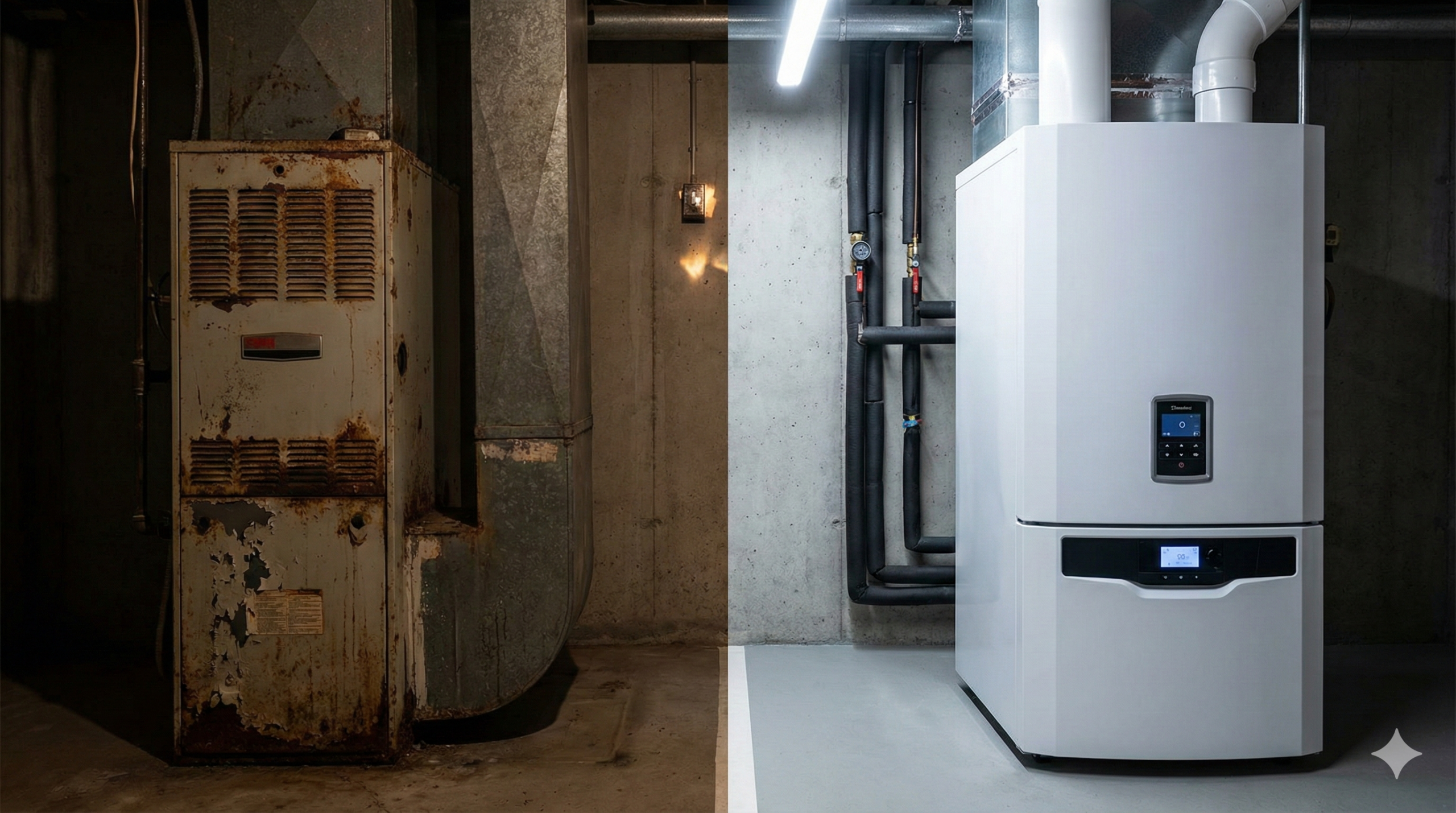
- Rust or corrosion: On cabinet, heat exchanger, or connections
- Cracks: In heat exchanger (serious safety concern), housing, or ductwork connections
- Soot or discoloration: Around furnace burners or vents (indicates combustion problems)
- Moisture or water damage: Around unit or in drain pan
Comfort Decline
If your system struggles to maintain set temperatures:
- Takes longer to reach desired temperature
- Can’t keep up during moderate weather (not just extreme cold)
- Runs constantly without satisfying thermostat
- Produces noticeably less airflow than before
These symptoms indicate the system is losing capacity—often a sign that major components are failing.
Obsolete Refrigerant (Heat Pumps)
Heat pumps manufactured before 2010 likely use R-22 refrigerant, which is:
- No longer manufactured (phased out for environmental reasons)
- Extremely expensive when available ($100+ per pound)
- Increasingly difficult to source
If your heat pump uses R-22 and develops a leak, repair costs may exceed replacement costs. Systems using R-410A (current standard) don’t face this issue.
Factors That Extend System Lifespan
You can influence how long your system lasts:
Professional Annual Maintenance
This is the single most important factor in system longevity. Annual maintenance:
- Catches small problems before they become big failures
- Keeps components clean and operating efficiently
- Verifies safety controls function properly
- Maintains manufacturer warranty coverage
The data: Studies consistently show maintained systems last 40–50% longer than neglected ones. A $150–200 annual maintenance visit can add years to your system’s life.
Regular Filter Changes
Clogged filters cause:
- Restricted airflow (system works harder)
- Overheating (triggers safety shutdowns, stresses components)
- Dirt bypass (contaminants reach internal components)
- Frozen coils (heat pumps)
The habit: Check filters monthly. Replace when dirty—typically every 1–3 months depending on filter type, pets, and household dust levels.
Proper System Sizing
Oversized systems short-cycle (turn on and off frequently), causing:
- Excessive wear on motors and compressors
- Inconsistent temperatures
- Poor humidity control
- Shortened lifespan
Undersized systems run constantly, also accelerating wear.
The lesson: When replacing equipment, insist on proper load calculations—not just matching the old system’s size.
Quality Installation
Installation quality affects every day of your system’s life:
- Proper refrigerant charge (heat pumps)
- Correct airflow across coils
- Appropriate duct sizing and sealing
- Level installation (affects drainage and compressor life)
- Proper electrical connections
A system installed correctly starts its life in optimal condition. Poor installation creates problems from day one.
Protecting Outdoor Equipment
For heat pumps and AC condensers:
- Maintain 2+ feet clearance around the unit
- Keep vegetation trimmed away
- Remove leaves and debris regularly
- Consider a cover during extended non-use (but never run a covered unit)
- Rinse coils periodically to remove dirt and salt deposits
Addressing Repairs Promptly
Small problems become big problems:
- A failing capacitor stresses the compressor
- A dirty flame sensor causes repeated ignition attempts
- Low refrigerant makes the compressor work harder
- A worn belt damages the blower motor
Prompt heating repair prevents cascade failures that shorten system life.
Factors That Shorten System Lifespan
Avoid these lifespan killers:
Skipping Maintenance
Neglected systems fail earlier. Period. The money “saved” by skipping maintenance is lost many times over in:
- More frequent repairs
- Higher energy bills
- Earlier replacement
- Emergency service premiums
Ignoring Warning Signs
That strange noise or slight performance decline? It’s not going away on its own. Ignored symptoms become expensive failures.
Improper Thermostat Use
Extreme temperature setbacks stress equipment:
- Dramatic setbacks force systems to run at maximum capacity for extended periods
- Heat pumps trigger expensive auxiliary heat trying to recover from deep setbacks
- Constant on/off cycling from narrow temperature bands wears components
Better approach: Moderate, consistent temperatures with gradual setbacks (2–3 degrees for heat pumps, 5–8 degrees for furnaces).
Closing Too Many Vents
Closing vents in unused rooms seems logical but creates problems:
- Increases static pressure in ductwork
- Forces system to work against resistance
- Can cause overheating and safety shutdowns
- Stresses blower motors
Keep at least 80% of vents open for proper airflow.
DIY Repairs Gone Wrong
Some maintenance is DIY-appropriate (filter changes, clearing debris). But amateur repairs can:
- Void warranties
- Create safety hazards
- Cause additional damage
- Miss underlying problems
When in doubt, call a professional.
The Repair vs. Replace Decision
When your aging system needs repair, how do you decide whether to fix it or replace it?
The 50% Rule
If repair costs exceed 50% of replacement cost, replace the system.
Example:
- New system cost: $8,000
- 50% threshold: $4,000
- Repair estimate: $3,500
In this case, the repair is below threshold—but barely. Consider the system’s age and overall condition before deciding.
The Age Factor
Adjust your threshold based on system age:
| System Age | Repair Threshold |
|---|---|
| Under 10 years | Repair unless major component failure |
| 10–15 years | Repair if cost is under 50% of replacement |
| 15–20 years | Repair only if cost is under 30% of replacement |
| Over 20 years | Strongly consider replacement for any significant repair |
The Efficiency Calculation
Older systems are less efficient. Calculate potential savings:
Example:
- Current system: 80% AFUE furnace, $1,200 annual heating cost
- New system: 95% AFUE furnace, estimated $1,000 annual heating cost
- Annual savings: $200
- New system cost: $6,000
- Simple payback: 30 years
In this case, efficiency alone doesn’t justify replacement. But add in:
- Reduced repair costs
- Improved reliability
- Better comfort
- Warranty coverage
The calculation becomes more favorable.
The Comfort Factor
Sometimes the decision isn’t purely financial:
- Are you comfortable in your home?
- Does the system maintain consistent temperatures?
- Is it quiet enough?
- Do you trust it to work when you need it?
Peace of mind has value. If your aging system causes stress every time temperatures drop, replacement may be worthwhile regardless of repair costs.
Planning for Replacement
Smart homeowners plan for replacement before emergency failure:
Know Your System’s Age
Find the manufacture date:
- Check the rating plate on your equipment
- Look up the serial number on the manufacturer’s website
- Ask during your next maintenance visit
Start Budgeting Early
When your system reaches 10 years old, start setting aside funds for replacement. Even $50–100 monthly builds a meaningful replacement fund over 5 years.
Research Options Before You Need Them
Learn about:
- Current equipment options and efficiency ratings
- Approximate costs for your home size
- Available rebates and tax credits
- Financing options if needed
Making these decisions under pressure (when your system fails in January) leads to rushed choices.
Schedule Replacement Strategically
The best time to replace:
- Spring or fall: HVAC companies are less busy, potentially offering better pricing
- Before failure: You choose the timeline, not the weather
- When rebates are available: Utility and manufacturer incentives vary seasonally
How Coastal Carolina Comfort Can Help
Whether you’re maintaining an aging system, deciding between repair and replacement, or planning for the future, we’re here to help:
For aging systems:
- Honest assessment of remaining lifespan
- Maintenance to maximize remaining years
- Prompt heating repair when issues arise
- Clear recommendations without pressure
For replacement planning:
- Load calculations for proper sizing
- Equipment options at various price points
- Efficiency comparisons for your situation
- Rebate and incentive guidance
Our commitment: We’ve served Summerville families since 2005. We’ll tell you honestly whether your system has years left or whether you’re better off replacing it. Our goal is your long-term comfort and value—not a quick sale.
Contact us for an honest assessment of your heating system’s condition and remaining lifespan.
Frequently Asked Questions
How do I find out how old my heating system is? Check the rating plate on your furnace or heat pump—it lists the manufacture date or a serial number that encodes the date. Many manufacturers use the first four digits of the serial number to indicate week and year of manufacture (e.g., 0519 = week 5 of 2019). Your HVAC technician can also determine age during a service visit.
Should I replace my system before it fails completely? Ideally, yes. Proactive replacement lets you choose equipment carefully, schedule installation conveniently, and potentially get better pricing during off-peak seasons. Emergency replacement means rushed decisions, premium pricing, and possibly settling for whatever’s available immediately.
Does a new system really save that much on energy bills? It depends on your current system’s efficiency and condition. Replacing a 15-year-old, 80% AFUE furnace with a 95% AFUE model can reduce heating costs by 15–20%. Replacing a worn heat pump with a new high-efficiency model can save even more. The older and less efficient your current system, the greater the potential savings.
Can I just replace the outdoor unit of my heat pump? Technically possible, but usually not recommended. Mismatched indoor and outdoor components reduce efficiency, may void warranties, and can cause operational problems. When the outdoor unit fails, replacing the complete system ensures proper matching and maximum efficiency.
What’s the most cost-effective way to extend my system’s life? Annual professional maintenance combined with regular filter changes. These two practices—costing perhaps $200–300 per year total—can add 5+ years to your system’s lifespan and reduce repair costs throughout its life. It’s the highest-return investment you can make in your HVAC system.