

AC Keeps Turning On and Off: Short Cycling Causes and Fixes in South Carolina
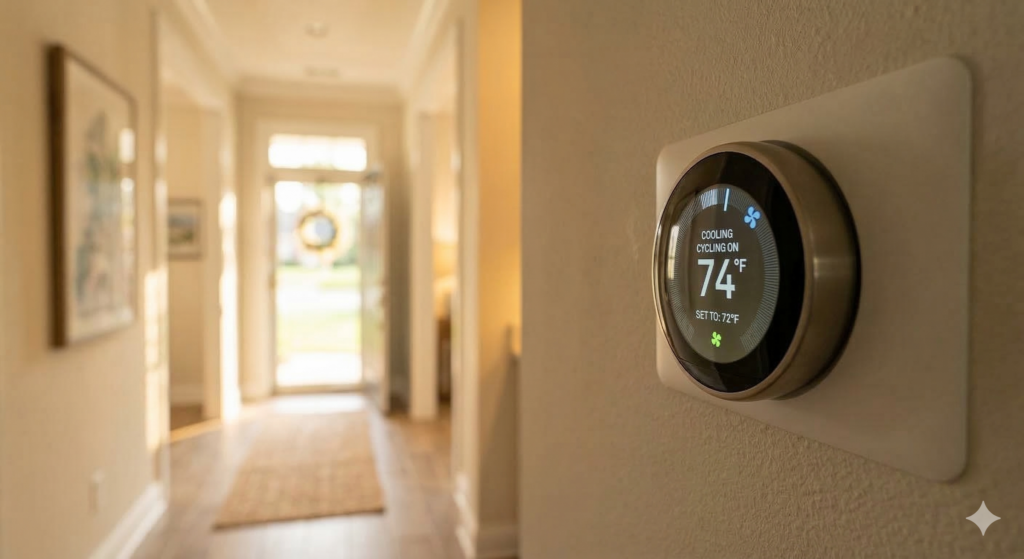
AC Keeps Turning On and Off: Short Cycling Causes and Fixes in South Carolina Short cycling is when your air conditioning system turns on, runs for only a few minutes (typically 2–8 minutes instead of the normal 10–20 minute cycle), shuts off, and then starts again shortly after. This pattern repeats continuously without the system ever completing a full cooling cycle. The most common causes are an oversized AC system, a failing compressor or capacitor, a refrigerant leak that’s triggering low-pressure safety shutoffs, or a thermostat malfunction. Short cycling isn’t just an annoyance — it’s one of the most damaging conditions for your air conditioning system. Coastal Carolina Comfort diagnoses short cycling across Summerville, Charleston, Columbia, and every community we serve in the South Carolina Lowcountry and Midlands. Call (843) 708-8735 for a same-day diagnostic. Why Short Cycling Damages Your AC System Every time your compressor starts, it draws significantly more electrical current than during steady operation — typically 4–8 times its running amperage. In a normal cycle, this startup surge happens a few times per hour. In a short-cycling system, the compressor may start and stop 10–15 times per hour, each time drawing that heavy startup current. This repeated electrical stress overheats the compressor windings, weakens the capacitor faster, increases wear on the contactor, and spikes your energy bills — all while failing to actually cool your home because the system never runs long enough to complete a full cooling cycle. In South Carolina’s climate, where the cooling season runs from April through October, short cycling compounds damage faster than in regions with shorter summers. Six months of short cycling can take years off a compressor’s life. The 7 Most Common Causes of AC Short Cycling 1. Oversized AC System This is the most common cause of chronic short cycling — and the hardest to fix because it’s a design problem, not a component failure. An oversized AC system cools the air near the thermostat quickly but shuts off before it has time to properly cool the rest of the home or adequately remove humidity. Minutes later, the temperature near the thermostat rises again, the system kicks back on, cools briefly, shuts off — and the cycle repeats. In South Carolina, oversized systems create a particularly unpleasant result: the home may reach the set temperature on the thermostat but feel clammy and uncomfortable because the short run times don’t allow the evaporator coil to remove enough moisture from the air. A house at 72°F with 65% indoor humidity feels warmer and stickier than a house at 74°F with 50% humidity. Oversized systems are distressingly common in South Carolina new construction — particularly in Summerville’s Nexton and Cane Bay communities, Lexington’s newer subdivisions, and Daniel Island and Mount Pleasant developments — where builder-grade installations may prioritize cost or use rule-of-thumb sizing rather than Manual J load calculations. The fix for an oversized system is either replacement with a correctly sized unit or, in some cases, installation of a variable-speed system that can modulate its output to match the actual load. 2. Failing or Failed Capacitor A weakening run capacitor can’t deliver sufficient electrical energy to keep the compressor running through a full cycle. The compressor starts, draws heavily on the failing capacitor, and the capacitor’s voltage drops below the threshold — causing the compressor to shut down on an overcurrent safety. The capacitor partially recovers during the off-cycle, the system tries again, and the pattern repeats. This is one of the most common and most affordable AC repairs — typically $150–$300. It’s also one of the easiest to prevent through regular AC maintenance, which includes testing capacitor health before the component fails. 3. Low Refrigerant Triggering Safety Shutoffs When refrigerant levels drop below a certain threshold, the system’s low-pressure safety switch activates and shuts down the compressor to prevent damage. As the system sits idle, pressures equalize enough for the safety switch to reset. The system starts again, runs until pressures drop, and shuts off again — creating a short cycling pattern. Low refrigerant always means a leak. Simply adding refrigerant without repairing the leak creates a recurring problem that worsens as the leak grows. In South Carolina’s humid environment, running a low-charge system also risks freezing the evaporator coil — adding another layer of problems. 4. Frozen Evaporator Coil Ice buildup on the evaporator coil restricts airflow and disrupts the heat exchange process. As ice accumulates, the system’s safety mechanisms may shut it down. The system restarts after partial thawing, runs until ice rebuilds, and shuts down again. In South Carolina’s humidity, a frozen coil is especially problematic because the melting ice produces heavy condensation that can overwhelm the drain pan and flood floors. If you see ice on the indoor unit and your system is short cycling, turn the system off for 2–3 hours to allow complete thawing before calling for diagnosis. 5. Thermostat Malfunction A thermostat with a faulty temperature sensor, dead battery in a wireless sensor, or improper placement can send erratic signals to the system. If the thermostat oscillates between readings — sensing 73°F one minute and 76°F the next — the system responds by cycling on and off in rapid succession. Smart thermostats with multiple sensors, learning algorithms, and Wi-Fi connectivity have more potential failure points than simple programmable models. If short cycling started after a thermostat change or firmware update, the thermostat itself is the likely culprit. 6. Dirty or Blocked Condenser Coil When the outdoor condenser coil can’t release heat effectively — due to dirt buildup, pollen coating, or vegetation growing too close — the system’s high-pressure safety switch can activate and shut down the compressor. After the system cools down briefly, it restarts and the cycle continues. Keeping vegetation cleared 2 feet from the outdoor unit and scheduling annual coil cleaning prevents this cause entirely. 7. Compressor Overheating A compressor that’s failing internally — due to worn bearings, valve leaks, or electrical winding degradation — generates excessive heat during operation.