
The Lowcountry Climate and Your AC: What South Carolina Humidity Does to Your Cooling System
The South Carolina Lowcountry has one of the most demanding climates for residential air conditioning systems in the entire United States. The combination of sustained high temperatures, extreme relative humidity that routinely exceeds 80% to 90%, salt-laden coastal air, and a cooling season that stretches from April through October creates operating conditions that accelerate component wear, promote biological growth inside HVAC systems, and shorten equipment lifespans compared to most other U.S. markets. At Coastal Carolina Comfort, we service AC systems across Summerville, Charleston, and the surrounding communities every day, and we see firsthand how our climate affects the equipment that keeps Lowcountry families comfortable. Understanding these climate-specific challenges helps homeowners make smarter decisions about maintenance, repairs, and system selection.
The Humidity Problem: It’s Not Just About Temperature
Most people focus on temperature when they think about AC performance, but in the Lowcountry, humidity is the more significant factor. Air conditioning systems do two jobs simultaneously: they cool the air (sensible cooling) and they remove moisture from the air (latent cooling, also called dehumidification). In a dry climate, the cooling load dominates. In the Lowcountry, the dehumidification load is enormous — and it affects your system in ways that go beyond comfort.
What Extreme Humidity Does to Your System
When outdoor relative humidity sits above 80% — which is the norm in the Lowcountry from May through September — your AC system has to work significantly harder to remove moisture from indoor air. This additional workload manifests in several ways.
Extended runtime. Your system runs longer per cycle to bring indoor humidity to a comfortable level (ideally 45-55% relative humidity). Longer runtime means more operating hours, more wear on the compressor, blower motor, and other mechanical components, and higher electricity consumption.
Condensate overload. Your system may pull several gallons of water per day from the air during peak humidity. All that water has to exit through the condensate drain system. The volume alone puts stress on drain lines, drain pans, and condensate pumps — and creates ideal conditions for algae and biofilm growth that causes drain clogs. This is why condensate drain issues are among the most common AC repair calls we handle in the Lowcountry.
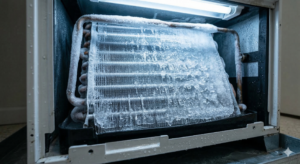
Evaporator coil moisture. The evaporator coil operates in a perpetually wet environment during the cooling season, which promotes mold and biofilm growth on the coil surface. This biological buildup restricts airflow, reduces heat transfer efficiency, degrades indoor air quality, and can eventually lead to coil corrosion and refrigerant leaks.
Indoor air quality impacts. When your AC system can’t adequately dehumidify, indoor humidity rises above comfortable levels. Sustained indoor humidity above 60% creates conditions for mold growth on walls, ceilings, and in hidden spaces — and it makes your home feel uncomfortable even when the temperature reads correctly on the thermostat.
The Oversized AC Problem
Ironically, one of the most common HVAC mistakes in the Lowcountry is installing an oversized AC system — one that’s too powerful for the home’s actual cooling load. An oversized system cools the air quickly but doesn’t run long enough per cycle to adequately dehumidify. It short cycles — turning on and off frequently — which fails to remove enough moisture and puts extra stress on the compressor.
Proper system sizing in the Lowcountry requires a Manual J load calculation that accounts for our region’s extreme humidity levels, not just the square footage of the home. If your home feels cool but clammy, or if you notice that your AC cycles frequently without maintaining comfortable humidity levels, your system may be oversized for your space.
Salt Air Corrosion: The Coastal Factor
Homes in Charleston, James Island, Mount Pleasant, Sullivan’s Island, Folly Beach, Daniel Island, and other coastal areas face an additional challenge that inland communities like Summerville encounter to a lesser degree: salt air corrosion.
Salt particles carried by coastal breezes accelerate oxidation on metal components. For your AC system, this means faster degradation of the outdoor condenser coil’s aluminum fins, corrosion on copper refrigerant lines and connections, oxidation of electrical contacts and wiring, and rust on the condenser unit’s steel cabinet and structural components.
The effects are cumulative and progressive. A condenser coil coated in salt residue operates less efficiently because the corroded fins restrict airflow and heat transfer. Corroded electrical connections increase resistance and generate heat, which accelerates further degradation. Corroded refrigerant line connections can develop micro-leaks that slowly drain your system’s charge over months.
Protecting Coastal AC Systems
For homeowners within a few miles of the coast, additional protective measures extend system life.
Regular condenser coil rinsing. A gentle freshwater rinse of the outdoor unit every few weeks during peak season helps remove salt deposits before they cause significant corrosion.
Coil coatings. Some manufacturers offer factory-applied or aftermarket corrosion-resistant coatings for condenser coils. These coatings add a protective layer between the salt air and the metal components.
More frequent professional maintenance. Coastal properties benefit from semi-annual or even quarterly professional maintenance to catch corrosion-related issues early. What might take five years to develop in Summerville can occur in two to three years on James Island or Sullivan’s Island.
Elevated condenser placement. Raising the outdoor unit off the ground helps reduce exposure to salt-laden moisture that pools at ground level, especially during coastal storms and king tides.
Extended Cooling Season: The Wear Factor
In northern markets, AC systems may run three to four months per year. In the Lowcountry, your cooling system operates six to seven months annually — from early April through late October, and sometimes into November. In unusually warm years, some systems run more than 200 days.
This extended runtime directly affects every component in your system. Compressor motors accumulate operating hours faster. Capacitors, which store electrical energy for motor startups, degrade with each cycle and reach end-of-life sooner. Contactors, which switch power to the compressor, develop carbon buildup and pitting from thousands of additional on-off cycles. Blower motor bearings wear proportionally to hours of operation.
The practical implication is straightforward: AC systems in the Lowcountry age faster than the same equipment installed in cooler climates. A system rated for a 15-year lifespan by the manufacturer — based on national average operating conditions — may realistically deliver 12 to 14 years in Summerville and 10 to 13 years in coastal Charleston, depending on maintenance quality.
This accelerated timeline matters when making repair-versus-replacement decisions. A 12-year-old system in the Lowcountry has logged the equivalent operating hours of a 15 to 18-year-old system in the Midwest. Age alone is not the right metric — cumulative operating stress is what actually determines remaining useful life.
Lowcountry-Specific AC Challenges by Area
Different parts of the Lowcountry present different challenges for AC systems, and understanding your specific area helps you anticipate the maintenance and repair needs you’re most likely to encounter.
Summerville and Inland Dorchester County
Summerville sits slightly inland, which reduces salt air exposure compared to the coast. However, the area’s expanding new construction — particularly in Nexton, Cane Bay, and Carnes Crossroads — means many homes have builder-grade AC systems that may be minimally sized for the home’s actual cooling and dehumidification load. The historic district presents its own challenges: older homes with retrofit ductwork, insufficient return air paths, and attic-mounted air handlers that bake in South Carolina’s 140°F+ attic temperatures during summer.
Downtown Charleston and the Peninsula
Charleston’s peninsula experiences a heat island effect — the concentration of pavement, buildings, and limited tree cover creates localized temperatures that can run several degrees higher than surrounding areas. Historic homes downtown also face unique HVAC constraints: many were not designed for central air conditioning, and retrofitting ductwork into a 200-year-old structure requires creative solutions. Window units and ductless mini-splits are common in historic homes, and each has its own maintenance requirements.
West Ashley, James Island, and Coastal Communities
These areas face the full force of salt air corrosion combined with flood zone considerations. Outdoor condenser units in flood-prone areas can sustain damage from storm surge and standing water. Even without flooding, the elevated ground-level moisture in these areas accelerates corrosion on the lower portions of outdoor equipment and on ductwork in crawl spaces.
Mount Pleasant and Daniel Island
Higher-end homes in these areas often have more complex HVAC systems — multi-zone configurations, whole-home dehumidification systems, smart thermostat integration, and variable-speed equipment. These systems offer superior performance when properly maintained but require more specialized knowledge to diagnose and repair. The proximity to the coast also means salt air exposure is a constant factor.
What Smart Lowcountry Homeowners Do Differently
Based on years of serving this market, we can tell you what separates the homeowners who get 15+ years from their systems from those who face repeated breakdowns starting at year 8.
They maintain proactively. Semi-annual professional AC maintenance is the single highest-ROI investment for Lowcountry homeowners. Catching a failing capacitor, a developing refrigerant leak, or a growing drain clog during a $150 maintenance visit saves hundreds or thousands in emergency repairs.
They change filters more frequently. Every 30 days during peak cooling season is the Lowcountry standard, not the 60-90 days many filter packages suggest. Our high pollen counts, humidity-driven particulate loads, and extended runtime demand more frequent filter replacement.
They pay attention to early warning signs. The homeowners who call when they first notice signs their AC needs repair — warm air, unusual sounds, higher bills, moisture issues — almost always face smaller repair bills than those who wait until the system fails completely.
They choose right-sized systems. When it’s time for replacement, they work with a contractor who performs a proper Manual J load calculation rather than just matching the tonnage of the old system. Proper sizing for Lowcountry humidity conditions means better dehumidification, more consistent comfort, and longer system life.
Coastal Carolina Comfort: Built for the Lowcountry Climate
We’re not a national franchise adapting generic protocols to a local market. Coastal Carolina Comfort was founded here, operates here, and our team lives in the same communities we serve. We understand what salt air does to a condenser coil in Mount Pleasant, why drain lines clog faster in James Island, and why attic-mounted air handlers in Summerville’s historic district need extra attention.
For AC repair needs across the Lowcountry, we’re ready to help. Visit our service pages for AC repair in Summerville, SC and AC repair in Charleston, SC, or explore our indoor air quality services to address humidity and air quality concerns that go beyond your cooling system.
Call (843) 708-8735 to schedule a diagnostic or maintenance visit with a team that knows the Lowcountry inside and out.
Frequently Asked Questions
Why does my AC seem to work harder in the Lowcountry than where I lived before?
Because it is working harder. The combination of sustained heat, extreme humidity, and a 6-7 month cooling season means your AC system runs far more hours per year and handles a significantly greater dehumidification load than systems in most other U.S. markets. This is normal for the Lowcountry — but it means your system needs more frequent maintenance to keep performing reliably.
Does salt air really damage my AC system?
Yes. Salt particles in coastal air accelerate corrosion on the outdoor condenser coil, copper refrigerant lines, electrical connections, and the unit’s steel cabinet. Homes within a few miles of the coast — including properties in Charleston, James Island, Mount Pleasant, Sullivan’s Island, and Folly Beach — experience accelerated component degradation compared to inland areas like Summerville.
How long do AC systems typically last in the Lowcountry?
Well-maintained systems in the Lowcountry typically last 12 to 15 years. Neglected systems often begin experiencing significant failures at 8 to 10 years. Coastal properties with salt air exposure may see slightly shorter lifespans unless additional protective measures are taken. Compare this to the 15-20 year lifespans commonly cited in national averages, which reflect cooler climates with shorter cooling seasons.
Why does my home feel clammy even when the AC is running?
This is often a sign that your system is oversized for your home’s actual cooling load. An oversized AC cools the air temperature quickly but doesn’t run long enough per cycle to adequately remove humidity. The result is cool but clammy indoor air. The solution may involve system replacement with properly sized equipment or the addition of a whole-home dehumidifier.
Is it worth adding a whole-home dehumidifier in the Lowcountry?
For many Lowcountry homes, a dedicated dehumidifier working alongside the AC system significantly improves indoor comfort and air quality. It reduces the dehumidification burden on the AC, allowing it to cool more efficiently. It also helps prevent mold growth, reduces musty odors, and creates a more consistently comfortable indoor environment. Our indoor air quality services include whole-home dehumidification solutions.
Does the Lowcountry climate affect which AC system I should buy?
Absolutely. System selection in the Lowcountry should prioritize dehumidification performance, corrosion resistance (especially for coastal properties), variable-speed or multi-stage compressor technology for longer run cycles, and proper sizing based on a Manual J load calculation that accounts for our humidity levels. We can guide you through the selection process based on your specific home and location.
RELATED READING
- AC Repair in Summerville, SC — Local expertise for Lowcountry systems
- AC Repair in Charleston, SC — Coastal repair specialists
- Signs Your AC Needs Repair — Catch climate-driven wear before it becomes a breakdown
- Why Regular AC Maintenance Prevents Costly Repairs — Essential in the Lowcountry’s demanding climate
- Emergency AC Repair in the Lowcountry — When your system gives out in the summer heat