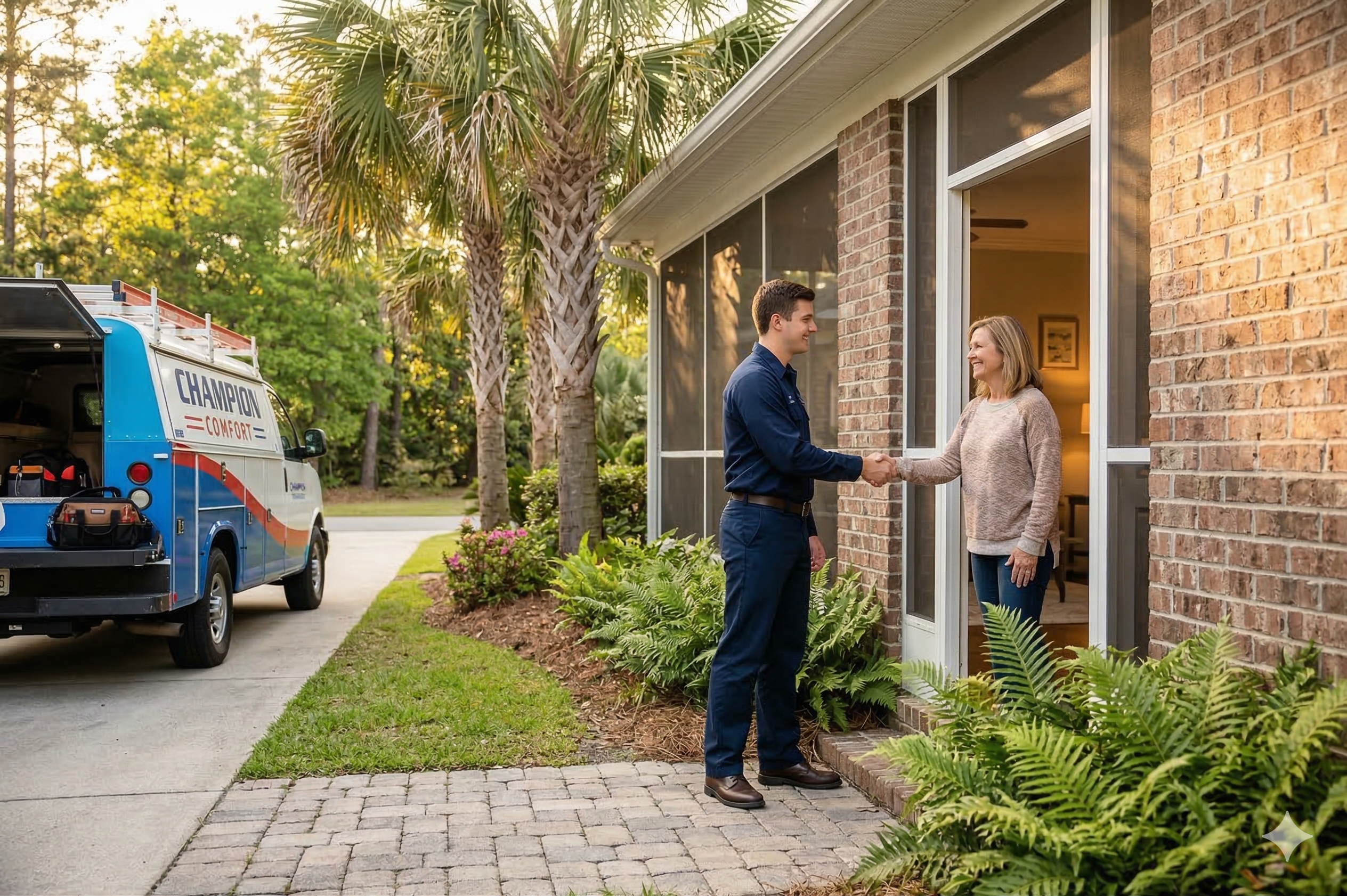
How to Choose an AC Repair Company in the Lowcountry
Choosing the right AC repair company is a decision that affects your comfort, your safety, and your wallet. In the Lowcountry — where summers are long, humidity is relentless, and your cooling system is the most critical mechanical system in your home — the contractor you call matters as much as the repair itself. A qualified technician using the right parts with transparent pricing will fix the problem once. An unqualified or dishonest contractor can misdiagnose the issue, install inferior parts, void your warranty, or recommend unnecessary work that costs you thousands. Coastal Carolina Comfort has been serving Summerville, Charleston, and the surrounding communities since 2019, and we’ve built our reputation on the kind of honest, competent service that we’d want for our own families. Here are the seven criteria we believe every Lowcountry homeowner should evaluate before hiring an AC repair company.
1. Verify South Carolina Contractor Licensing
This is the non-negotiable starting point. South Carolina requires HVAC contractors to hold a mechanical contractor license issued by the SC Department of Labor, Licensing, and Regulation (LLR). This license verifies that the contractor has met minimum competency standards, carries required insurance, and operates as a legitimate business.
Operating without a license is illegal, and hiring an unlicensed contractor creates real risks for you. Work performed by an unlicensed contractor can void your manufacturer’s equipment warranty. If something goes wrong — property damage, personal injury, or faulty work — you may have no legal recourse. An unlicensed contractor is also unlikely to carry adequate insurance, which means any damage to your home or injury on your property could become your financial responsibility.
You can verify a contractor’s license status through the SC LLR’s online verification tool. If a company can’t or won’t provide their license number when asked, that’s all the information you need — move on.
2. Look for NATE Certification
NATE (North American Technician Excellence) certification is the most widely recognized industry credential for HVAC technicians. It indicates that a technician has passed rigorous, third-party testing on installation and service practices for specific equipment types.
NATE certification isn’t required by law, which is exactly why it’s valuable as a differentiator. Companies that invest in NATE certification for their technicians are demonstrating a commitment to professional competency that goes beyond the minimum legal requirements.
At Coastal Carolina Comfort, our technicians are NATE-certified. We believe this matters because the Lowcountry’s climate creates unique HVAC challenges — humidity management, salt air corrosion, extended system runtime — that require technician-level expertise to diagnose and resolve correctly.
3. Read Google Reviews — But Read Them Critically
Online reviews are a valuable resource, but they require thoughtful interpretation. Here’s how to use them effectively.
Volume matters. A company with 200 reviews averaging 4.8 stars tells a more reliable story than a company with 12 reviews averaging 5.0 stars. A larger sample size smooths out outliers and gives you a more accurate picture of consistent performance.
Read the negative reviews. Every company has some. What matters is the nature of the complaints and how the company responded. Communication issues, scheduling delays, and billing confusion are common complaints in any service business and are often resolved. Complaints about misdiagnosis, incomplete repairs, damage to property, or refusal to honor warranties are more serious and suggest systemic problems.
Look for specifics. Reviews that mention specific technician names, describe the problem and solution, or reference transparency in pricing are generally more credible than generic five-star reviews that say “Great service!” Detail indicates a real experience.
Check the BBB. The Better Business Bureau tracks complaint patterns and resolution rates. A company’s BBB rating and complaint history can reveal issues that don’t always surface in Google reviews.
4. Demand Transparent, Upfront Pricing
The most common source of frustration in HVAC service is pricing surprises — getting a bill that’s significantly higher than expected because the scope of work changed, additional issues were “discovered,” or the initial estimate was intentionally low to get in the door.
A reputable AC repair company will provide a clear, upfront price for the repair after completing the diagnosis and before performing any work. This price should include the diagnostic fee, parts, and labor. If additional issues are discovered during the repair, the company should inform you and get authorization before proceeding with additional work.
Questions to ask about pricing before hiring:
Do you charge a diagnostic or service call fee? Is that fee waived if I proceed with the repair? Will I receive a written estimate before any work begins? Does the estimate include parts, labor, and any applicable warranties? Are there any circumstances where the final price could exceed the estimate?
At Coastal Carolina Comfort, we believe transparent pricing is foundational to trust. Our technicians explain what they find, provide the price upfront, and get your approval before touching a wrench. For a detailed breakdown of typical repair costs, read our guide on AC repair costs in South Carolina.
5. Evaluate Warranty Terms on Repairs
A repair is only as good as the warranty behind it. Ask about both the parts warranty and the labor warranty before authorizing work.
Parts warranty covers the replacement component itself. Quality contractors use OEM (original equipment manufacturer) parts or equivalent-quality components that carry manufacturer warranties. Ask what happens if the same part fails again within the warranty period — will you pay for a new part, or is it covered?
Labor warranty covers the workmanship — the installation of the part. If the part is fine but the installation was faulty and causes a problem, the labor warranty ensures you’re not paying again for someone else’s mistake.
The specifics matter. A 90-day labor warranty is industry minimum. A one-year labor warranty demonstrates greater confidence in the quality of work. Some companies offer extended warranties or maintenance agreements that include warranty coverage.
6. Assess Response Time and Availability
In the Lowcountry, an AC failure during July or August is a time-sensitive situation. Response time matters — not just how fast a company can get to you, but how reliable their scheduling is.
Ask about typical response times for your area. A company headquartered in Summerville will generally provide faster service to Summerville, Nexton, and Cane Bay than to Mount Pleasant or James Island, and vice versa. Geography matters in a service business.
Ask whether they offer same-day emergency service. Ask whether they serve your specific area — the Lowcountry covers a large geography from North Charleston to James Island to Mount Pleasant to Summerville, and not every company serves every area equally well.
Also consider this: a company that’s always available immediately may not be very busy, which could indicate quality or reputation issues. A company with a short wait — a few hours to a day — is often a sign of healthy demand balanced with adequate staffing.
7. Look for Local Roots and Community Investment
HVAC service is inherently local. A company that’s rooted in your community has a built-in incentive to do right by you, because their reputation depends on it. Chain operations and large regional companies may provide competent service, but the accountability structure is different from a locally owned business where the owner lives in the same community.
Things to look for: physical business address in the area (not just a P.O. box), involvement in local organizations or events, long-term presence in the community, and a team that understands the specific challenges of your area — from Summerville’s historic district to Charleston’s peninsula to the coastal properties on James Island and Daniel Island.
Coastal Carolina Comfort is a family-owned business headquartered at 110 Lipman Street in Summerville, SC. We’ve been serving our neighbors since 2019, and our team lives in the communities we serve. When you call us, you’re calling neighbors — not a distant call center.
Red Flags to Watch For
Beyond what to look for, here are warning signs that should make you pause.
No license or reluctance to provide one. Walk away immediately.
A diagnosis that happens in five minutes. A thorough diagnostic takes time. A technician who glances at the system and declares a major repair within minutes may not be investigating thoroughly — or may be defaulting to the most expensive solution.
Pressure to replace rather than repair. If a technician is pushing replacement on a relatively new system without clearly explaining why, get a second opinion. Understand the actual repair vs. replacement decision framework before making a commitment.
No written estimate. Any legitimate contractor will provide a written estimate. Verbal-only pricing creates disputes and eliminates accountability.
Dramatically lower pricing than competitors. If a quote is 40-50% below other estimates for the same work, ask questions. It may indicate inferior parts, an incomplete scope of work, or a company that will “discover” additional problems once work begins.
No online presence or reviews. In 2026, a legitimate HVAC company has a website, a Google Business Profile, and reviews. An absence of these basic markers warrants skepticism.
Why Lowcountry Homeowners Choose Coastal Carolina Comfort
We measure ourselves against every criterion on this list because we believe our customers should hold us to the same standard we recommend.
We’re licensed, insured, and NATE-certified. We provide upfront pricing before every repair. We offer transparent warranty terms on parts and labor. We respond quickly from our Summerville headquarters to serve homes across Summerville and Charleston. We’re family-owned, locally rooted, and accountable to our community.
If you’re experiencing signs that your AC needs repair, or if you simply want a company you can trust for the long term, we’d welcome the opportunity to earn your business.
Call (843) 708-8735 or learn more about us to see why our neighbors trust Coastal Carolina Comfort with their home comfort.
Frequently Asked Questions
How do I verify an HVAC contractor’s license in South Carolina?
You can check a contractor’s license status through the South Carolina Department of Labor, Licensing, and Regulation’s online verification tool. Ask the company for their license number, then search for it on the LLR website. If a company can’t provide a valid license number, do not hire them.
What is NATE certification and does it matter?
NATE stands for North American Technician Excellence. It’s a third-party certification that verifies a technician has demonstrated competency through rigorous testing on HVAC installation and service. While not legally required, NATE certification indicates a technician’s skills have been independently verified — which provides an extra layer of confidence for homeowners.
Should I get multiple quotes for AC repair?
For major repairs — compressor replacement, coil replacement, or any repair exceeding $1,000 — getting two to three quotes from licensed contractors is reasonable. For minor repairs like capacitor or contactor replacement, the cost difference between reputable contractors is usually small, and speed of resolution may matter more than shopping for the lowest price.
How do I know if a company is trying to sell me a repair I don’t need?
A trustworthy technician will explain what they found during diagnosis, show you the evidence where possible (photos, meter readings), and explain why the repair is necessary in terms you understand. If you feel pressured, if the explanation doesn’t make sense, or if the technician can’t answer your questions clearly, getting a second opinion is always appropriate.
What’s the difference between a local HVAC company and a national chain?
Local companies are typically owner-operated, with a direct accountability to their community reputation. National chains may have standardized processes and broader resources but often use subcontractors and have a different accountability structure. Neither model is inherently better — what matters is licensing, certification, transparency, and the quality of the technicians who actually show up at your door.
Does Coastal Carolina Comfort serve my area?
We serve the entire Lowcountry from our Summerville headquarters, including Summerville, Charleston, West Ashley, Mount Pleasant, James Island, Daniel Island, North Charleston, Goose Creek, Nexton, Cane Bay, and surrounding communities. Call (843) 708-8735 to confirm service availability in your specific area.
RELATED READING
- AC Repair in Summerville, SC — Meet your local AC repair experts
- AC Repair in Charleston, SC — Trusted service across the Lowcountry
- How Much Does AC Repair Cost in South Carolina? — Know fair pricing before you commit
- Signs Your AC Needs Repair — Recognize when it’s time to call
- Emergency AC Repair in the Lowcountry — When you need fast help from a team you can trust