Home of the $0 FREE Service Call Club | 0% Interest for 24 Months

Home of the $0 FREE Service Call Club | 0% Interest for 24 Months

Home of the $0 FREE Service Call Club | 0% Interest for 24 Months

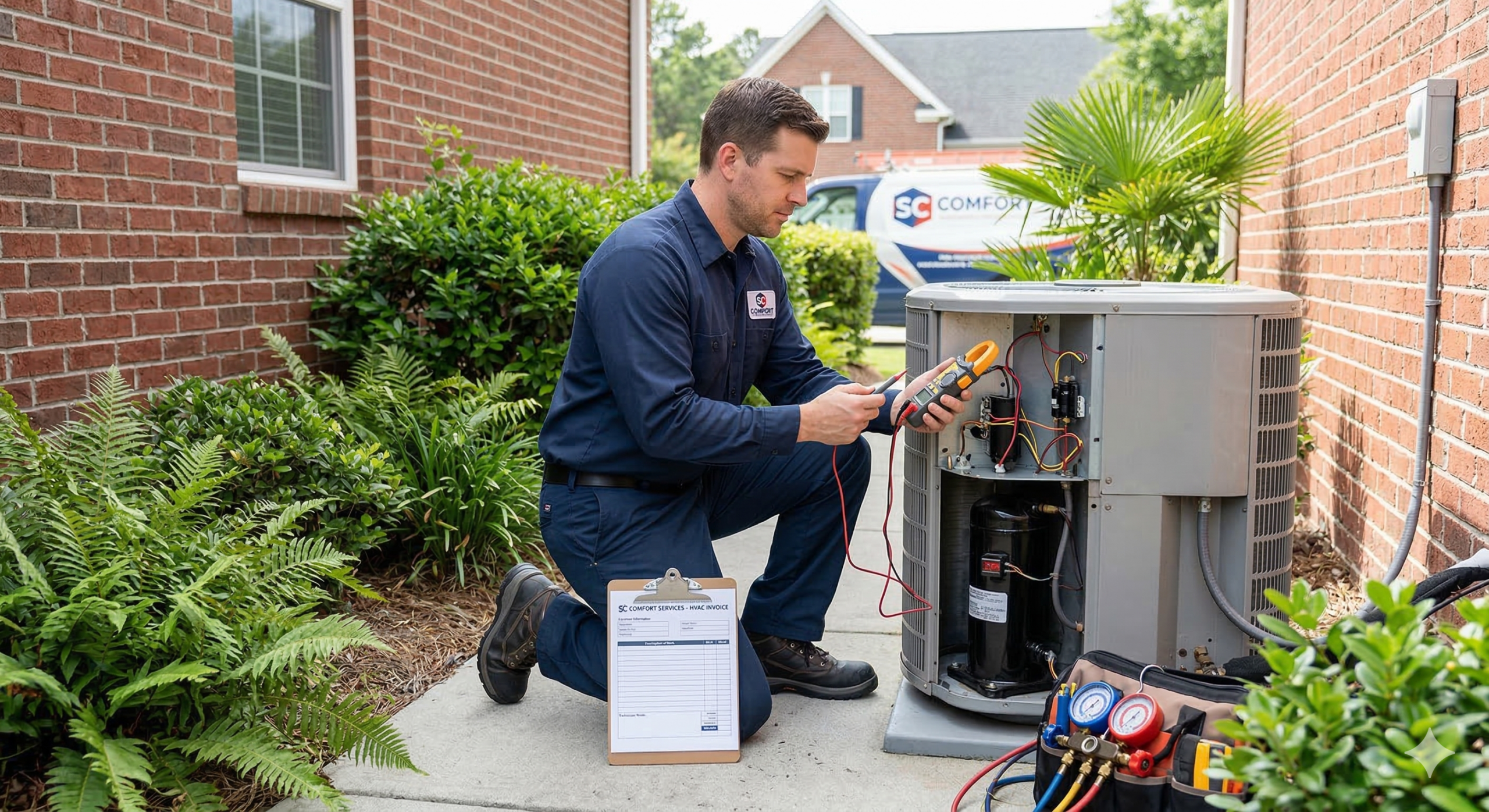
A technician in a navy uniform kneels by an outdoor HVAC unit, using a multimeter to check the system. Tools, gauges, and a clipboard are nearby. The AC repair scene is outside a brick house in South Carolina, surrounded by green plants.

How Much Does AC Repair Cost in South Carolina?

The average cost of AC repair in South Carolina ranges from $150 to $650 for common fixes like capacitor replacements, refrigerant recharges, and contactor swaps. Major component repairs — including compressor replacement, evaporator coil replacement, and condenser fan motor swaps — typically cost between $1,000 and $3,500 or more, depending on the system type, the part required, and labor. Coastal Carolina Comfort provides transparent, upfront pricing on every AC repair we perform across Summerville, Charleston, and the Lowcountry, so you know exactly what you’re paying before we start any work. We believe honest pricing builds trust, and trust is the foundation of every relationship we have with our neighbors.

Understanding what drives AC repair costs helps you make informed decisions, avoid overpaying, and know when repair makes sense versus when it’s time to consider replacement.

AC Repair Cost Breakdown by Repair Type

Every AC repair is different, but the pricing below reflects what South Carolina homeowners can typically expect in 2026 for the most common repairs. These ranges account for the diagnostic fee, parts, and labor.

Minor Repairs ($150–$400)

Capacitor replacement: $150–$300. The run capacitor is one of the most frequently replaced components in residential AC systems. It stores the electrical charge needed to start and run the compressor and fan motors. Capacitors are relatively inexpensive parts, and a skilled technician can replace one in under an hour.

Contactor replacement: $150–$350. The contactor is an electrical switch that controls power flow to the compressor and condenser fan motor. Like capacitors, contactors wear out from the constant on-off cycling that South Carolina’s long cooling season demands.

Condensate drain clearing: $100–$250. When the condensate drain line clogs — extremely common in the Lowcountry’s humid climate — water backs up and can trigger a system shutdown via the float switch. Clearing the line is a straightforward service call.

Thermostat replacement or recalibration: $150–$400. Depending on whether you’re replacing a basic thermostat or upgrading to a programmable or smart thermostat, costs vary. The diagnosis and wiring work contribute more to cost than the thermostat itself in most cases.

Moderate Repairs ($400–$1,000)

Refrigerant recharge (with leak detection): $250–$800. The cost depends on the type and amount of refrigerant needed. Systems using R-410A are less expensive to recharge than older systems that originally used R-22, which has been phased out under EPA regulations and is now extremely expensive when available. The leak detection component adds cost but is essential — simply adding refrigerant without finding the leak means the charge will drop again.

Blower motor replacement: $400–$900. The blower motor circulates conditioned air through your ductwork. When it fails, you’ll notice weak or absent airflow from your vents. Variable-speed blower motors cost more than single-speed models.

Condensate pump replacement: $250–$500. Some installations require a condensate pump to move water from the drain pan to an exterior drain. When the pump fails, water accumulates and can cause damage.

Major Repairs ($1,000–$3,500+)

Compressor replacement: $1,500–$3,500. The compressor is the most expensive component in your AC system. Replacing a compressor involves recovering the existing refrigerant, removing the old compressor, installing the new one, pulling a vacuum on the system, and recharging with the correct amount of refrigerant. Labor is intensive, and the part itself is expensive. When a compressor fails on an older system, this is often the point where AC repair versus replacement becomes the central question.

Evaporator coil replacement: $1,000–$2,500. The evaporator coil sits inside the indoor air handler and absorbs heat from your indoor air. Coil replacements require significant labor because accessing the coil often means partially dismantling the air handler. Leaking evaporator coils are a common source of refrigerant loss.

Condenser coil replacement: $1,000–$2,800. The condenser coil sits in the outdoor unit and releases the heat your system absorbs from indoors. In coastal South Carolina, condenser coils are particularly susceptible to salt air corrosion, which accelerates degradation — especially for homes in Charleston, James Island, Sullivan’s Island, and other properties close to the coast.

What Factors Affect Your AC Repair Cost?

The ranges above are guidelines, not guarantees. Several factors influence where your specific repair falls within those ranges.

System Type and Size

Central air conditioners, heat pumps, ductless mini-splits, and package units have different component configurations and varying parts costs. A 2-ton system serving a smaller home typically costs less to repair than a 5-ton system serving a larger property, simply because the components are sized differently and the larger parts cost more.

Refrigerant Type

This is a significant cost factor that many homeowners don’t anticipate. If your system was manufactured before 2010, it likely uses R-22 refrigerant (commonly called Freon). R-22 was phased out under the EPA’s Clean Air Act, and production ceased in 2020. The remaining supply is limited and expensive — an R-22 recharge can cost several hundred dollars more than an equivalent R-410A recharge. If your system requires R-22 and has a significant leak, this is often a strong financial argument for system replacement rather than repair.

Part Availability

Standard components for common residential systems from manufacturers like Daikin, Goodman, Trane, Carrier, Lennox, and Rheem are generally readily available. Specialty parts, discontinued components, or parts for older systems may require ordering and add wait time and potentially cost.

Diagnostic Complexity

Some issues are immediately apparent — a visibly damaged capacitor, an obviously clogged drain line. Others require more involved testing — checking refrigerant pressures, performing a leak search, testing electrical components with specialized meters, or evaluating ductwork. The complexity of the diagnostic process affects labor time.

Warranty Coverage

If your system is still under the manufacturer’s parts warranty (typically 5 to 10 years depending on the manufacturer and whether the system was registered), the parts cost may be covered, and you’d only be responsible for labor. Always check your warranty status before authorizing a major repair. Our team can help you determine warranty coverage during the diagnostic visit.

Time of Year and Demand

Emergency repairs during peak summer demand (June through August) sometimes carry premium pricing at some companies — though not all. At Coastal Carolina Comfort, we maintain consistent, transparent pricing year-round. That said, scheduling a repair during the spring or fall “shoulder seasons” when demand is lower often means faster response times and more scheduling flexibility.

How to Avoid Overpaying for AC Repair

Knowing the fair cost range for your repair type is the first step. Beyond that, here are practical ways to protect yourself.

Get a Clear Diagnosis Before Authorizing Work

A reputable HVAC company will diagnose the problem, explain what they found, and provide an upfront price before performing any repair. If a technician can’t or won’t explain what’s wrong in terms you understand, that’s a red flag. At Coastal Carolina Comfort, our technicians explain every finding in plain language — we want you to understand what your system needs and why.

Ask About the Diagnostic Fee

Most HVAC companies charge a diagnostic or service call fee, typically ranging from $75 to $150 in the Summerville and Charleston market. Some companies waive this fee if you proceed with the repair; others charge it regardless. Coastal Carolina Comfort offers $0 service calls for Comfort Club members and transparent diagnostic pricing for all customers.

Compare, But Compare Apples to Apples

Getting multiple opinions on major repairs is reasonable. When comparing quotes, make sure you’re comparing the same repair scope — the same part, the same warranty, the same labor. A significantly lower quote might mean a lower-quality aftermarket part or doesn’t include the full scope of work.

Check Licensing and Credentials

South Carolina requires HVAC contractors to hold a mechanical contractor license through the SC Department of Labor, Licensing, and Regulation. NATE certification is an additional industry credential that indicates technician-level competency. Both of these matter — an unlicensed technician working on your system can void your warranty and create safety issues. Our guide on how to choose an AC repair company in the Lowcountry covers credentials and other evaluation criteria in detail.

When Repair Cost Makes Replacement the Smarter Choice

There’s a threshold where continued repair stops making financial sense. The general guideline is the 50% rule: if a single repair costs more than 50% of the price of a new system, replacement typically delivers better long-term value.

Other factors that shift the math toward replacement include system age (over 12-15 years), the use of phased-out R-22 refrigerant, declining SEER efficiency rating compared to modern systems, and a pattern of increasing repair frequency. If you’ve had two or more repairs in the past 12 months, it’s worth having a conversation about whether your next dollar goes further toward a new system.

We’ve written a comprehensive guide on AC repair vs. replacement that walks through the decision framework in detail, including the financial breakpoints that help Lowcountry homeowners make the right call.

Get Transparent AC Repair Pricing From Coastal Carolina Comfort

We’re a family-owned HVAC company headquartered in Summerville, SC, serving homeowners across the Lowcountry with honest, upfront pricing on every repair. Our NATE-certified technicians diagnose the problem first, explain what they find, and give you the price before we start — no surprises.

We serve Summerville, Charleston, West Ashley, Mount Pleasant, James Island, North Charleston, and surrounding communities. We offer $0 service calls for Comfort Club members and 0% interest financing for 24 months on qualifying repairs.

Call (843) 708-8735 or request a free quote to get honest pricing on your AC repair.

Frequently Asked Questions

What is the average cost of AC repair in Summerville, SC?

Most common AC repairs in Summerville cost between $150 and $650, including the diagnostic fee, parts, and labor. Major component repairs such as compressor or evaporator coil replacement range from $1,000 to $3,500 depending on the system. These ranges align with South Carolina state averages for residential AC repair.

Does Coastal Carolina Comfort charge a diagnostic fee?

We offer $0 service calls for Comfort Club members and competitive diagnostic pricing for all customers. The diagnostic fee is always communicated upfront, and we provide a full explanation of findings and an itemized repair price before performing any work.

Why is R-22 refrigerant so expensive?

R-22 (commonly called Freon) was phased out under the EPA’s Clean Air Act due to its ozone-depleting properties. Production in the United States ceased in 2020, and the remaining supply is limited, which has driven prices significantly higher. If your system uses R-22, the cost of recharging can be several hundred dollars more than systems using the current standard refrigerant, R-410A.

Should I repair my AC or just replace it?

The decision depends on system age, repair cost, repair frequency, and refrigerant type. As a general rule, if a single repair exceeds 50% of the cost of a new system, or if your system is over 12 years old and requiring frequent fixes, replacement typically delivers better value. Read our detailed breakdown on AC repair vs. replacement.

Do you offer financing for AC repairs?

Yes. Coastal Carolina Comfort offers 0% interest financing for 24 months on qualifying repairs and replacements. This helps our customers address critical AC issues without financial stress, especially during peak summer when repairs can’t wait.

How do I know if I’m getting a fair price for AC repair?

Ask for a clear diagnosis and itemized pricing before authorizing work. Compare quotes from licensed, NATE-certified contractors — not just the cheapest option. A fair price includes professional diagnosis, quality parts, competent labor, and a warranty on the repair. Our guide to choosing an AC repair company covers what to look for in detail.


RELATED READING

Share This Post

Get 10% Off Your First Service and a FREE Quote


More To Explore

A rustic cottage with wood siding and a screened porch sits among moss-draped trees. Palmetto plants surround the house, while a gravel driveway leads to it—a generator and AC unit offer relief from the South Carolina humidity.
Air Conditioning

The Lowcountry Climate and Your AC: What South Carolina Humidity Does to Your Cooling System

The Lowcountry Climate and Your AC: What South Carolina Humidity Does to Your Cooling System The South Carolina Lowcountry has one of the most demanding climates for residential air conditioning systems in the entire United States. The combination of sustained high temperatures, extreme relative humidity that routinely exceeds 80% to 90%, salt-laden coastal air, and a cooling season that stretches from April through October creates operating conditions that accelerate component wear, promote biological growth inside HVAC systems, and shorten equipment lifespans compared to most other U.S. markets. At Coastal Carolina Comfort, we service AC systems across Summerville, Charleston, and the surrounding communities every day, and we see firsthand how our climate affects the equipment that keeps Lowcountry families comfortable. Understanding these climate-specific challenges helps homeowners make smarter decisions about maintenance, repairs, and system selection. The Humidity Problem: It’s Not Just About Temperature Most people focus on temperature when they think about AC performance, but in the Lowcountry, humidity is the more significant factor. Air conditioning systems do two jobs simultaneously: they cool the air (sensible cooling) and they remove moisture from the air (latent cooling, also called dehumidification). In a dry climate, the cooling load dominates. In the Lowcountry, the dehumidification load is enormous — and it affects your system in ways that go beyond comfort. What Extreme Humidity Does to Your System When outdoor relative humidity sits above 80% — which is the norm in the Lowcountry from May through September — your AC system has to work significantly harder to remove moisture from indoor air. This additional workload manifests in several ways. Extended runtime. Your system runs longer per cycle to bring indoor humidity to a comfortable level (ideally 45-55% relative humidity). Longer runtime means more operating hours, more wear on the compressor, blower motor, and other mechanical components, and higher electricity consumption. Condensate overload. Your system may pull several gallons of water per day from the air during peak humidity. All that water has to exit through the condensate drain system. The volume alone puts stress on drain lines, drain pans, and condensate pumps — and creates ideal conditions for algae and biofilm growth that causes drain clogs. This is why condensate drain issues are among the most common AC repair calls we handle in the Lowcountry. Evaporator coil moisture. The evaporator coil operates in a perpetually wet environment during the cooling season, which promotes mold and biofilm growth on the coil surface. This biological buildup restricts airflow, reduces heat transfer efficiency, degrades indoor air quality, and can eventually lead to coil corrosion and refrigerant leaks. Indoor air quality impacts. When your AC system can’t adequately dehumidify, indoor humidity rises above comfortable levels. Sustained indoor humidity above 60% creates conditions for mold growth on walls, ceilings, and in hidden spaces — and it makes your home feel uncomfortable even when the temperature reads correctly on the thermostat. The Oversized AC Problem Ironically, one of the most common HVAC mistakes in the Lowcountry is installing an oversized AC system — one that’s too powerful for the home’s actual cooling load. An oversized system cools the air quickly but doesn’t run long enough per cycle to adequately dehumidify. It short cycles — turning on and off frequently — which fails to remove enough moisture and puts extra stress on the compressor. Proper system sizing in the Lowcountry requires a Manual J load calculation that accounts for our region’s extreme humidity levels, not just the square footage of the home. If your home feels cool but clammy, or if you notice that your AC cycles frequently without maintaining comfortable humidity levels, your system may be oversized for your space. Salt Air Corrosion: The Coastal Factor Homes in Charleston, James Island, Mount Pleasant, Sullivan’s Island, Folly Beach, Daniel Island, and other coastal areas face an additional challenge that inland communities like Summerville encounter to a lesser degree: salt air corrosion. Salt particles carried by coastal breezes accelerate oxidation on metal components. For your AC system, this means faster degradation of the outdoor condenser coil’s aluminum fins, corrosion on copper refrigerant lines and connections, oxidation of electrical contacts and wiring, and rust on the condenser unit’s steel cabinet and structural components. The effects are cumulative and progressive. A condenser coil coated in salt residue operates less efficiently because the corroded fins restrict airflow and heat transfer. Corroded electrical connections increase resistance and generate heat, which accelerates further degradation. Corroded refrigerant line connections can develop micro-leaks that slowly drain your system’s charge over months. Protecting Coastal AC Systems For homeowners within a few miles of the coast, additional protective measures extend system life. Regular condenser coil rinsing. A gentle freshwater rinse of the outdoor unit every few weeks during peak season helps remove salt deposits before they cause significant corrosion. Coil coatings. Some manufacturers offer factory-applied or aftermarket corrosion-resistant coatings for condenser coils. These coatings add a protective layer between the salt air and the metal components. More frequent professional maintenance. Coastal properties benefit from semi-annual or even quarterly professional maintenance to catch corrosion-related issues early. What might take five years to develop in Summerville can occur in two to three years on James Island or Sullivan’s Island. Elevated condenser placement. Raising the outdoor unit off the ground helps reduce exposure to salt-laden moisture that pools at ground level, especially during coastal storms and king tides. Extended Cooling Season: The Wear Factor In northern markets, AC systems may run three to four months per year. In the Lowcountry, your cooling system operates six to seven months annually — from early April through late October, and sometimes into November. In unusually warm years, some systems run more than 200 days. This extended runtime directly affects every component in your system. Compressor motors accumulate operating hours faster. Capacitors, which store electrical energy for motor startups, degrade with each cycle and reach end-of-life sooner. Contactors, which switch power to the compressor, develop carbon buildup and pitting from thousands of additional on-off cycles. Blower motor bearings

A service technician from a leading AC repair company shakes hands with a woman at her front door. A Chillowee Comfort van is parked in the driveway of a brick house surrounded by greenery, serving the Lowcountry community.
Air Conditioning

How to Choose an AC Repair Company in the Lowcountry

How to Choose an AC Repair Company in the Lowcountry Choosing the right AC repair company is a decision that affects your comfort, your safety, and your wallet. In the Lowcountry — where summers are long, humidity is relentless, and your cooling system is the most critical mechanical system in your home — the contractor you call matters as much as the repair itself. A qualified technician using the right parts with transparent pricing will fix the problem once. An unqualified or dishonest contractor can misdiagnose the issue, install inferior parts, void your warranty, or recommend unnecessary work that costs you thousands. Coastal Carolina Comfort has been serving Summerville, Charleston, and the surrounding communities since 2019, and we’ve built our reputation on the kind of honest, competent service that we’d want for our own families. Here are the seven criteria we believe every Lowcountry homeowner should evaluate before hiring an AC repair company. 1. Verify South Carolina Contractor Licensing This is the non-negotiable starting point. South Carolina requires HVAC contractors to hold a mechanical contractor license issued by the SC Department of Labor, Licensing, and Regulation (LLR). This license verifies that the contractor has met minimum competency standards, carries required insurance, and operates as a legitimate business. Operating without a license is illegal, and hiring an unlicensed contractor creates real risks for you. Work performed by an unlicensed contractor can void your manufacturer’s equipment warranty. If something goes wrong — property damage, personal injury, or faulty work — you may have no legal recourse. An unlicensed contractor is also unlikely to carry adequate insurance, which means any damage to your home or injury on your property could become your financial responsibility. You can verify a contractor’s license status through the SC LLR’s online verification tool. If a company can’t or won’t provide their license number when asked, that’s all the information you need — move on. 2. Look for NATE Certification NATE (North American Technician Excellence) certification is the most widely recognized industry credential for HVAC technicians. It indicates that a technician has passed rigorous, third-party testing on installation and service practices for specific equipment types. NATE certification isn’t required by law, which is exactly why it’s valuable as a differentiator. Companies that invest in NATE certification for their technicians are demonstrating a commitment to professional competency that goes beyond the minimum legal requirements. At Coastal Carolina Comfort, our technicians are NATE-certified. We believe this matters because the Lowcountry’s climate creates unique HVAC challenges — humidity management, salt air corrosion, extended system runtime — that require technician-level expertise to diagnose and resolve correctly. 3. Read Google Reviews — But Read Them Critically Online reviews are a valuable resource, but they require thoughtful interpretation. Here’s how to use them effectively. Volume matters. A company with 200 reviews averaging 4.8 stars tells a more reliable story than a company with 12 reviews averaging 5.0 stars. A larger sample size smooths out outliers and gives you a more accurate picture of consistent performance. Read the negative reviews. Every company has some. What matters is the nature of the complaints and how the company responded. Communication issues, scheduling delays, and billing confusion are common complaints in any service business and are often resolved. Complaints about misdiagnosis, incomplete repairs, damage to property, or refusal to honor warranties are more serious and suggest systemic problems. Look for specifics. Reviews that mention specific technician names, describe the problem and solution, or reference transparency in pricing are generally more credible than generic five-star reviews that say “Great service!” Detail indicates a real experience. Check the BBB. The Better Business Bureau tracks complaint patterns and resolution rates. A company’s BBB rating and complaint history can reveal issues that don’t always surface in Google reviews. 4. Demand Transparent, Upfront Pricing The most common source of frustration in HVAC service is pricing surprises — getting a bill that’s significantly higher than expected because the scope of work changed, additional issues were “discovered,” or the initial estimate was intentionally low to get in the door. A reputable AC repair company will provide a clear, upfront price for the repair after completing the diagnosis and before performing any work. This price should include the diagnostic fee, parts, and labor. If additional issues are discovered during the repair, the company should inform you and get authorization before proceeding with additional work. Questions to ask about pricing before hiring: Do you charge a diagnostic or service call fee? Is that fee waived if I proceed with the repair? Will I receive a written estimate before any work begins? Does the estimate include parts, labor, and any applicable warranties? Are there any circumstances where the final price could exceed the estimate? At Coastal Carolina Comfort, we believe transparent pricing is foundational to trust. Our technicians explain what they find, provide the price upfront, and get your approval before touching a wrench. For a detailed breakdown of typical repair costs, read our guide on AC repair costs in South Carolina. 5. Evaluate Warranty Terms on Repairs A repair is only as good as the warranty behind it. Ask about both the parts warranty and the labor warranty before authorizing work. Parts warranty covers the replacement component itself. Quality contractors use OEM (original equipment manufacturer) parts or equivalent-quality components that carry manufacturer warranties. Ask what happens if the same part fails again within the warranty period — will you pay for a new part, or is it covered? Labor warranty covers the workmanship — the installation of the part. If the part is fine but the installation was faulty and causes a problem, the labor warranty ensures you’re not paying again for someone else’s mistake. The specifics matter. A 90-day labor warranty is industry minimum. A one-year labor warranty demonstrates greater confidence in the quality of work. Some companies offer extended warranties or maintenance agreements that include warranty coverage. 6. Assess Response Time and Availability In the Lowcountry, an AC failure during July or August is a

SCHEDULE A $0 FREE SERVICE CALL AND GET A FREE QUOTE


GET A FREE ESTIMATE and schedule service


GET A FREE ESTIMATE and schedule service