AC Refrigerant Leak: Signs, Causes, and Why It's a Bigger Repair in 2026
By the Coastal Carolina Comfort team · Last updated 2026-05-20
A leaking AC is not just inefficient, it's an EPA-regulated repair that has changed shape since January 2025. Here is what is leaking, how to spot it, and what your options look like under the new refrigerant rules.
Quick Answer: AC Refrigerant Leak in Plain Terms
A refrigerant leak means your AC system has lost some or all of its working fluid through corrosion, a connection failure, or component damage. The system runs but cools poorly, often with ice on the lines, longer run cycles, or hissing near the connections. EPA regulations passed under the AIM Act prevent homeowners from handling refrigerants, so this is a licensed-technician repair. Coastal Carolina Comfort diagnoses refrigerant leaks for the standard $110 diagnostic fee, applied toward the repair when you authorize the work.
What a Refrigerant Leak Does to Your AC System
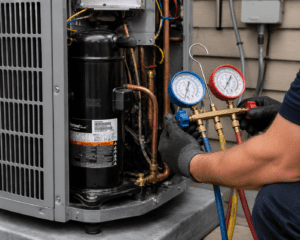
Refrigerant is the working fluid that absorbs heat inside your home and releases it outside. The system is a closed loop. There is exactly the amount of refrigerant the manufacturer specified, and that amount does not change under normal operation. When refrigerant leaks out, three things happen in sequence.
First, the system becomes undercharged. The remaining refrigerant cannot move as much heat per cycle. The home stays warmer than the thermostat setting. The system runs longer to compensate. Energy bills rise. The Lowcountry's long cooling season means an undercharged system racks up an outsized utility cost compared to drier regions where the system runs fewer hours per day.
Second, the evaporator coil begins to freeze. With less refrigerant absorbing heat inside the evaporator, the remaining refrigerant gets colder than it should. Moisture in the air freezes on the coil. You may see ice on the indoor unit or on the refrigerant lines outside. A frozen coil makes the problem worse fast, the iced-over coil cannot transfer heat at all, the compressor runs against a blocked system, and the eventual thaw drops water all over your air handler.
Third, the compressor strains. A refrigerant-starved compressor runs hot, draws more current, and shortens its own life. A refrigerant leak that goes unaddressed for a season often turns into a compressor failure the following season. See our guide on AC compressor failure for what that cascade looks like.
Signs of an AC Refrigerant Leak
Refrigerant leaks rarely announce themselves. There is usually a window of weeks where the symptoms are subtle before the system becomes obviously broken. Knowing what to watch for helps you catch the leak while it is still a small repair.
Weak cooling that gets worse over time
A system slowly losing refrigerant cools less effectively each week. The thermostat reads correctly but the rooms feel warmer than the setting. Run cycles get longer. If your AC seems to be working harder than last summer for the same comfort level, low refrigerant is high on the differential.
Ice on the refrigerant lines or the indoor coil
Visible frost or ice on the copper lines outside your home, or on the evaporator coil inside the air handler, is a strong refrigerant-related signal. Sometimes the icing happens overnight when the system runs at lower demand and becomes obvious in the morning. Do not run the system with visible ice, shut it off and call for a diagnostic.
Hissing or bubbling sounds near connections
A larger leak can be audible, a hissing sound from a connection, or bubbling if the leak is submerged in oil. Most refrigerant leaks are too small to hear, but if you do hear hissing near the outdoor unit, it confirms a leak and locates it.
Oily residue around fittings or coils
Refrigerant carries lubricating oil through the system. When refrigerant leaks, the oil leaks with it and stays behind as a visible residue. Dark wet spots on the copper lines, around brazed joints, or on the outdoor unit cabinet are evidence of an active or recent leak.
Longer run cycles and rising energy bills
The system that runs an extra hour every afternoon to reach the setpoint pulls extra cost from your meter. If your Dominion Energy or Berkeley Electric bill jumped without a weather explanation, the underlying cause may be a refrigerant problem that has not yet shown up as a comfort failure.
Why Refrigerant Leaks Happen in Lowcountry Systems
Refrigerant lines are copper tubing brazed at the connections. A properly installed system should hold its charge for the life of the equipment. Leaks happen because the lines or connections fail, and in the Lowcountry there are specific conditions that drive that failure earlier than elsewhere.
Salt-air corrosion (the Lowcountry specialty)
Properties east of I-26, on James Island, on Daniel Island, in Mount Pleasant, and within a couple of miles of the harbor see airborne salt deposit on copper refrigerant lines and outdoor coil fins. The salt holds moisture against the copper. Over years, that produces pinhole corrosion that leaks slowly. By the time the homeowner notices the cooling weakness, the leak has been growing for months. Charleston salt air HVAC corrosion is the dimension of equipment lifespan that national install guides do not cover.
Vibration and mechanical fatigue
Refrigerant lines flex slightly every time the compressor cycles on and off. Over hundreds of thousands of cycles, brazed joints develop micro-cracks. This is a normal aging mode independent of salt air, but the Lowcountry's long cooling season (March through October) means systems here run more cycles per year than equipment in cooler climates.
Factory defects and installation issues
A small percentage of new systems leak from day one, a brazing joint that was not perfectly sealed at the factory, or a fitting that was not tightened correctly at install. These leaks usually announce themselves within the first year. If your system is under warranty and leaking, document the diagnosis carefully and engage the manufacturer warranty process.
Coil corrosion from indoor sources
Indoor evaporator coils can corrode from the air-side of the coil rather than the water-side. Formaldehyde from new building materials, household cleaning products, or combustion byproducts react with moisture on the coil and produce corrosive compounds that pit the copper. This is less common than salt-air corrosion in the Lowcountry but does happen in newer construction with off-gassing materials.
How a Refrigerant Leak Is Diagnosed
Refrigerant leaks are diagnosed with one of three methods, sometimes combined. The Coastal technician picks the approach that fits the suspected leak size and location.
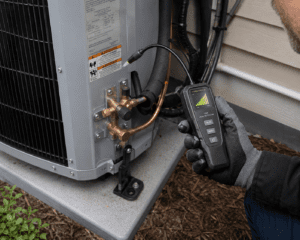
Electronic leak detection
An electronic refrigerant detector sniffs the air around connections, valves, and coil surfaces for the trace amounts of refrigerant that escape from any active leak. The detector identifies the general location of the leak. For larger leaks, this is usually enough to pinpoint the problem.
UV dye injection
For slow or intermittent leaks that an electronic detector struggles to find, the technician injects a small amount of fluorescent dye into the refrigerant. The dye circulates with the refrigerant through the closed loop. Wherever the refrigerant is leaking out, the dye marks the spot, visible under a UV light. The dye stays in the system for months, which helps catch leaks that only show up under certain operating conditions.
Pressure testing with nitrogen
For new installations or systems that have been opened for service, the technician pressurizes the lines with dry nitrogen and watches for pressure drop over time. This confirms the system can hold a charge before the actual refrigerant goes in.
What Changed for Refrigerant Leak Repairs in January 2025
If your AC system uses R-410A refrigerant (which covers most systems installed between 2010 and 2024), the repair calculus changed on January 1, 2025. The change is widely misunderstood. Here is the accurate framing.
The EPA AIM Act, 40 CFR Part 84
Under the American Innovation and Manufacturing Act, the EPA's Technology Transitions rule prohibits the manufacture or import of new residential split-system air conditioners and heat pumps using R-410A starting January 1, 2025. Equipment manufactured before that date can still be installed through January 1, 2026.
R-410A refrigerant itself is NOT banned. Production and import of the refrigerant for servicing existing systems continues. There is no end date on servicing legacy R-410A equipment. If your system is leaking, it can be repaired and recharged with R-410A, the technician just cannot install a new R-410A system in your home.
The two common replacement refrigerants for new equipment are R-454B (Daikin, Trane, others) and R-32 (Daikin and others). Both are A2L mildly flammable refrigerants, which is a different handling category than R-410A, relevant to your technician's training and to the equipment you would buy to replace, not to a repair of your existing system.
The practical effect on a refrigerant leak repair
The price of R-410A has risen meaningfully since the phasedown began. Refrigerant manufacturers have been allocating production toward higher-margin uses, and the long-term trajectory is upward. A refrigerant leak repair that involved recharging an R-410A system in 2022 costs more today, primarily because of the refrigerant material cost.
On older systems, particularly R-410A systems that are 12 years or older with other signs of wear, the repair-versus-replace math has shifted. A pinhole leak on an aging condenser coil that would have been a clear "repair it" call in 2022 is more often a "consider replacement" conversation in 2026. The decision depends on system age, where the leak is, how much refrigerant the system needs, and whether you want to extend the life of equipment that will need replacement within a few years anyway.
Coastal's diagnostic includes a frank conversation about which path makes more financial sense. No pressure either direction.
EPA Section 608, why homeowners cannot DIY this
EPA Section 608 of the Clean Air Act requires technician certification for anyone who purchases, handles, or recovers refrigerants. Homeowners legally cannot buy R-410A, R-454B, R-32, or any other regulated refrigerant. They cannot legally recover refrigerant from a system, repair a leak, or recharge a system. This is not Coastal policy, it is federal law, enforced through retailer ID checks and EPA-licensed disposal tracking.
Every Coastal technician holds current EPA 608 certification. The diagnostic, the leak repair, the refrigerant recovery if needed, and the recharge all happen within that regulatory framework.
What an AC Refrigerant Leak Repair Costs
Refrigerant leak repairs are one of the more variable line items in HVAC service. The cost depends on how much refrigerant the system has lost, where the leak is, what it takes to access the leak, and the refrigerant type. The $110 diagnostic fee covers locating the leak and giving you a written repair quote. The fee is applied toward the repair when you authorize the work.
The two cost drivers worth understanding: refrigerant material cost (which has risen for R-410A) and access labor (a leak in an evaporator coil inside an attic air handler is more labor than a leak on an outdoor line set). The technician's quote breaks these out before any work starts.
On systems where the leak is in the evaporator coil and the system is more than a decade old, the conversation often turns to repair-versus-replace rather than a pure repair quote. We walk through that math honestly.
EPA 608 Certified Technicians
Every Coastal technician holds current EPA Section 608 certification, the federal requirement for refrigerant handling.
Same-Day Service
Most Charleston and Summerville service calls are answered the same day from our Lipman St. dispatch in Summerville.
Licensed and Insured
SC LLR Mechanical Contractor license, NATE certification, full liability and workers' compensation insurance.
Get Your Refrigerant Leak Diagnosed
Coastal Carolina Comfort serves both metros from a single Summerville location. Pick the page for your area for service-area details and the local contact form.
If Your AC Has These Symptoms, A Refrigerant Leak Could Be Behind Them
AC Not Cooling
The system runs but the house never reaches setpoint. An undercharged refrigerant loop is a common cause when the system is also showing longer run cycles.
AC Blowing Warm Air
The fan runs but the air at the vents is warm. Severely low refrigerant produces exactly this pattern as the system loses ability to transfer heat.
AC Frozen Evaporator Coil
Ice on the indoor coil or the refrigerant lines outside. Low refrigerant is the leading cause of evaporator freezing in humid Lowcountry conditions.
AC Refrigerant Leak: Frequently Asked Questions
The most reliable signals are weak cooling that gets worse over time, visible ice on the refrigerant lines or evaporator coil, oily residue around fittings, and longer run cycles or higher energy bills without a weather explanation. A technician with electronic leak detection, UV dye, or a nitrogen pressure test can confirm and locate the leak.
No. EPA Section 608 of the Clean Air Act requires technician certification for anyone who purchases, handles, or recovers refrigerants. Homeowners legally cannot buy R-410A, R-454B, R-32, or any other regulated refrigerant. This is federal law, not a service-provider policy. Refilling a leaking system also fails to fix the underlying problem, the refrigerant will leak right back out.
R-410A refrigerant itself is not banned. The EPA AIM Act (40 CFR Part 84) prohibits the manufacture or import of new residential split-system AC and heat pump equipment that uses R-410A as of January 1, 2025. Existing R-410A equipment can still be serviced, repaired, and recharged with R-410A. There is no end date for servicing legacy systems.
It depends on where the leak is, how old the system is, and what refrigerant it uses. A small leak on a service valve or line set on a system less than 10 years old is usually a clear repair. A leak in the evaporator coil on a 12-plus-year-old R-410A system often tips toward replacement because the repair cost approaches a meaningful fraction of replacement cost. Coastal technicians walk through the actual numbers during the diagnostic visit.
R-410A material costs have risen since the AIM Act phasedown began. Manufacturers have allocated production toward higher-margin uses, supply is tightening over time, and that flows through to the repair price. The labor side of the repair (locating the leak, brazing, evacuating, recharging) has not changed materially. The refrigerant itself is the cost driver.
Yes. Properties east of I-26, on James Island, on Daniel Island, in Mount Pleasant, and within a couple of miles of the harbor see airborne salt deposit on copper refrigerant lines and outdoor coil fins. The salt holds moisture against the copper, and over years that produces the pinhole corrosion that becomes a leak. We see this pattern far more often than equipment installed inland.
You can, for a short window, but you should not for long. An undercharged system overworks the compressor. The compressor runs hotter, draws elevated current, and degrades faster. A refrigerant leak that goes unaddressed for one cooling season often becomes a compressor failure the next season. The repair-only window narrows quickly. If you suspect a leak, the right move is a diagnostic before the next heat wave.
Suspect a Refrigerant Leak? Get an EPA-Certified Diagnosis.
$110 diagnostic, applied toward the repair. Same-day service from Lipman St. Coastal technicians hold current EPA 608 certification.
📞 (843) 708-8735Coastal Carolina Comfort · 110 Lipman St, Summerville, SC 29483 · Licensed & Insured · NATE-Certified