
AC Making Strange Noises? A Sound-by-Sound Diagnostic for Lowcountry Homeowners
[AUTHOR — Coastal Carolina Comfort technician] · Updated for the 2026 cooling season · ~8 minute read
Match the sound to the cause. Grinding means worn motor bearings. Buzzing means electrical — capacitor, contactor, or loose connection. Hissing means refrigerant leak or duct leak. Banging or clanking means a loose internal part. Squealing means a worn blower belt or dry bearings. Screaming or screeching means high-pressure cutoff — shut the system off and call. Clicking on start and stop is normal; continuous clicking is not. Coastal Carolina Comfort diagnoses each of these on the first visit; some are homeowner-fixable, some are not.
A residential AC has roughly a dozen places it can produce noise — the compressor inside the outdoor unit, the condenser fan motor, the blower motor in the air handler, the contactor, the refrigerant lines, the ductwork, and the cabinet panels. Each part fails in a characteristic way, and each failure mode produces a characteristic sound. That makes "what is my AC doing?" surprisingly diagnosable from outside the unit.
Coastal Carolina Comfort techs run service calls in Summerville and Charleston with the homeowner's noise description as the first data point. The same sound, in the same part of the system, points to the same handful of causes. The walk-through below maps the most common AC noises to their most likely cause and the right next move.
How to use this diagnostic
Stand near the indoor air handler with the AC running. Listen. Walk outside and stand near the condenser. Listen again. Note: which unit is making the noise (indoor or outdoor), what the noise sounds like, and when it happens (start-up only, the whole run cycle, shut-down only).
Those three pieces of information narrow the diagnosis to one or two components. The sound-by-sound list below assumes you've localized the sound to the indoor or outdoor unit and identified its rough character.
Match the sound to the cause
Grinding Worn motor bearings
Metal-on-metal grinding, usually steady through the run cycle. Source: a blower motor (indoor) or condenser fan motor (outdoor) whose bearings have dried out or worn through. The bearings normally have a sealed lubricant pack; once that pack fails, the bearings grind until the motor seizes.
What to do: shut the AC off. Running a motor on failing bearings damages the shaft and accelerates failure to total seizure, which is a meaningfully larger repair. Coastal Carolina Comfort replaces brand-matched blower and condenser motors as single-visit repairs once the failed motor is identified.
Buzzing Electrical — capacitor, contactor, or loose connection
An audible electrical hum, usually from the outdoor unit, often without the fan or compressor running. Source: a failing capacitor that can't deliver start charge, a contactor coil energized but unable to pull the contacts closed, or a loose terminal arcing under load.
What to do: shut the system off at the breaker. Buzzing electrical components are an active fire risk on outdoor units exposed to vegetation and weather. Capacitor and contactor diagnosis requires a multimeter; both are routine repairs once identified, with parts stocked on Coastal Carolina Comfort trucks for the most common platforms.
Hissing Refrigerant leak or duct leak
A steady hiss, especially audible when the system is running. Source: refrigerant escaping under high pressure (most often at a line-set joint, the schrader valve, or a corroded section of the indoor coil) — or, less dangerously, return air leaking from the ductwork before it reaches the air handler.
Distinguish between the two by location. Hissing from the line set or near the outdoor unit is almost always refrigerant. Hissing at a register or near accessible ductwork is almost always duct.
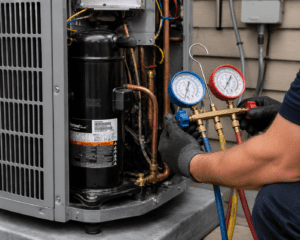
What to do for refrigerant hiss: shut the system off. Refrigerant leaks are EPA Section 608 regulated; recovery, repair, and recharge require a certified technician. Continuing to run with a leak damages the compressor as charge drops.
What to do for duct hiss: not an emergency. The system runs fine but loses cooling capacity and efficiency to the leak. Duct sealing is a scheduled-visit repair.
Banging or clanking Loose internal part
Sharp irregular impact sounds, especially at start-up or during fan operation. Source: a loose blower fan blade striking the housing, a loose mounting bracket, a foreign object (twig, leaf debris, a stick) caught in the outdoor condenser fan, or — less commonly but more seriously — a loose connecting rod inside the compressor.
What to do: shut the AC off. For outdoor banging, visually inspect the condenser cage for visible debris and clear it (with the breaker off). For indoor banging, the air handler needs to come open — that's a tech job. A loose compressor part is a sign that compressor failure is imminent; Coastal Carolina Comfort techs identify this on the diagnostic and the conversation typically moves to repair-versus-replace.
Squealing Worn blower belt or dry bearings
A high-pitched whine or squeal, usually at start-up, sometimes throughout the cycle. Source: an older belt-driven blower with a slipping or glazed belt, or any motor whose bearings are starting to fail (a precursor to the grinding sound described above).
Most residential air handlers now use direct-drive blower motors (no belt), so squealing in newer systems usually points to bearings rather than belts.
What to do: schedule a service visit. Belt replacement is fast on the systems that still use them. Bearing replacement is a motor replacement.
Screaming or screeching High-pressure cutoff — shut it off
A loud, sudden, sustained screeching from the outdoor unit. Source: the high-pressure safety switch has activated because pressure inside the refrigerant loop has exceeded design limits. This happens when the condenser coil can't reject heat fast enough (fouled coil, low ambient airflow), when refrigerant is dangerously overcharged, or when the metering device has failed.
Continued operation under high-pressure conditions risks compressor damage and, in rare cases, line-set rupture. Call Coastal Carolina Comfort — high-pressure events are diagnosed and repaired same-day in the Summerville and Charleston markets.
Clicking Normal at start/stop, abnormal if continuous
Single clicks when the system starts and again when it stops are normal — that's the contactor closing and opening. Persistent clicking during the run cycle, or rapid repeated clicks without the compressor starting, is the abnormal pattern. Source: a thermostat with a stuck relay, a contactor that's failing to fully close, or a control board cycling repeatedly through a startup attempt.
What to do: if the system also fails to cool, see the AC won't turn on diagnostic. If the system cools but the clicking is constant, schedule a service visit. A failing contactor that keeps trying will eventually weld shut or burn out.
Rattling Loose panel, debris, or vibration
A rattle from the outdoor cabinet usually means a loose access panel, a screw vibrating in its hole, or debris (a stick, a pine cone, a piece of insulation) caught between the fan blade and the cage. Indoor rattling typically points to a loose blower housing, an unsecured cabinet panel, or air filter rattling in a too-loose slot.
What to do: for outdoor rattles, kill power at the disconnect, open the cage, remove visible debris, tighten visible loose screws on the cabinet. Indoor rattles can be more involved — schedule a visit if a panel inspection doesn't resolve it.
Whistling Restricted airflow
A high-pitched whistle from a vent, the return grille, or near the air handler. Source: airflow being forced through a restriction — most often a clogged air filter, partially closed dampers, or undersized return ductwork that can't supply the air handler's design flow rate.
What to do: pull and inspect the air filter. Replace if matted, gray, or older than 60 days. In Lowcountry pollen seasons the interval shortens. If the whistle persists after a fresh filter, the cause is ductwork — a Coastal Carolina Comfort tech can run a static pressure measurement to identify the restriction.
Should you keep going, or stop and call?
The decision rule, same as every Coastal Carolina Comfort diagnostic:
- Keep going: filter replacement (for whistling), debris removal (for rattling, with the breaker off), single-click confirmation at start and stop.
- Stop and call: grinding, buzzing, hissing from refrigerant lines, banging, screaming/screeching, continuous clicking, squealing that doesn't resolve with a filter check.
A safety note
Both indicate active failure modes that get worse with continued operation. An electrical short on the outdoor unit can ignite surrounding vegetation. A refrigerant leak damages the compressor as charge drops below threshold. Shut the system off at the thermostat and the breaker; call rather than waiting for the next regularly scheduled service interval.
Localized the sound? Tell us what you heard.
The information that routes the right truck:
Which unit was making the noise (indoor air handler or outdoor condenser). What the noise sounds like in your own words. When in the cycle it happens (start, run, stop, all the time). Whether the system is still cooling. Tell the dispatcher these and the tech arrives with the parts that match your symptom.
Call (843) 708-8735 for same-day Summerville and Charleston routing.
What an AC noise repair involves
Repair scope follows the diagnosed cause. The general scope by sound category:
Motor or bearing replacement (grinding, squealing)
A larger-scope repair. Blower and condenser motors are brand-matched by horsepower, voltage, frame size, and rotation direction. ECM (variable-speed) motors cost more than PSC (single-speed). Once the failed motor is identified, replacement is a single-visit repair on most platforms.
Electrical repair (buzzing, abnormal clicking)
Capacitor and contactor replacements are among the fastest repairs in the symptom cluster. Parts are stocked on the truck for common platforms. Loose-wire repairs are scope-by-finding.
Refrigerant leak repair plus recharge (hissing at the line set)
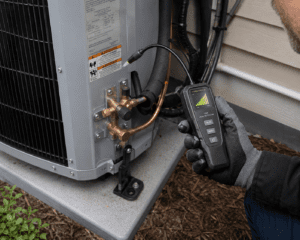
Variable scope. Leak detection (electronic leak detector, UV dye, or pressure decay testing) comes first, then the seal or component replacement, then evacuation and recharge to manufacturer spec. Refrigerant is EPA Section 608 regulated. Systems on R-22 (phased out for new equipment) carry meaningfully higher recharge costs than R-410A or R-454B systems.
Duct sealing (hissing at registers, whistling at vents)
Scheduled service. Coastal Carolina Comfort uses aerosol sealing or manual mastic on accessible duct sections. Inside-wall sections expand scope. Duct sealing pays back in cooling efficiency and humidity control across a Lowcountry summer.
Compressor diagnosis (banging from the outdoor unit, persistent loud operation)
The largest-scope outcome. If the diagnostic identifies the compressor as the source, the conversation moves to repair-versus-replace based on the system's age, refrigerant type, remaining warranty, and the cost differential. Variable-speed replacement systems handle Lowcountry humidity load better than single-stage replacements on the same footprint.
Why Lowcountry AC systems develop noise problems sooner
Three reasons coastal SC systems show noise-related failures earlier than inland systems:
- Salt air accelerates electrical contact corrosion. Contactor terminals, capacitor leads, and outdoor disconnect blades pit faster east of I-26 than inland. The buzzing and abnormal-clicking failure modes show up sooner in coastal systems as a result.
- Humidity stresses bearings. Sealed motor bearings rely on their lubricant pack staying inside the bearing housing. High dewpoint summer operation, especially under continuous load, accelerates the failure timeline. Grinding and squealing failures track with how hard the system has had to work through Lowcountry humidity peaks.
- Outdoor cabinets accumulate debris fast. Pollen seasons, oak leaf drops in fall, and proximity to vegetation in suburban developments mean the outdoor cabinet collects more debris in a coastal SC year than the same system would inland. Rattling, banging from debris, and high-pressure events from fouled coils all track to this.
Get this fixed in your area
Coastal Carolina Comfort runs same-day routing for AC noise diagnostics across both the Summerville and Charleston markets. Bring the noise description from the walk-through above and the tech will arrive with the parts most likely to match.
Summerville and Berkeley County
Same-day diagnostic across Nexton, Cane Bay, Carnes Crossroads, Knightsville, Wescott Plantation, Historic Downtown, and Summers Corner.
Summerville AC repair →Charleston and the Lowcountry
Mount Pleasant, Daniel Island, James Island, West Ashley, Johns Island, North Charleston, and the surrounding Lowcountry communities.
Charleston AC repair →Related diagnostic guides
-
AC won't turn on
When the buzz or click is the only sound and the system won't start — the diagnostic for the upstream-of-compressor cluster.
-
AC short cycling
When the start-and-stop pattern itself is the symptom, and the noise is repeated clicking or short bursts of operation.
-
AC frozen evaporator coil
When refrigerant hissing pairs with a frozen coil — the freeze is downstream of the leak.
Frequently asked questions
Is it safe to keep using my AC if it's making strange noises?
It depends on the noise. Grinding, buzzing, hissing from the refrigerant lines, screaming, and banging are all "shut it off" sounds — continued operation makes the underlying failure worse and risks larger repair scope. Whistling at a vent and rattling from debris are uncomfortable but not damaging. When in doubt, shut the system off at the thermostat and call Coastal Carolina Comfort; the diagnostic visit is meaningfully cheaper than a compressor replacement.
What sound does a failing AC compressor make?
The two most common compressor failure sounds are a sustained loud humming (the compressor is energized but mechanically locked and can't start) and irregular banging from inside the outdoor cabinet (a loose internal component is striking the housing during operation). Either pattern is a stop-and-call signal. Coastal Carolina Comfort techs verify with a clamp meter and compressor electrical tests; the next conversation is repair-versus-replace based on the system's age and warranty.
Why is my AC making a buzzing sound but not turning on?
The most common cause is a failed run capacitor. The contactor closes (you hear the electrical buzz of the energized coil), but the capacitor can't deliver the start charge needed to spin the compressor or condenser fan. A multimeter test confirms the diagnosis in seconds. Replacement capacitors are stocked on Coastal Carolina Comfort trucks for the most common platforms.
How loud is too loud for a residential AC unit?
Older single-stage outdoor units run noisier than newer variable-speed equipment, so "too loud" depends on the system's design baseline. The diagnostic question is "has it gotten louder than it used to be?" — that's the signal that something has changed. A system that has run quietly for years and suddenly grew louder is a service call. A system that has always run loud and hasn't changed is a system that's noisy by design.
What does an AC refrigerant leak sound like?
A steady hiss, sometimes a slight whistle, audible at the line set (the insulated copper lines running between the indoor and outdoor units) or at the indoor coil access panel. Refrigerant under pressure escapes through small holes with a characteristic sustained sound, distinct from the intermittent rattling or vibrating noises that come from mechanical issues. Refrigerant work is EPA Section 608 regulated — the leak repair and recharge require a certified Coastal Carolina Comfort technician.
Can a noisy AC fix itself?
No. Noises from AC systems are mechanical or electrical signals that a component is operating outside design parameters. Those conditions don't reverse without intervention. The opposite is more common: the noise gets louder as the underlying failure progresses, and the repair scope grows with it. The lightest-scope repair on most AC noises is the one done early.
Strange noise from your AC? Don't let it run.
Call (843) 708-8735 for same-day Summerville and Charleston service.