 Heating Repair Scams: How Summerville Homeowners Can Protect Themselves from Dishonest Contractors
Heating repair scams typically involve fake diagnoses (especially the “cracked heat exchanger” scare), bait-and-switch pricing, unnecessary repairs, and high-pressure sales tactics designed to rush you into expensive decisions. Protect yourself by getting second opinions on major repairs, verifying contractor licensing through South Carolina’s LLR website, checking reviews and BBB ratings, and never authorizing work without a written estimate. Legitimate heating repair companies explain problems clearly, provide documentation, and give you time to decide. If a technician pressures you to replace your entire system immediately or demands cash payment, those are major red flags requiring a second opinion.
Why Heating Repair Scams Are So Effective
Scammers exploit a perfect storm of circumstances:
You’re vulnerable. When your heat fails in January, you’re cold, stressed, and desperate for a solution. Rational decision-making suffers.
You lack expertise. Most homeowners can’t evaluate whether a diagnosis is legitimate. You’re trusting someone you just met to tell you the truth about complex equipment.
The stakes feel high. Heating problems can involve safety concerns (carbon monoxide, gas leaks) that make you afraid to question recommendations.
Time pressure is real. You need heat now, not next week. This urgency makes you susceptible to pressure tactics.
Dishonest contractors know all of this—and they use it against you.
Understanding common scams helps you recognize them before you become a victim.
The “Cracked Heat Exchanger” Scam
This is the most common and most lucrative heating repair scam. Here’s how it works:
The Setup
A technician arrives for routine maintenance, a minor repair, or a “free inspection” offer. During the visit, they examine your furnace and deliver alarming news:
“I found a crack in your heat exchanger. This is very dangerous—carbon monoxide could be leaking into your home right now. You need to stop using this furnace immediately.”
The Fear Factor
Heat exchanger cracks are a legitimate safety concern. A cracked heat exchanger can leak carbon monoxide—an odorless, colorless gas that kills hundreds of Americans annually. The technician is counting on you knowing this.
They may show you:
- Photos (possibly from another furnace or the internet)
- A video scope image (often misrepresented or from another job)
- “Evidence” of carbon monoxide (using a detector held near the furnace)
The Pressure
With fear established, the pressure begins:
“I can’t in good conscience leave this running. Your family is at risk. We need to shut this down today.”
“The heat exchanger can’t be repaired—you need a new furnace. Fortunately, I can get a crew here tomorrow.”
“If you sign today, I can give you a discount. Otherwise, the price goes up.”
The Reality
Heat exchanger cracks do occur—but they’re far less common than scammers claim. Many “cracks” are actually:
- Normal seams or welds in the metal
- Surface discoloration or rust
- Expansion joints designed into the exchanger
- Completely fabricated
Legitimate diagnosis requires:
- Visual inspection with proper lighting
- Sometimes specialized cameras or dye testing
- Combustion analysis measuring actual CO levels
- Documentation you can verify
How to Protect Yourself
Don’t panic. A cracked heat exchanger is serious but rarely an immediate emergency. You have time to verify the diagnosis.
Ask for documentation. Request photos or video of the actual crack on your actual furnace. Ask where specifically the crack is located.
Get a second opinion. Before authorizing replacement, have another company inspect the furnace. A legitimate crack will be found by both technicians.
Check CO levels yourself. If you have carbon monoxide detectors (you should), check their readings. Plug-in detectors with digital displays show current levels.
Verify the company. Is this a reputable local company or someone who showed up offering a “free inspection”?
The Bait-and-Switch Pricing Scam
This scam lures you with low prices, then inflates costs once work begins.
How It Works
The bait: You see an advertisement or receive a quote for an attractively low price:
- “$49 furnace tune-up!”
- “Heating repair starting at $249!”
- “Free diagnostic with any repair!”
The switch: Once the technician arrives and begins work, the price escalates:
“The $49 tune-up doesn’t include the combustion analysis—that’s another $150.”
“I found several problems. The $249 was just for the service call. The actual repairs will be $800.”
“The diagnostic is free, but the part you need costs $400, and labor is $300.”
Red Flags
- Prices dramatically lower than competitors
- Vague descriptions of what’s included
- “Starting at” pricing without clear parameters
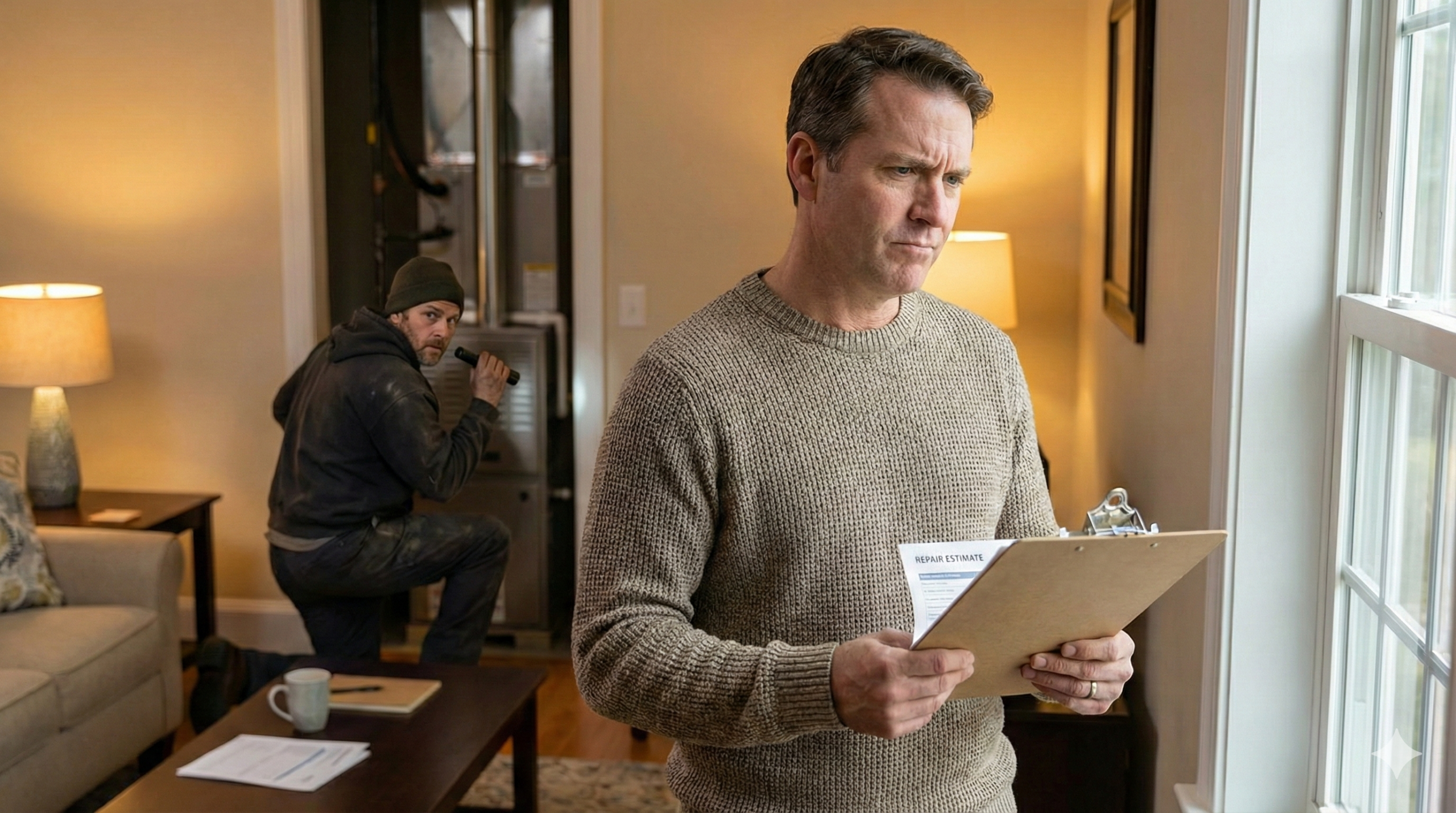
- Refusal to provide written estimates before work begins
- Costs that escalate significantly once technician is on-site
How to Protect Yourself
Get detailed written estimates before any work begins. The estimate should specify:
- Diagnostic/service call fee
- Specific repairs recommended
- Parts costs
- Labor costs
- Total price
Ask “what’s included” when scheduling. If the answer is vague, that’s a warning sign.
Compare multiple quotes. If one quote is dramatically lower than others, ask why. Legitimate companies have similar cost structures.
Don’t feel obligated. A technician in your home doesn’t mean you must authorize their repairs. You can pay the diagnostic fee and get a second opinion.
The Unnecessary Repair Scam
Some technicians recommend repairs you don’t actually need.
Common Unnecessary Repair Claims
“Your capacitor is weak.” Capacitors do fail, but “weak” is subjective. Some technicians replace functional capacitors as a revenue generator.
“You need a new thermostat.” Thermostats rarely fail completely. Many “thermostat problems” are actually wiring issues, dead batteries, or user error.
“Your refrigerant is low.” (Heat pumps) Refrigerant doesn’t deplete naturally—low levels indicate a leak. Adding refrigerant without fixing the leak is a temporary (and expensive) bandage.
“All these parts are worn and should be replaced.” Preventive replacement has some merit, but replacing multiple functional parts is often unnecessary.
How to Protect Yourself
Ask questions:
- What specifically is wrong with this part?
- What happens if I don’t replace it?
- How urgent is this repair?
- Can you show me the problem?
Understand the diagnosis. A legitimate technician can explain the problem in terms you understand. Vague explanations or technical jargon designed to confuse you are red flags.
Get a second opinion on expensive repairs. If the diagnosis is legitimate, another technician will confirm it.
Request the old parts. For replaced components, ask to see (or keep) the old parts. This discourages phantom repairs.
The “Your System Is Dangerous” Scam
Beyond heat exchangers, scammers use other safety fears to pressure sales:
Common Scare Tactics
“Your gas valve is leaking.” Gas leaks are serious—but also verifiable. You can smell gas leaks (the odorant is added specifically for detection). A technician claiming an odorless leak should demonstrate it with a gas detector.
“Your electrical connections are a fire hazard.” Loose connections can be hazardous, but they’re also easily tightened. This shouldn’t require system replacement.
“Your flue is blocked—carbon monoxide is backing up.” Flue blockages occur but are usually visible and verifiable. Ask to see the blockage.
“Your system is too old to be safe.” Age alone doesn’t make a system dangerous. Well-maintained older systems can operate safely for decades.
The Pattern
Notice the pattern: all these claims involve safety fears that make you afraid to question the diagnosis or delay action.
Legitimate safety concerns exist—but legitimate technicians:
- Show you the actual problem
- Explain it clearly
- Provide documentation
- Give you time to verify and decide
Scammers create urgency and pressure immediate decisions.
How to Protect Yourself
Verify safety claims independently:
- Check your carbon monoxide detectors
- Smell for gas odors
- Look at the “problem” yourself if possible
Get a second opinion before authorizing major work based on safety claims.
Call your gas company if gas leaks are claimed. They’ll inspect for free and have no incentive to sell you equipment.
Trust your instincts. If something feels like a high-pressure sales pitch rather than a professional diagnosis, it probably is.
The “Emergency” Upsell Scam
This scam turns minor repairs into major replacements.
How It Works
You call for a specific repair—maybe your furnace won’t ignite. The technician arrives, diagnoses the problem (a $150 ignitor), then pivots:
“I can replace the ignitor, but honestly, your system is on its last legs. You’re going to be calling me back every few months. You’d be better off replacing the whole thing now.”
Or:
“The ignitor is just a symptom. The real problem is your control board, and those are $600. At that point, you’re throwing good money after bad on a 12-year-old system.”
The Psychology
This scam exploits:
- Your trust (they correctly diagnosed the initial problem)
- Your fear (nobody wants repeated breakdowns)
- Your lack of knowledge (you can’t evaluate their claims)
- The sunk cost of the service call (you’ve already paid for the diagnosis)
How to Protect Yourself
Stick to the original problem. If you called about an ignitor, get the ignitor fixed. Evaluate system replacement separately, without pressure.
Ask specific questions:
- What exactly is wrong with the control board?
- How do you know it will fail soon?
- What’s the expected lifespan of my current system?
Get replacement quotes separately. If you’re considering replacement, get quotes from multiple companies—not just the one pressuring you during a repair call.
Know your system’s age and condition. A 12-year-old heat pump in good condition has years of life left. A 20-year-old furnace with multiple recent repairs might legitimately need replacement.
Red Flags: Warning Signs of Scam Operators
Watch for these indicators:
Before They Arrive
| Red Flag | Why It’s Suspicious |
|---|---|
| Unsolicited contact (door-to-door, cold calls) | Reputable companies don’t need to solicit |
| Dramatically low prices | Below-cost pricing indicates bait-and-switch |
| No physical address or only P.O. box | Difficult to hold accountable |
| Can’t provide license number | May not be properly licensed |
| Pressure to schedule immediately | Prevents you from researching them |
| No online reviews or very few | Possibly a fly-by-night operation |
During the Service Call
| Red Flag | Why It’s Suspicious |
|---|---|
| Arrives in unmarked vehicle | Legitimate companies display branding |
| Can’t show company ID | May not be who they claim |
| “Discovers” multiple serious problems | Classic upselling pattern |
| Won’t show you the problem | May not exist |
| Uses technical jargon to confuse | Hiding behind complexity |
| Pressures immediate decision | Preventing second opinions |
| Demands cash payment | Avoiding paper trail |
| Won’t provide written estimate | No accountability |
The Diagnosis and Recommendation
| Red Flag | Why It’s Suspicious |
|---|---|
| Every problem is “dangerous” or “emergency” | Fear-based selling |
| Repair cost approaches replacement cost | Pushing toward replacement |
| “Can’t get parts” for repairable system | May be false |
| Refuses to do repair, only replacement | Prioritizing profit over service |
| Discount only available “today” | Pressure tactic |
| Can’t explain problem in plain language | May not understand it themselves |
How to Find Legitimate Heating Repair
Protect yourself by choosing contractors carefully:
Verify Licensing
South Carolina requires HVAC contractors to be licensed. Verify at the Department of Labor, Licensing and Regulation (LLR) website: llr.sc.gov
What to check:
- Active license status
- License type appropriate for the work
- Any disciplinary actions
Check Certifications
NATE Certification: North American Technician Excellence certifies individual technicians. While not required, it indicates training and competence.
Manufacturer certifications: Some technicians are certified by specific equipment manufacturers (Carrier, Trane, Lennox, etc.).
Research Reputation
Google Reviews: Look for patterns in reviews. A few negative reviews are normal; consistent complaints about specific issues (bait-and-switch, pressure tactics) are warning signs.
BBB Rating: Check the Better Business Bureau for ratings and complaint history.
Local references: Ask neighbors, friends, or family for recommendations.
Get Multiple Estimates
For any significant repair (over $300) or replacement:
- Get at least three written estimates
- Compare what’s included in each
- Ask questions about differences
- Be suspicious of outliers (very high or very low)
Trust Your Instincts
If something feels wrong—aggressive sales tactics, evasive answers, pressure to decide immediately—trust that feeling. Legitimate contractors respect your right to take time and make informed decisions.
What to Do If You’ve Been Scammed
If you believe you’ve been victimized:
Document Everything
- Save all receipts, contracts, and written communications
- Take photos of any work performed
- Note names, dates, and details of conversations
- Keep the old parts if you have them
Dispute Charges
Credit card: Contact your card issuer to dispute the charge. Explain that services weren’t delivered as promised or that you were subjected to fraudulent practices.
Check or cash: Recovery is more difficult, but document everything for potential legal action.
File Complaints
South Carolina LLR: File a complaint against licensed contractors at llr.sc.gov. Unlicensed contracting is also reportable.
Better Business Bureau: File a complaint at bbb.org. This creates a public record and may prompt resolution.
South Carolina Attorney General: Consumer protection complaints can be filed at scag.gov.
Federal Trade Commission: Report fraud at reportfraud.ftc.gov.
Get a Legitimate Assessment
Have a reputable company evaluate what was done:
- Was the diagnosed problem real?
- Was the repair performed correctly?
- Was the work necessary?
This documentation supports complaints and potential legal action.
Warn Others
Leave honest reviews on Google, Yelp, and other platforms. Your experience may prevent others from being victimized.
Coastal Carolina Comfort’s Commitment to Honest Service
We’ve served Summerville families since 2005, and our reputation is built on doing things right:
Honest diagnosis:
- We identify the actual problem—not invented issues
- We show you what we find when possible
- We explain problems in plain language
- We provide documentation of our findings
Transparent pricing:
- Written estimates before work begins
- No surprise charges
- Clear explanation of costs
- We’ll tell you if repair doesn’t make economic sense
No pressure tactics:
- We give you time to decide
- We encourage second opinions on major repairs
- We don’t use scare tactics to force decisions
- We respect your right to say no
Proper credentials:
- Licensed in South Carolina
- Insured for your protection
- Experienced technicians who know Lowcountry homes
We know scam operators damage trust in our entire industry. That’s why we’re committed to showing Summerville homeowners what legitimate heating repair looks like.
Need a second opinion? Contact us for an honest assessment of your heating system.
Frequently Asked Questions
How do I know if a “cracked heat exchanger” diagnosis is real? Request documentation—photos or video of the actual crack on your furnace, with clear identification of the location. Get a second opinion from another reputable company before authorizing replacement. Check your carbon monoxide detectors for elevated readings. A legitimate crack will be confirmed by multiple technicians and may show measurable CO levels.
What should I do if a technician pressures me to decide immediately? Resist the pressure. Legitimate emergencies (active gas leaks, CO detector alarms) are rare. For most situations, you have time to get a second opinion. A technician who won’t let you think or consult others is prioritizing their sale over your interests. Pay the diagnostic fee if applicable and call another company.
Is it worth getting a second opinion on a $200 repair? For minor repairs, a second opinion may cost more than it saves. However, if something feels wrong about the diagnosis or the technician’s behavior raised red flags, a second opinion provides peace of mind. For repairs over $500, second opinions are almost always worthwhile.
How can I verify a contractor’s license in South Carolina? Visit the South Carolina Department of Labor, Licensing and Regulation website (llr.sc.gov) and use their license verification tool. Search by company name or license number. Verify the license is active, appropriate for HVAC work, and has no disciplinary actions.
What’s a reasonable diagnostic fee? In the Summerville area, diagnostic or service call fees typically range from $75–125 for regular hours, $100–175 for after-hours or emergency calls. This fee covers the technician’s time to travel to your home and diagnose the problem. It’s usually applied toward repairs if you authorize work. Fees significantly outside this range warrant questions.