

Why Regular AC Maintenance Prevents Costly Repairs
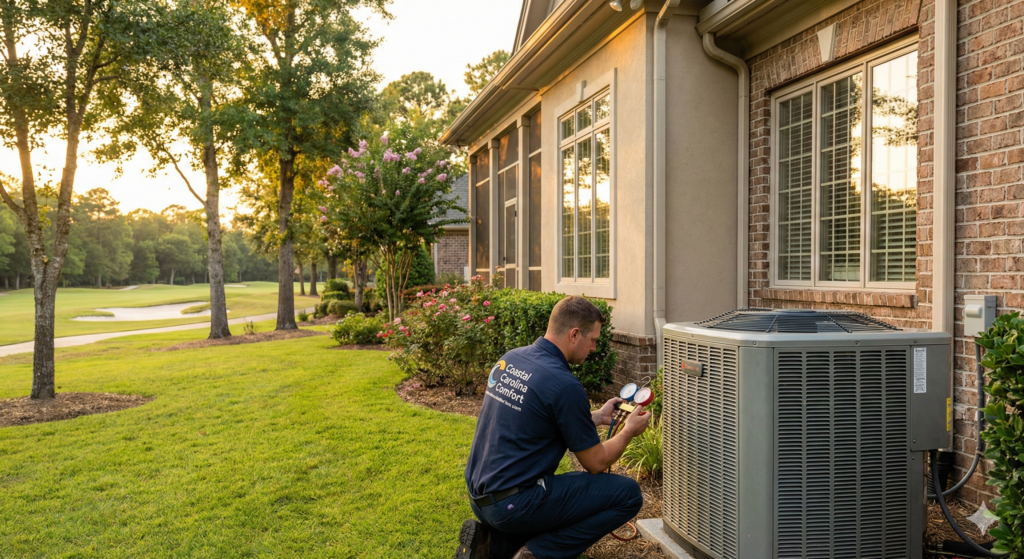
Why Regular AC Maintenance Prevents Costly Repairs Professional AC maintenance is the single most effective way to prevent unexpected breakdowns, extend your system’s lifespan, and keep repair costs low over time. A comprehensive tune-up performed once or twice per year allows a trained technician to identify and address failing components — worn capacitors, low refrigerant levels, dirty coils, corroded electrical connections — before they cascade into expensive emergency repairs. In the Lowcountry, where AC systems run six to seven months per year and endure extreme humidity, salt air exposure, and sustained high temperatures, maintenance isn’t optional if you want your system to reach its full lifespan. Coastal Carolina Comfort’s preventive maintenance program covers every critical component, and the homeowners who follow a regular maintenance schedule consistently experience fewer breakdowns, lower energy bills, and longer system life. Here’s what professional AC maintenance actually involves, how it prevents the most common and costly repairs, and why it matters more in South Carolina than almost anywhere else. What Professional AC Maintenance Includes A proper AC tune-up is not a quick visual inspection and a filter change. It’s a systematic evaluation of every component that can fail, degrade, or lose performance over time. At Coastal Carolina Comfort, our NATE-certified technicians follow a comprehensive checklist during every maintenance visit. Electrical Component Testing Your technician tests the run capacitor and start capacitor with a multimeter to measure microfarad readings. A capacitor that’s weakened but still functional today may fail within weeks under peak summer load — identifying this during a maintenance visit means a $200 scheduled replacement instead of a $400+ emergency call. We also inspect contactors for pitting and carbon buildup, check wiring connections for corrosion or looseness, and verify that safety controls and disconnect switches are functioning properly. Refrigerant Level Verification Using pressure gauges connected to the system’s service ports, your technician checks that the refrigerant charge matches the manufacturer’s specifications. Low refrigerant means a leak exists somewhere in the system — and identifying a slow leak during a maintenance visit prevents the scenario where your system gradually loses cooling capacity, works harder, consumes more electricity, and eventually shuts down entirely. Coil Inspection and Cleaning Both the evaporator coil (indoor) and condenser coil (outdoor) are checked for dirt, debris, and biological buildup. In the Lowcountry, the evaporator coil is particularly susceptible to mold and biofilm growth because it operates in a perpetually moist environment. A dirty evaporator coil restricts airflow, reduces heat absorption, and can cause the coil to freeze — all problems that lead to repair calls. The condenser coil accumulates dirt, pollen, grass clippings, and — in coastal areas — salt residue that corrodes the aluminum fins. Condensate Drain Line Inspection and Treatment The condensate drain line is one of the most common sources of AC service calls in our market. Our technicians flush the drain line, check the drain pan for cracks or corrosion, and treat the line to prevent algae and biofilm buildup. A $20 preventive treatment during a maintenance visit prevents a $200+ emergency drain clearing call — or worse, water damage to your ceiling or flooring. Thermostat Calibration and Operation We verify that your thermostat is reading temperatures accurately, communicating properly with the system, and cycling the equipment at appropriate intervals. A miscalibrated thermostat can cause short cycling, excessive runtime, or temperature inconsistencies that you might attribute to a system problem when the real issue is a $15 calibration fix. Air Filter Assessment We check and replace the air filter if needed, and we discuss the right filter type and replacement frequency for your specific system and home. In the Lowcountry’s high-pollen environment, homeowners often benefit from changing filters every 30 days during peak season rather than the standard 60-90 day recommendation you’ll find in most owner’s manuals. Airflow and Ductwork Inspection Your technician checks supply and return airflow at the registers, looks for obvious ductwork issues like disconnected sections or crushed flex duct (extremely common in South Carolina attic spaces), and verifies that the blower motor is operating within normal parameters. How Maintenance Prevents the Five Most Costly AC Repairs Each of the repairs below is one that maintenance directly prevents or mitigates. Repair 1: Compressor Failure ($1,500–$3,500) The compressor is the most expensive component in your AC system, and it rarely fails without a contributing cause. Low refrigerant forces the compressor to work under abnormal pressures. Dirty coils restrict heat transfer and cause the compressor to overheat. Electrical issues like failing capacitors put additional stress on the compressor motor. Regular maintenance addresses all three contributing factors, dramatically reducing the risk of catastrophic compressor failure. Repair 2: Evaporator Coil Replacement ($1,000–$2,500) Evaporator coils can develop refrigerant leaks over time, particularly in the Lowcountry where the coil’s perpetually moist operating environment accelerates corrosion. Maintenance catches early signs of coil degradation — unusual temperature differentials across the coil, minor pressure drops, or visible corrosion — allowing for planned repair or replacement rather than an emergency situation. Repair 3: Blower Motor Failure ($400–$900) Blower motors fail when they’re overworked. The most common overwork scenario is restricted airflow — typically from dirty filters, dirty evaporator coils, or ductwork issues. Every one of those root causes is addressed during a standard maintenance visit. A clean system with good airflow means your blower motor operates within its designed parameters instead of straining to push air through restrictions. Repair 4: Frozen Evaporator Coil (Variable — $200–$800+) A frozen coil is almost always a symptom of another problem: low refrigerant, restricted airflow, or a dirty coil. Maintenance catches all three root causes. Left unaddressed, a repeatedly freezing coil can damage the compressor — turning a $200 root-cause repair into a $3,000+ compressor replacement. Repair 5: Condensate Drain Backup ($100–$250 + potential water damage) This is the single most preventable AC service call in the Lowcountry. Our systems pull massive amounts of moisture from the air during the cooling season, and that moisture must drain properly. Algae, mold, and biofilm will inevitably build up in