
Emergency AC Repair: What to Do When Your AC Breaks Down in the Lowcountry Heat
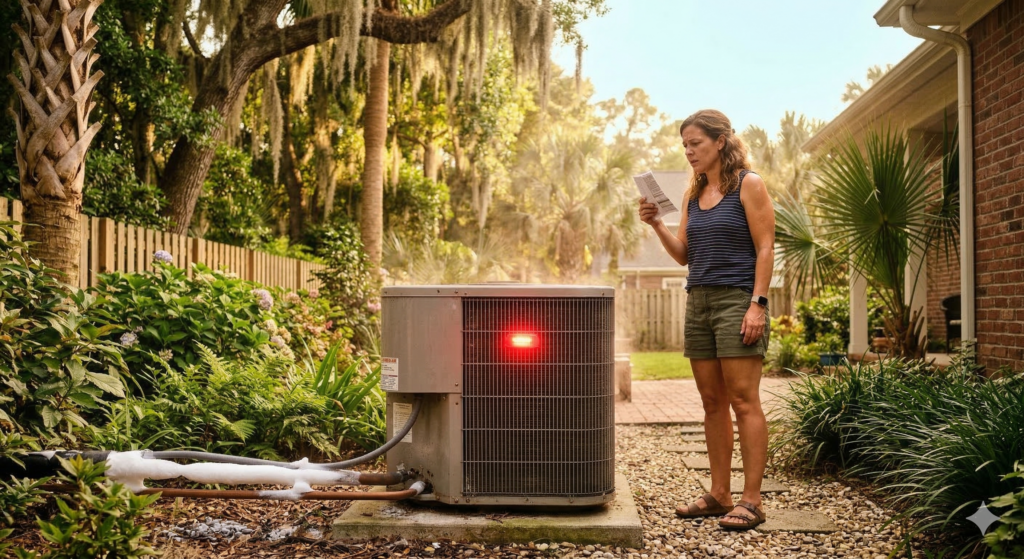
Emergency AC Repair: What to Do When Your AC Breaks Down in the Lowcountry Heat A complete AC failure in the South Carolina Lowcountry during summer is not just an inconvenience — it can become a genuine health and safety concern within hours. When outdoor temperatures reach 95°F or higher and relative humidity pushes past 80%, indoor temperatures in an uncooled home can exceed 90°F in as little as two to three hours. For households with elderly family members, young children, or anyone with respiratory or cardiovascular conditions, this creates real risk. Coastal Carolina Comfort provides same-day emergency AC repair across Summerville, Charleston, and the entire Lowcountry, with NATE-certified technicians who carry the most common replacement parts on their trucks so we can resolve the majority of emergency calls in a single visit. This guide covers exactly what to do when your AC fails unexpectedly, what steps to take immediately to protect your family and your home, and how to get professional help quickly. What Qualifies as an AC Emergency? Not every AC issue is an emergency, and knowing the difference helps you make smart decisions about urgency and cost. An AC emergency is any situation where the loss of cooling creates a safety risk or where continued operation could cause significant damage to the system or your home. True emergencies — call immediately: Your system has completely stopped working during a heat advisory or when outdoor temperatures exceed 90°F. The indoor temperature is climbing and you have vulnerable household members. You smell burning or see smoke coming from your indoor air handler or outdoor condenser unit. Your system is actively leaking water into living spaces, ceilings, or near electrical panels. You hear loud banging, grinding, or popping sounds that suddenly started during operation. Urgent but not emergency — call within 24 hours: Your AC is running but only producing lukewarm air. You notice ice forming on the refrigerant lines or evaporator coil. Short cycling has started but the system is still providing some cooling. A gradual decline in cooling performance over the past few days. If you’re unsure whether your situation is an emergency, it’s always better to call and describe what’s happening. Our team can help you assess the urgency over the phone and advise on immediate steps while we dispatch a technician. Immediate Steps When Your AC Fails When your AC stops working, taking the right steps in the first 30 minutes can protect your family, prevent secondary damage, and give your technician a head start on diagnosis. Step 1: Check the Thermostat and Breaker Before assuming the worst, rule out the simplest causes. Verify your thermostat is set to “cool” mode, the temperature is set below the current room temperature, and the fan is set to “auto.” Then check your electrical panel — AC systems use dedicated breakers, and a tripped breaker is one of the most common reasons for a sudden shutdown. Reset it once. If it trips again immediately, do not reset it a second time — a repeatedly tripping breaker indicates an electrical fault that requires professional attention. Step 2: Check Your Air Filter A severely clogged air filter can cause the evaporator coil to freeze, which eventually triggers a system shutdown. If your filter is visibly dirty or clogged, replace it and then set your thermostat to “fan only” for 30 to 60 minutes. This circulates air across the frozen coil to help it thaw. After thawing, try running the system in cooling mode again. Step 3: Inspect the Outdoor Unit Go outside and look at your condenser unit. Make sure it’s running — you should hear the fan and compressor. Check for obvious issues like vegetation growing against the unit (maintain at least two feet of clearance), a visibly damaged fan blade, or standing water around the base from a recent storm. If the outdoor unit isn’t running at all but the indoor fan is blowing, the issue is likely in the condenser, the compressor, or the electrical connection between the two units. Step 4: Protect Your Home Close blinds and curtains on sun-facing windows to reduce solar heat gain. Close doors to unused rooms to concentrate whatever cool air remains in the spaces you’re actively using. Avoid using the oven, dishwasher, dryer, or any heat-generating appliance. If you have ceiling fans, run them counterclockwise to create a wind-chill effect. Step 5: Protect Vulnerable Household Members Move elderly family members, infants, and pets to the coolest room in the house — usually a ground-floor room on the north-facing side. Provide plenty of water. If indoor temperatures exceed 85°F and you have high-risk individuals in the home, consider relocating to a cooled space — a neighbor’s home, a community center, or even a public library — until the repair is completed. Why Lowcountry AC Emergencies Are Different An AC breakdown in South Carolina’s Lowcountry presents challenges that homeowners in other regions simply don’t face, and understanding these factors helps explain why fast response matters here more than in most places. Extreme Heat and Humidity Combination It’s not just the temperature — it’s the combination. A 95°F day with 85% relative humidity produces a heat index well above 100°F. When your indoor environment mirrors these conditions, the risk of heat exhaustion and heat stroke rises significantly, especially for vulnerable populations. The Lowcountry’s cooling season runs from April through October, which means your AC system bears a heavier workload than systems in most other U.S. markets. Moisture and Mold Risk When your AC stops running, it also stops dehumidifying your indoor air. In a region where outdoor humidity routinely exceeds 80%, your indoor humidity can climb above 60% within hours of an AC shutdown. Elevated indoor humidity creates ideal conditions for mold and mildew growth — especially in ductwork, on evaporator coils, and in crawl spaces. The longer the system stays down, the greater the moisture damage risk. System Stress During Peak Season Lowcountry AC systems work harder and run longer than systems