

AC Repair vs. AC Replacement: How Lowcountry Homeowners Should Decide
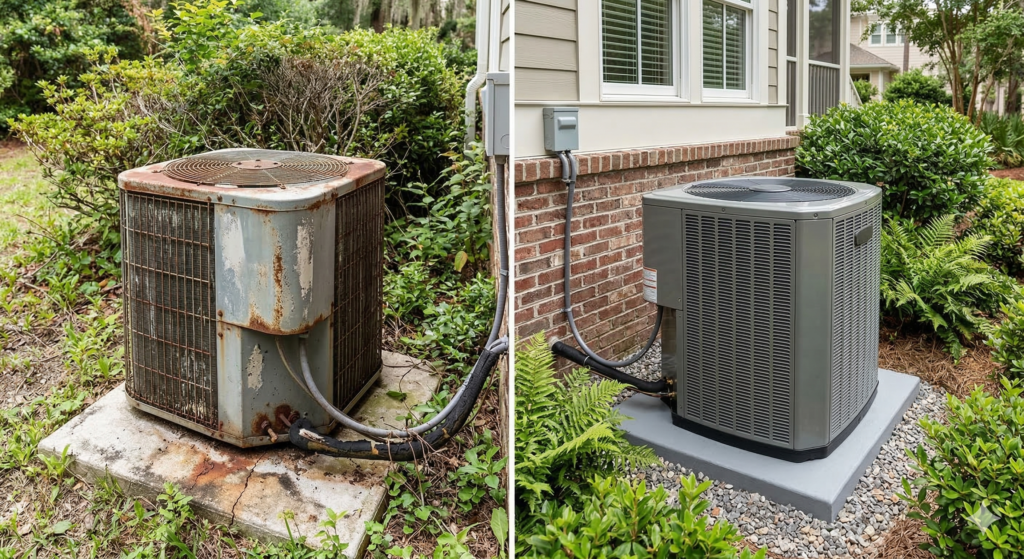
AC Repair vs. AC Replacement: How Lowcountry Homeowners Should Decide Deciding whether to repair or replace your air conditioning system is one of the most consequential financial decisions a homeowner faces, and there is no universal right answer. The smart choice depends on your system’s age, the cost of the current repair, your repair history, the refrigerant your system uses, and the efficiency gap between your current unit and modern equipment. Coastal Carolina Comfort walks every customer through this decision honestly, because we’ve seen firsthand that the wrong call — repairing a system that should be replaced, or replacing one that had years of life left — costs Lowcountry families real money. Here’s the framework we use to help homeowners across Summerville, Charleston, and the surrounding communities make the right decision. The 50% Rule: The Foundational Decision Framework The most widely referenced guideline in the HVAC industry is the 50% rule: if a single repair costs more than 50% of the price of a new system, replacement is typically the better financial move. To apply this rule, you need two numbers: the cost of the proposed repair and the approximate cost of a new system installed. For example, if a new AC system for your home would cost roughly $6,000 installed and the repair estimate is $3,200, that’s 53% — and the math favors replacement. This rule works well as a starting point, but it doesn’t account for system age, efficiency gains, or the cumulative cost of recent repairs. That’s where the rest of this framework comes in. System Age: The Most Important Variable Air conditioning systems in the South Carolina Lowcountry have a typical functional lifespan of 12 to 15 years. Some well-maintained systems last longer; many systems in our climate — where the cooling season runs April through October and humidity accelerates component wear — start declining noticeably after 10 to 12 years. Under 8 Years Old: Almost Always Repair A system less than 8 years old is still in its productive years. Most manufacturers offer 5 to 10 year parts warranties (10 years if properly registered), which means major component replacements may be covered. Unless the system has a fundamental design flaw or has suffered catastrophic damage, repair is almost always the right call for systems in this age range. 8 to 12 Years Old: Evaluate Case by Case This is the gray zone. A well-maintained system at 8 to 10 years old can have significant life remaining. A neglected system at 10 to 12 years old may be approaching end-of-life. In this range, consider the repair cost relative to the system’s remaining value, look at the pattern of recent repairs, and factor in the efficiency gains you’d get from a new system. Over 12 Years Old: Lean Toward Replacement Systems past 12 years are entering the end of their expected lifespan, especially in our climate. If you’re facing a major repair — compressor replacement, evaporator coil replacement, or a significant refrigerant leak — on a system this age, the numbers almost always favor investing in new equipment. The repair might fix today’s problem, but another major component failure is likely within the next few years. Over 15 Years Old: Replacement Is Usually the Right Call At this age, even a relatively minor repair should trigger a replacement conversation. The system is well past its expected lifespan, it’s operating at a fraction of the efficiency of modern equipment, and parts may become increasingly difficult to source. The money you spend on repairs at this stage would be better applied toward a new system that will run more efficiently and reliably for the next 15 years. The R-22 Factor: A Unique Financial Pressure If your air conditioning system was manufactured before 2010, it almost certainly uses R-22 refrigerant, commonly known as Freon. R-22 was phased out under the EPA’s Clean Air Act due to its ozone-depleting properties, and U.S. production ended in 2020. The practical impact for homeowners is significant: the remaining R-22 supply is limited and expensive. An R-22 recharge can cost several hundred dollars more than the equivalent service on a system using R-410A, the current industry standard. And if your system has a substantial refrigerant leak, you face a compounding problem — the repair cost is high, the refrigerant cost is high, and the system is old enough that another component failure is likely. For Lowcountry homeowners with R-22 systems, the refrigerant situation alone often tips the repair-vs-replacement analysis toward replacement, especially when combined with the energy efficiency gains available in modern equipment. Repair Frequency: The Pattern Matters A single repair on an otherwise healthy system is not cause for concern. A pattern of increasing repair frequency — two or more service calls in the past 12 months, or three or more in the past 24 months — tells a different story. It suggests that multiple components are aging simultaneously, and today’s fix will likely be followed by another within months. Think of it like a car with 200,000 miles: you can keep replacing individual parts, but at some point the cumulative repair cost exceeds what a newer, more reliable vehicle would cost. The same economics apply to AC systems. When we see a pattern of escalating repairs at Coastal Carolina Comfort, we tell our customers honestly. We’d rather have a straightforward conversation now than have you pay for three more repairs over the next year before reaching the same conclusion. Energy Efficiency: The Hidden Cost of Keeping an Old System This is the factor homeowners most often overlook, and it can be the most financially significant over time. Air conditioning efficiency is measured by the SEER (Seasonal Energy Efficiency Ratio) rating. Higher SEER means less electricity consumed per unit of cooling. The minimum SEER rating for new systems sold in the Southeast United States (including South Carolina) is now SEER2 15, with many mid-range and high-efficiency systems rated at SEER2 16 to 20+. By comparison, a system installed 12 to 15 years ago